- 5 min read
French Mortgage Rates in 2027: Forecasts and Buying Strategies

At the end of summer 2026, the average French mortgage rate stood at 3.31% across all loan terms in August 2026, according to the Crédit Logement/CSA Observatory.
The economic environment has become more challenging. The European Central Bank (ECB) raised its interest rates in June and again in September 2026 in response to renewed inflationary pressure, while French government borrowing costs rose significantly.
To assess your borrowing capacity and decide when to move forward with your property plans, this guide examines the outlook for 2027: recent rate trends, key macroeconomic factors, scenarios by mortgage term and ways to strengthen your application.
For a broader overview, read our report on the 2026 property market.
Key takeawaysAverage mortgage rate in August 2026: 3.31% across all terms, with indicative rates of 3.1% over 15 years, 3.3% over 20 years and 3.35% over 25 years [1][2].
ECB deposit rate: 2.50% as of 10 September 2026, following an earlier increase in June.
French government bond yields: reached their highest levels in more than 15 years in 2026, putting upward pressure on borrowing costs.
2027 outlook: scenarios range from stabilisation to rates approaching 4%. None is guaranteed.
Prime property: location and scarcity can matter more to long-term value than a difference of a few tenths of a percentage point in mortgage rates.
Planning a property purchase in 2026 or 2027?
An Engel & Völkers advisor can help you assess your budget, the local market and available properties, including opportunities marketed discreetly.
Table of Content
How have French mortgage rates evolved in 2025 and 2026?
Which economic factors will influence French mortgage rates in 2027?
French mortgage rates in 2027: scenarios by loan term
Should you buy property in 2026 or wait until 2027?
Prime property and regional markets: how could they respond to 2027 mortgage rates?
What could French mortgage rates look like by 2030?
How can you strengthen your mortgage application if rates rise?
Engel & Völkers: your partner for property plans in 2027
How have French mortgage rates evolved in 2025 and 2026?
Following their peak at the end of 2023, mortgage rates declined throughout 2024 and early 2025, supported by ECB rate cuts. They subsequently stabilised at around 3% to 3.4%, depending on the loan term.
The trend reversed in 2026. Renewed inflationary pressure in the euro area, partly driven by energy prices over the summer, prompted the ECB to raise its rates in June and September.
For mortgage borrowers, the increase has so far been more limited. The Crédit Logement/CSA Observatory reported an average mortgage rate of 3.31% in August 2026, representing a slight increase compared with the previous month.
Which economic factors will influence French mortgage rates in 2027?
Three main factors will shape the direction of mortgage rates in 2027.
ECB monetary policyAt its meeting on 10 September 2026, the ECB Governing Council raised all three key interest rates by 0.25 percentage points, bringing the deposit facility rate to 2.50%. If inflation remains above the ECB's 2% target, a restrictive monetary policy can increase banks' funding costs.
The yield on France's 10-year government bondThe French 10-year government bond, known as the OAT, serves as a benchmark for banks' refinancing costs. Its monthly average yield reached 4% in August 2026, its highest level since 2008. The spread with German Bunds widened further at the end of September. France's public debt and the approach of the 2027 presidential election also contribute to the country's risk premium
Banks' lending strategiesBanks may absorb part of an increase in market rates to attract strong borrowers. This helps explain why mortgage rates do not always rise as quickly as government bond yields or other market benchmarks.
French mortgage rates in 2027: scenarios by loan term
Three scenarios provide a framework for considering possible mortgage rate movements in 2027. The figures below are working assumptions, not official forecasts.
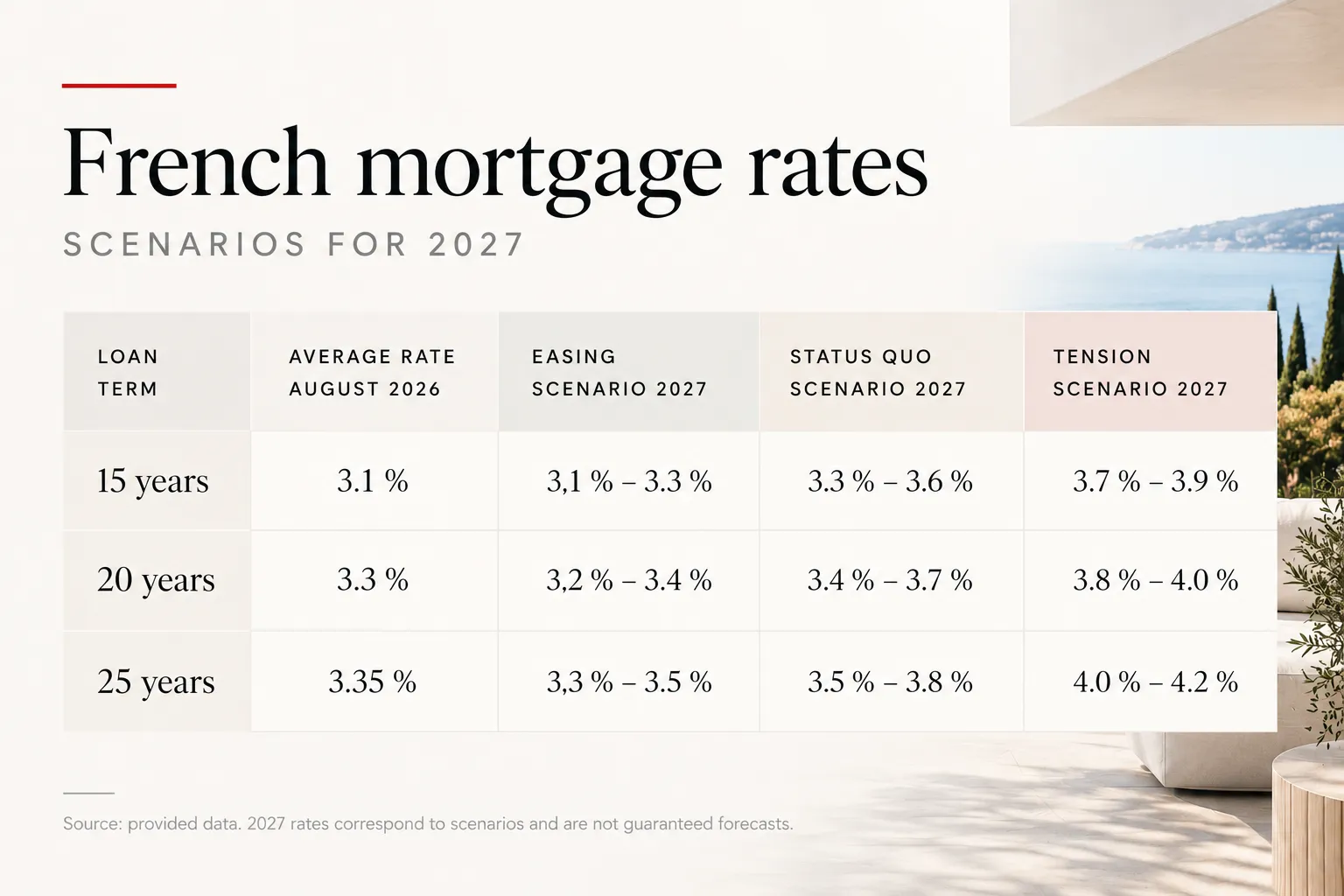
The easing scenario assumes that inflation declines and the ECB pauses further rate increases. The status quo scenario extends the current balance. The tension scenario assumes persistently high inflation and a higher risk premium on French government debt, potentially pushing mortgage rates towards 4%.
The 25-year term deserves particular attention. It is often used by first-time buyers to keep monthly repayments manageable, but it may be more exposed to a deterioration in lending conditions. The French High Council for Financial Stability (HCSF) also maintains its lending rules: a maximum debt-to-income ratio of 35%, including borrower insurance, and a maximum loan term of 25 years, extendable to 27 years in certain new-build cases involving deferred repayment.
Should you buy property in 2026 or wait until 2027?
A rise in mortgage rates mechanically reduces borrowing capacity. Consider a couple earning €8,000 per month and allocating €2,800 to monthly mortgage repayments, equivalent to 35% of their income. An increase in the interest rate from 3.4% to 3.9% over 20 years would reduce their borrowing capacity by approximately €20,000
Exemple concret, hors assurance : à 3,4 % sur 20 ans, ce couple peut emprunter environ 487 000 € ; à 3,9 %, sa capacité tombe à environ 466 000 €.
Sur un marché où les prix stagnent ou se négocient, une hausse des taux peut être en partie compensée par la négociation du prix d’achat. Sur un bien de prestige, une variation de taux de 0,5 point représente une charge d’intérêts supplémentaire, mais pèse moins que la qualité intrinsèque du bien et son emplacement.
Le bon timing dépend du profil : un acheteur au comptant ou avec un fort apport est peu sensible au taux, tandis qu’un primo-accédant sur 25 ans est directement concerné.
Si vous êtes déjà propriétaire, la valeur de votre bien actuel conditionne votre apport : demandez une estimation gratuite de votre bien immobilier pour calibrer votre stratégie d’achat.
Prime property and regional markets: how could they respond to 2027 mortgage rates?
Prime property is often less sensitive to interest rates than more credit-dependent market segments. High-net-worth buyers are more likely to purchase with cash or a substantial deposit, while the property's long-term value can take precedence over the cost of borrowing.
Prime property investment typically follows a long-term perspective, in which location and scarcity can matter more than a difference of a few tenths of a percentage point.
In Paris's most sought-after arrondissements, limited supply can support the value of exceptional properties. Our analysis of property prices per square metre by Paris arrondissement provides further context.
On the French Riviera, Nice, Cannes and the Gulf of Saint-Tropez attract substantial international demand, which may be less dependent on French mortgage conditions..
What could French mortgage rates look like by 2030?
A return to rates of 3% to 3.5% by 2030 remains possible if inflation in the euro area stabilises around 2% over the long term.
Several structural factors could limit this outlook. Investment in the energy transition may sustain inflationary pressure, while France's public debt continues to influence long-term yields. Conversely, an ageing population could weigh on economic growth and reduce price pressures.
For buyers planning to hold a property over the long term, the priority is less about perfectly timing interest rates and more about choosing a property whose value can be sustained or appreciated over time. Refinancing may also be possible if rates fall after the purchase, subject to the terms and costs involved.
How can you strengthen your mortgage application if rates rise?
Four key measures can help reduce the overall cost of a mortgage in a higher-rate environment.
Your deposit: although a deposit covering notary fees is not a legal requirement, most banks expect borrowers to contribute towards these costs. A larger deposit may help secure more favourable terms.
Borrower insurance: under the Lemoine Law, borrowers can change their insurance at any time, subject to the applicable conditions. Choosing an alternative policy may reduce the total cost of borrowing.
Your financial profile: stable employment, regular income, controlled debt and sufficient disposable income can support a stronger application.
Comparing lenders: obtaining offers from several banks, directly or through a mortgage broker, can help you negotiate terms based on the strength of your application.
For borrowers with substantial assets, some private banks also offer tailored financing arrangements.
Engel & Völkers: your partner for property plans in 2027
In a volatile interest rate environment, we help you make informed decisions based on a detailed understanding of the property market. Our approach combines accurate property valuations, advice on the timing of a sale or purchase, and access to a selection of prime properties in sought-after locations.
We support clients looking for exceptional properties as well as owners preparing to sell.
Each Engel & Völkers property advisor has in-depth knowledge of their local market and can identify opportunities that broader economic indicators may not reveal.
An exceptional acquisition, whatever the interest rate environment
The Engel & Völkers Private Office supports the acquisition of some of the most prestigious properties, offering a dedicated advisor and access to off-market opportunities.
Frequently asked questions about French mortgage rates in 2027
Not necessarily. If rates rise in 2027, waiting could increase borrowing costs and offset the benefit of a potential fall in property prices. In the prime property market, where supply is limited, the right timing may depend more on the property available than on the interest rate alone. A mortgage secured today may also be eligible for refinancing if rates subsequently fall.
No one can predict this with certainty. In August 2026, the average rate over 25 years was approximately 3.35%. Depending on inflation, ECB decisions and the cost of French government debt, rates could stabilise or move towards 4% in 2027.
Three main levers can help: a substantial deposit, a competitive borrower insurance policy and comparing offers from several banks, either directly or through a mortgage broker. Private banks may offer tailored terms to clients with significant assets.
A return to 3%–3.5% by 2030 is possible if inflation stabilises around 2% over the long term. However, French public debt and investment linked to the energy transition could continue to put upward pressure on long-term yields.
Contact
Contact your personal advisor


Engel & Völkers France
170 Rue du Faubourg Saint-Honoré
75008 Paris
Tel: +33145643030