Cool City Seattle – Emerald City
- 2 min.
- 4.8.2026

Issue
01/26
Location
South Pole, Antarctica
Photography
Hapag-Lloyd Cruises / Fabio Kohler
Eternal ice, whales, seals, penguins — and, with a bit of luck, even orcas. Three weeks aboard the expedition ship Hanseatic Nature from Ushuaia to the Antarctic Circle and back — an unforgettable adventure. GG had the exclusive opportunity to join this ultimate bucket-list journey.
Since boarding in Ushuaia – the southernmost city in the world – we have traveled 890 kilometers. The thermometer reads eight degrees Celsius; the sea beneath us is seven hundred meters deep and inky black. Above, grey clouds tumble and the wind howls.
Over the loudspeakers, the captain’s calm voice cuts through the storm: “Too much wind for the Falklands. We’re heading straight to South Georgia.” Here, weather and ice decide the course of every journey. The remote island in the South Atlantic, rich in wildlife, will be our first destination.
At 138 meters in length, the Hanseatic Nature carries 168 guests and 160 crew members. This Hapag-Lloyd expedition ship holds the highest ice-class rating for passenger vessels – PC6 – allowing it to break through up to ninety centimeters of solid ice. That first evening I sit at dinner with fellow travelers, sunlight streaming through the panoramic windows. Nothing yet hints at the four-and-a-half-meter waves forecast for the night ahead.
Sleep comes barely at all. The ship groans, the motion grows stronger. By morning I stumble out on deck, the boards slick with salt spray. The wind gauge reads gusts of forty-eight knots. Beneath a steely sky lie seven thousand meters of icy water, only six degrees. I retreat to the gym, where music pounds against the rhythm of the waves. That evening the three onboard restaurants – Lido, Hanseatic and The Hamptons – are visibly emptier. Many passengers have succumbed to seasickness. The ship’s doctor administers anti-nausea injections while outside the waves roar.


By the third day the sea begins to calm. Those still unwell can follow the daily briefings about upcoming landings on their cabin screens. On Deck 8 I step outside for a breath of clean air; in the Observatory there is tea and bircher muesli. I meet our captain, Alexander Rabe-Bär, at thirty-nine one of the youngest in the fleet. “I grew up sailing,” he tells me. “My stepfather was a ship’s doctor with Hapag. As a teenager I traveled the world, later studied nautical science, and served six years as an officer aboard the Europa.” This is already his third Antarctic voyage this year.
As I head back to my cabin, his voice suddenly echoes through the speakers: “Whales to port!” I rush outside and see spouts of water erupting all around – humpbacks, fin whales and sei whales, hundreds of them circling the ship.
A rare sight, the captain later explains; even the most seasoned sailors aboard have never witnessed such a dense gathering of whale species. Moments later we are invited into the corridors to toast the spectacle with a glass of champagne.
By morning the sun fights through the clouds and a rainbow arcs across the sea. Ahead of us rises South Georgia – green, rugged, framed by the first drifting icebergs. In my ears, the voice of Sir David Attenborough comes to mind: “millions of seabirds, 400,000 king penguins, some five million fur seals.” Before we set foot on land, our shoes and clothing are carefully disinfected – every seed, every trace of soil must be removed. Conservationists have painstakingly eradicated the island’s rats, yet avian flu remains a threat. Only once the expedition team has declared us “100 percent clean” may we go ashore.

We pass through a boot-washing station to prevent any contamination. Only one hundred guests are allowed on land at a time. We’re divided into colour-coded groups, each departing at scheduled intervals in their Zodiacs. On shore we must never crouch down or approach the animals too closely. This exemplary system follows the strict guidelines of the IAATO (International Association of Antarctica Tour Operators) – a comprehensive code of conduct designed to protect this fragile ecosystem and ensure sustainable tourism. Here, the Antarctic Treaty, signed on December 1, 1959 and in force since 1961, governs everything: It dedicates the continent solely to peaceful purposes, prohibits all military use and guarantees freedom of scientific research.
Between 1904 and 1966, more than 150,000 whales were killed and processed for trade in Grytviken, a former whaling station on the island. Today, the site is a museum – and entirely in the hands of hundreds of fur seals, lounging everywhere or curiously following us as we walk along the shore.
The next morning, my alarm rings at 5:30 a.m. Wrapped in layers, wearing rubber boots and a parka provided by the ship, I’m among the first to board the Zodiac and speed through snow and sleet toward land: Salisbury Plain – home to nearly 200,000 king penguins. Their orange necks glow through the mist; fur seals sprawl between them, albatrosses soar overhead, and gulls pick at carcasses. The ship’s biologists explain: the darker the orange, the older the bird. Standing up to 95 centimeters tall, the penguins waddle toward us, curious and unafraid. On our return to the ship, humpback whales escort us through the icy waters.
By afternoon, we reach Fortuna Bay, a stretch of coast further east – 20,000 penguins before a glittering glacier. The sun breaks through, casting the ice in a dazzling light. It’s Valentine’s Day: In the evening, every woman on board receives a single red rose.
The following day we arrive at Gold Harbour. Fur seals snort lazily on the sand; gentoo penguins dart between them while young seals wrestle playfully. Suddenly, a king penguin becomes tangled in seaweed – we watch as it struggles, then frees itself at last. Three companions had waited nearby, watching faithfully. When it’s free, they waddle off together. “We never intervene,” our naturalists remind us. “As hard as it is to watch, interfering would disrupt the balance.”
Later, on another Zodiac tour, we discover a colony of macaroni penguins – unmistakable with their bright yellow crests. The day’s highlight: A rare leopard seal suddenly surfaces beside us, exhaling loudly, sleek and powerful.
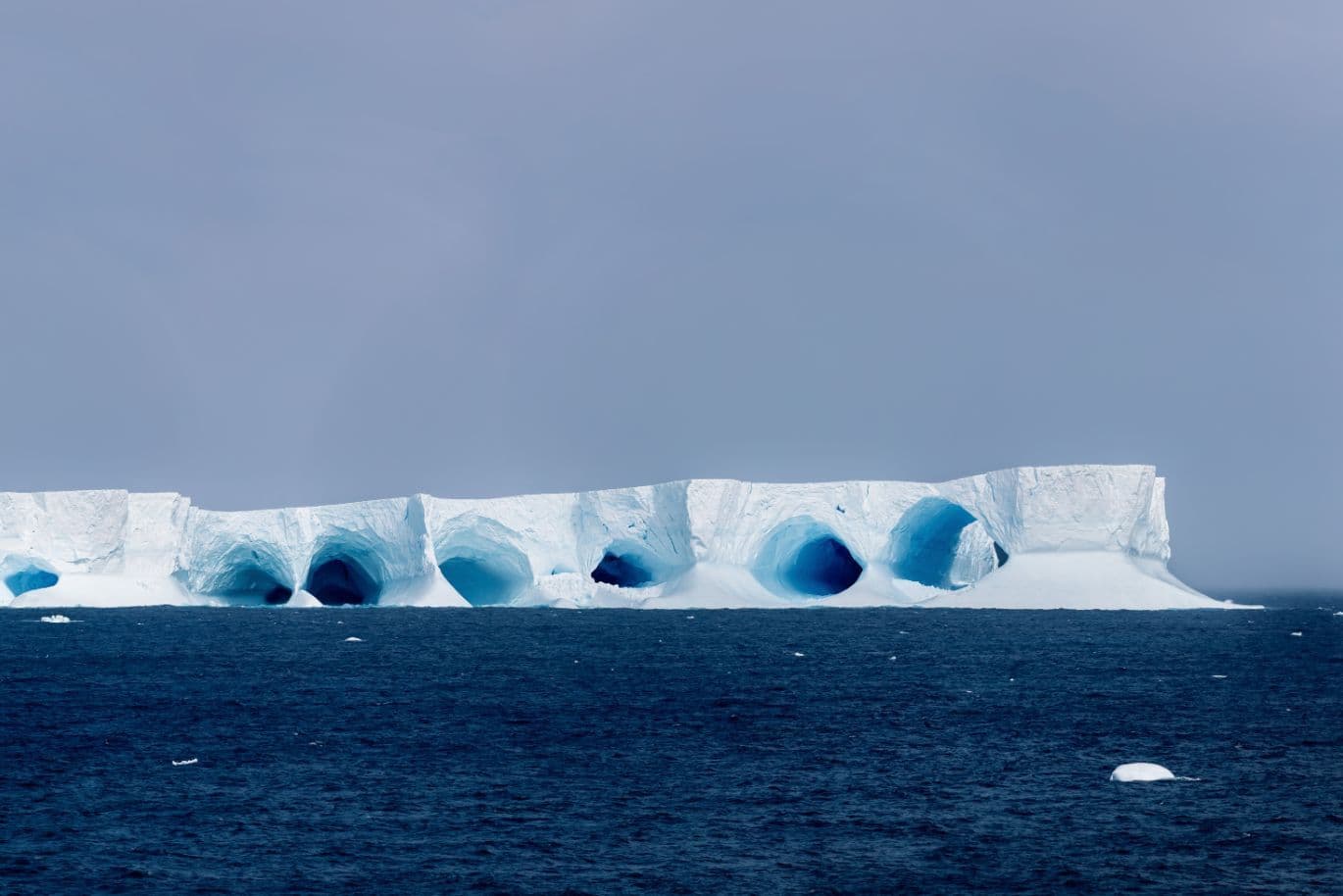
The next morning, the vast iceberg A23a appears on the horizon – larger than the island of Mallorca, towering two hundred meters above the water and visible from space, though only a fifth of its mass rises above the surface. It drifts slowly toward South Georgia. Scientists fear its melting freshwater could threaten local krill populations – the very foundation of the Antarctic food chain. (Editor’s note: By September, the giant had already shrunk to less than half its size – breaking apart at astonishing speed.) Back in my cabin, Kemylhina, my cabin attendant from the Philippines, tells me about her daughter in Manila – and how she works eight months a year aboard the Hanseatic to fund her studies.
We sail on to Elephant Island, where in 1916 the legendary explorer Ernest Shackleton left 23 of his men behind while he set out to find rescue. Now, chinstrap penguins climb the cliffs, elephant seals laze on the shore and, once again, a leopard seal surfaces beside our Zodiac – hunting penguins among the drifting ice.
The ice creaks and cracks around us, the sound deep and alive. Later that day, an iceberg blocks our passage through the Weddell Sea. Calmly, Captain Rabe-Bär’s voice comes over the speakers: “We won’t risk it. The ice decides where we go.” Out here, nature alone dictates the course. That evening, the sun sets in blazing reds; from my terrace I watch pink-tinged icebergs drift silently past in absolute stillness.
Yankee Harbour, in the South Shetland Islands, greets us with forty-knot winds – chinstrap penguins, fur seals, and beaches of black volcanic sand. On Deception Island, we hike across the rim of a collapsed volcano where a whaling station once stood. Then the brave among us take the plunge – into water barely three degrees above freezing. We run in screaming, submerge for a heartbeat, then scramble back out, legs numb. The Zodiac crew rushes us to the ship, and moments later I’m in the spa, letting the sauna thaw me slowly. The day ends early, in quiet exhaustion and awe.
We continue through the Neumayer Channel, past abandoned British and Argentine research huts, frozen in time. That evening, the sky unfolds in endless shades of rose and gold. By morning, we reach Prospect Point – our first step on the Antarctic mainland. Out on the water, ice floes are scattered with gentoo penguins; among them, two leopard seals. Suddenly, a call over the radio: “One of them just bit a Zodiac!” Three of the inflatable boats are later patched.
Our Zodiac driver, from Hamburg, has traveled to Antarctica every year since 2004 – except in 2020, during the pandemic. “That was terrible,” he tells me. “I felt trapped.” How has he seen the region change? “In some places, more rock is emerging from the melting ice. But the wildlife has rebounded dramatically. Years ago, you’d rarely see a whale – now we spot spouts almost daily. Penguins, seals… they’ve all returned in great numbers. The fur seals, in particular, can be quite territorial during mating season.”
At dinner, the captain announces: “We have just crossed the Antarctic Circle.” A true goosebump moment. That night, winds reach fifty knots. I lie awake, listening to the ten-force gales whistling around my cabin windows. The next morning, we land on Stonington Island to visit two abandoned research huts – one British, one American. It was here that the first two women ever to overwinter in Antarctica once lived. The Zodiac crossing is icy and rough; the air sharp as glass. We spot crabeater seals – the pale ones – and, as always, penguins. Later, on Pourquoi Pas Island, biologist Nadja Katharina Gerull explains: “These are all males. They’re recovering from the breeding season. During these months, they drift north on the ice floes, resting – before returning south to their colonies.”
Later that day we tour the ship’s provisions deck below – Hotel Manager Christoph Timm and his team oversee all supplies stored deep in the hull: “Since we’re at sea for over three weeks, meat and fish are frozen. Fresh fruit, vegetables and dairy – all stocked in Ushuaia before departure.”
At lunch I sit with a pilot couple from Frankfurt who now live in the U.S. – their first expedition cruise, and they’re enthralled. Another woman tells me she has saved for years for this journey: “I always dreamed of seeing penguins.” Most guests are nature lovers and adventurers at heart. Later, we spot more whales as I indulge in a hot waffle with red berries and vanilla ice cream – a small, perfect moment amid the vastness.

By 4 p.m., we land at Jougla Point on Wiencke Island, home to a colony of gentoo penguins and their fluffy chicks. They chase their parents across the rocks, crying out for food. Two well-preserved whale skeletons lie bleached along the shore.
Early the next morning we set out by Zodiac into tranquil Paradise Bay, past towering glacier walls. At the end of the excursion, the crew surprises us with hot chocolate – and, for those who wish, a generous splash of rum. Our final stop: Neko Harbour. As we prepare for our last Zodiac tour, a pair of minke whales surfaces right beside the ship. On land, we marvel at the penguin highway – a narrow path in the snow where the birds waddle dutifully toward the sea. Later, back on deck, we watch whales once more as the sun sets – painting the sky in colours so vivid it feels like the Antarctic itself is bidding us farewell.
The final 48 hours take us through the Drake Passage, one of the stormiest seas on Earth. But we are lucky – the fabled Drake Lake, not the Drake Shake. Even on the last stretch through the Beagle Channel toward Ushuaia, whales accompany us one more time.
At our farewell dinner, the captain shares the numbers: “7,676 kilometers traveled, 14,400 eggs used and 2,400 kilograms of meat consumed.”
The next morning, stepping ashore feels strange. After weeks of silence, the city’s noise is overwhelming. A journey to Antarctica humbles you. It shifts your sense of scale – reminding you how small we are, and how immense the privilege of having witnessed this frozen world.
You may also be interested in
GG Magazine exclusive content
GG is an independent magazine at the highest level. Exploring the world of architecture, lifestyle, design, fashion, yachting, luxury living and travel. We seek out the most exciting topics and personalities for you and invite you to get to know them from a fresh new angle. In GG, you will meet successful architects, interesting designers and exciting artists who are the talk of the town from London to New York and Berlin to Hong Kong.