&w=1920&q=75)
Podcast: Why invest in a multi-tenant house instead of buying individual apartments?
Come visit our new shop in Brno - now open! More info here.
&w=1920&q=75)
Everyone who sells real estate asks themselves the same question: what am I going to do with the money from the sale? Do I need it for a specific purpose? To fulfill a dream? Do I want to increase my standard of living, travel, take a pause from work, invest in my own education or that of my children? There are many possibilities. In addition to pursuing purely personal goals, various types of investment instruments are available if your aim is to work towards investing into the right vehicle for you; choices range from classic capital investments, shares and funds, investments in commodities, through real estate reinvestments. In the case of real estate reinvestments, there are again several sub-options on offer that we will talk about.
To get the most out of the money you make from your sale, you will need to answer three specific questions: What is your goal? Do you want to invest the entire proceeds from the sale, or just a part of it? How long you want to invest the money for: in other words, when do you want to have your asset liquid and available? After you have decided what your priorities are, you should thoroughly familiarize yourself with the different types of investments available to you. What is important to keep in mind is that not all three factors (sides) of the investment triangle – risk, return and liquidity – can be optimized simultaneously.
Which of the many available investment instruments do you find interesting that also suit your needs? We recommend that you contact an independent advisor who will help you identify and evaluate the opportunities and risks associated with the various investment instruments. Having this important information will help you make the best decision.

Classic investment tools include savings accounts and term deposits, both of which are considered low-risk options offered by financial institutions. However, the amount of interest is variable, depending on the current market conditions. It is therefore advisable to obtain more detailed information before making any decisions.
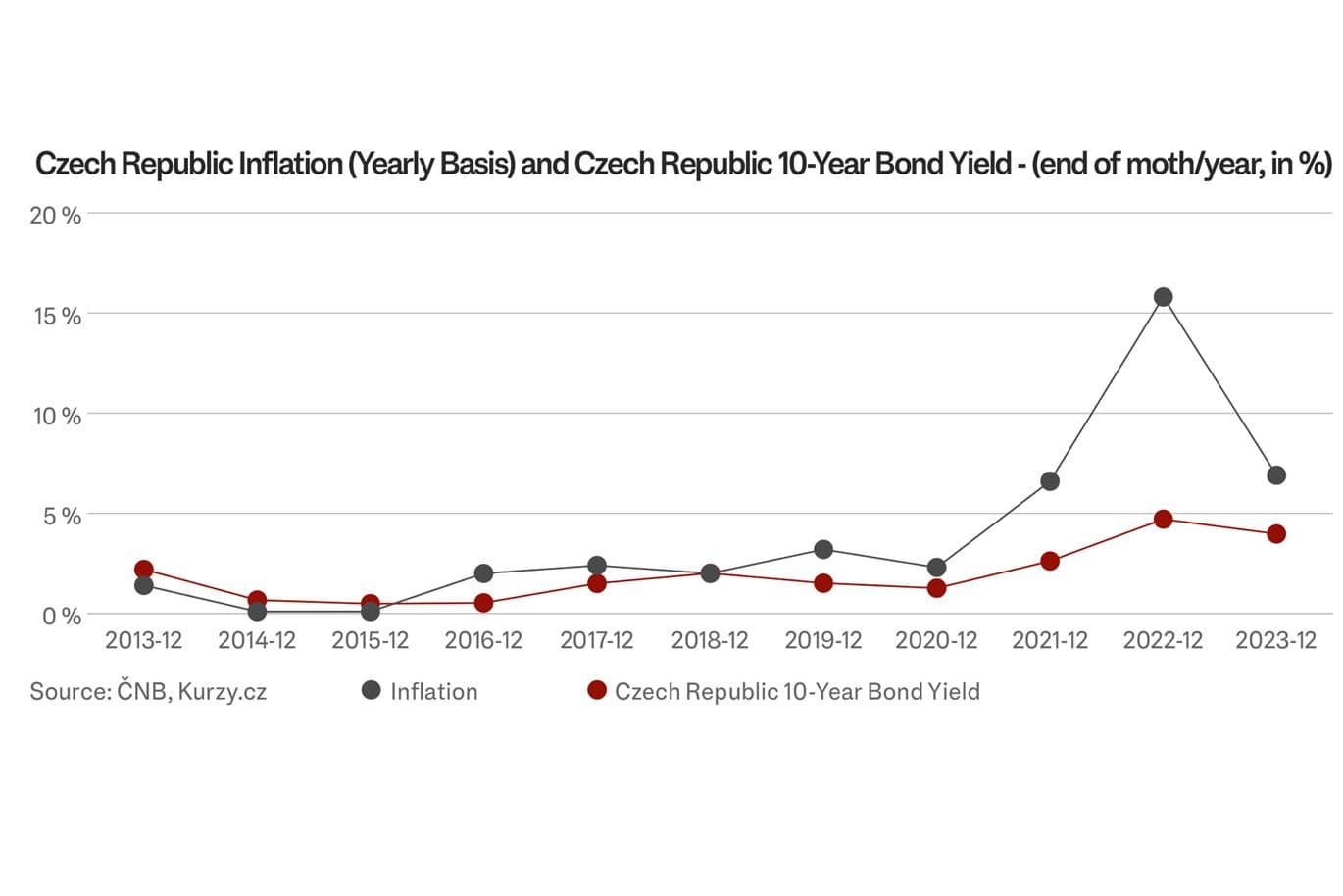
Bonds are issued by governments or commercial companies. In addition, there exist bond ETFs (Exchange Traded Funds). Bonds are also sometimes referred to as fixed income securities or debentures. If they are issued by the state - in the case of the Czech Republic by the Ministry of Finance - they are called government bonds. When the investor buys a bond, they in essence become the “lender” of money to the issuer of the bond (hereinafter referred to as the "issuer") at a fixed interest rate for a fixed period of time. During this time, the bonds can be traded on the stock exchange. Their exchange value depends on current market interest rates and related factors of supply and demand. If interest rates go up, demand usually goes down and so does the value of the bond, and vice versa. With investments, low risk usually means relatively low returns, sometimes even lower than the rate of inflation (see figure below). This general rule also applies to bonds.
If an investor is willing to assume a higher degree of risk and invest in stocks, ETFs (Exchange Traded Funds) and funds, and at the same time hopes to be able to select profitable choices (that don’t exceed the amount of risk the investor is willing to take) he will need to spend time understanding them, and ideally have gathered experience as an investor. The available offer of investment choices is extremely broad, including highly specialized products such as ecological or sustainable cash investments.
The returns on these instruments, however, can be very attractive, especially over a longer investment period. For example, the German stock index DAX has grown, over the past 30 years, from 1,578 DAX points in 1991 to around 15,900 points in 2021. This corresponds to a return of around eight percent per year. At the end of December 2023, the index rose to 16,751 points. However, investments in the stock market are usually associated with significant risks and can lead to the loss of the entire capital invested in shares
You may also be interested in

&w=1920&q=75)
&w=1920&q=75)

Contact


Engel & Völkers Czechia
Plzeňská 3351/19
150 00 Prague 5 - Smíchov, Czechia
Tel: +420 233 091 011