The residential investment market is an excellent choice if you are looking for good investment opportunities in Germany. Apartment buildings in large and medium-sized towns in particular make fantastic capital investment objects thanks to their potential for appreciation.
Good framework conditions mean that capital investment in apartment buildings is profitable and reliable. Click here for all key information on this attractive market.
Interactive diagrams and downloadable local market reports
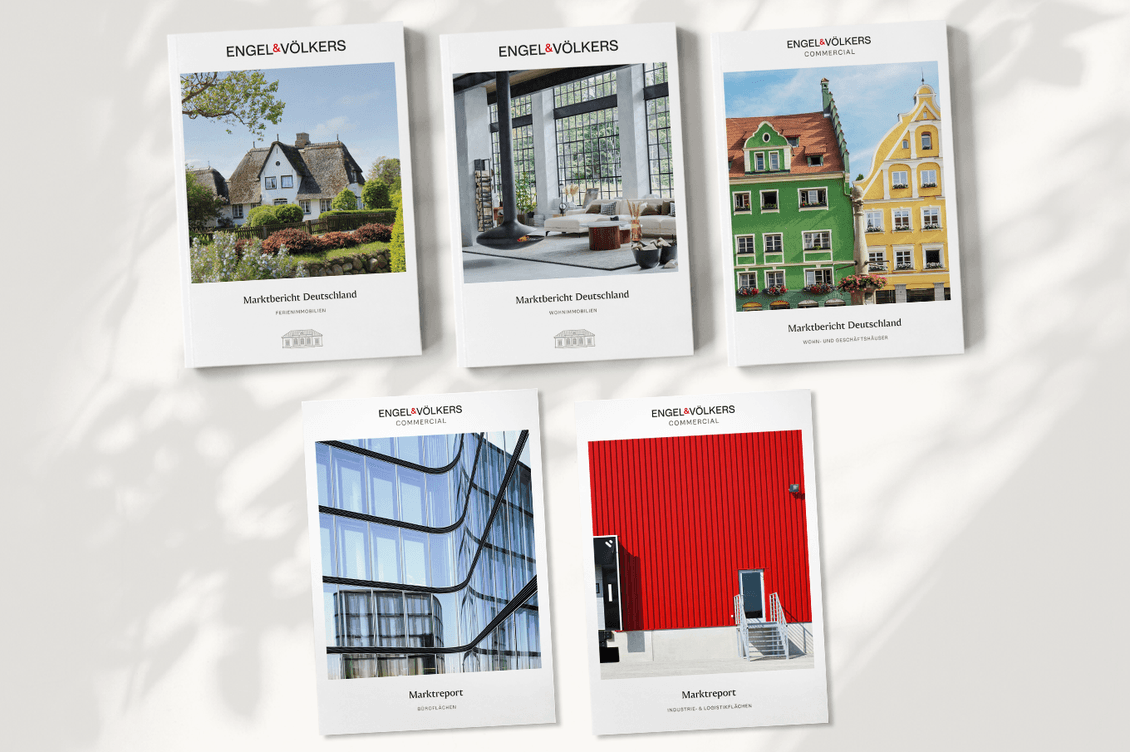
Use our interactive diagrams to compare current prices in different German towns and cities. Our database is continuously updated. You can also download PDF files with market report summaries for every town and city. They are updated twice a year. Visit the page for the respective city to access the PDFs. Click the following button to request the complete market report for Germany.
Compare cities
Use the drop-down menus to select your locations and click between two diagrams to close the menus.
Table of Contents
1. Capital investment in apartment buildings – asset class has stabilized
With the end of the interest rate rally, investments have become calculable again and interest in residential and commercial properties will increase in 2025. This development was already foreseeable in 2024, as trading activity in investment properties increased noticeably in the second half of the year again. The number of residential and commercial properties sold rose by 12% compared to the previous year, while the transaction volume increased by around 10%.
Around 80 percent of all districts and independent cities in Germany saw an increase in annual turnover from investment property sales. Only rural areas fell slightly behind here. It is also evident that a significant increase in transaction volumes was achieved in some towns and cities bordering the metropolitan areas. The comparatively lower price level makes it easier for private investors in particular to purchase a property there, especially in view of increased financing requirements.
Conclusion: In combination with an adjusted price level, there are currently good opportunities for a favorable market entry. The bottom has already been reached in 2024. Furthermore, increased demand for residential space with limited supply means that residential property will remain a sought-after asset class in the future.
2. Which areas are experiencing the most investment in apartment buildings?
There are major regional differences in where real estate investors invest their money, and the percentage changes compared to the previous year also differ significantly depending on the region.
3. How are prices for multi-family houses as capital investments developing in Germany?
There is currently an opportunity to enter the market at an attractive price. The price corrections came to an end in many places in mid-2024 and have since stabilized at a new level. In the fourth quarter of 2024, the average asking price for a residential and commercial property (existing) was EUR 1,941/m² nationwide. This corresponds to the level of around three years ago. However, real purchase prices have often fallen much more sharply - in some cases by up to 30 percent.
The asking price often had to be adjusted downwards due to owners' unrealizable price expectations. Nevertheless, the average asking price did not fall in the fourth quarter for the second time in a row. This shows that prices have stabilized at a new level.
4. How are rents for apartments developing in Germany?
For property owners, the high demand and limited supply in many places means good lettability, as the risk of rent losses is extremely low. There is a very high occupancy rate, particularly in major cities and many university towns, making these markets particularly attractive for risk-averse investors.
The need to refurbish many existing properties also results in solid potential for rent increases. Rents have already risen continuously across the board in recent years. In the second half of 2024, an apartment in Germany was offered for an average of EUR 10.01/m². This corresponds to an increase of 4.8 percent compared to the same half of the previous year.
5. How many apartments in multi family homes are vacant?
Forecasts for the coming years, based on a medium scenario (medium decrease in net immigration), show that the population in Germany will continue to grow. The population could increase by around 0.7% by 2030. In a high scenario (flat decrease in net immigration, high immigration from non-European countries), the population increase could even exceed 2% by 2030. In conjunction with a likely reduction in construction activity over the next few years, this will mean an increase in the housing shortage in many places in the future.
6. How important is the energy efficiency of apartment buildings?
Refurbished existing properties therefore offer solid potential for value appreciation. In addition, current entry-level prices, including modernization costs, are on average lower than new-build prices. This increases the demand for existing properties, especially as this is also available in popular inner-city locations.
7. What yields can capital investment in apartment buildings generate?
Yield trends in 2024 also reflect a stabilization of the apartment building market. In Germany's largest cities, the rapid increase in yields from the previous year has slowed. This is because the contrasting trends in prices and rents have weakened over the course of the year. Yields are therefore only likely to rise moderately in 2025.
Are you interested in further market reports or would you like to receive non-binding advice?
The real estate experts at Engel & Völkers Commercial look forward to hearing from you.
Thank you for your request. We will contact you shortly.
Your Engel & Völkers Team
8. How to make the right investments – Local market reports for several German towns and cities
On the city pages you will always find the latest figures in interactive graphics. In addition, we offer PDFs for download. These are updated twice a year.
See overview here (German only)
-
Vancouverstraße 2a20457 HamburgDeutschland
-
Phone +49 40 36 13 10