- 8 min read
- 12/03/2024
- by Doya Karolini
Confessions of an actor
Issue
02/24
Location
Greece
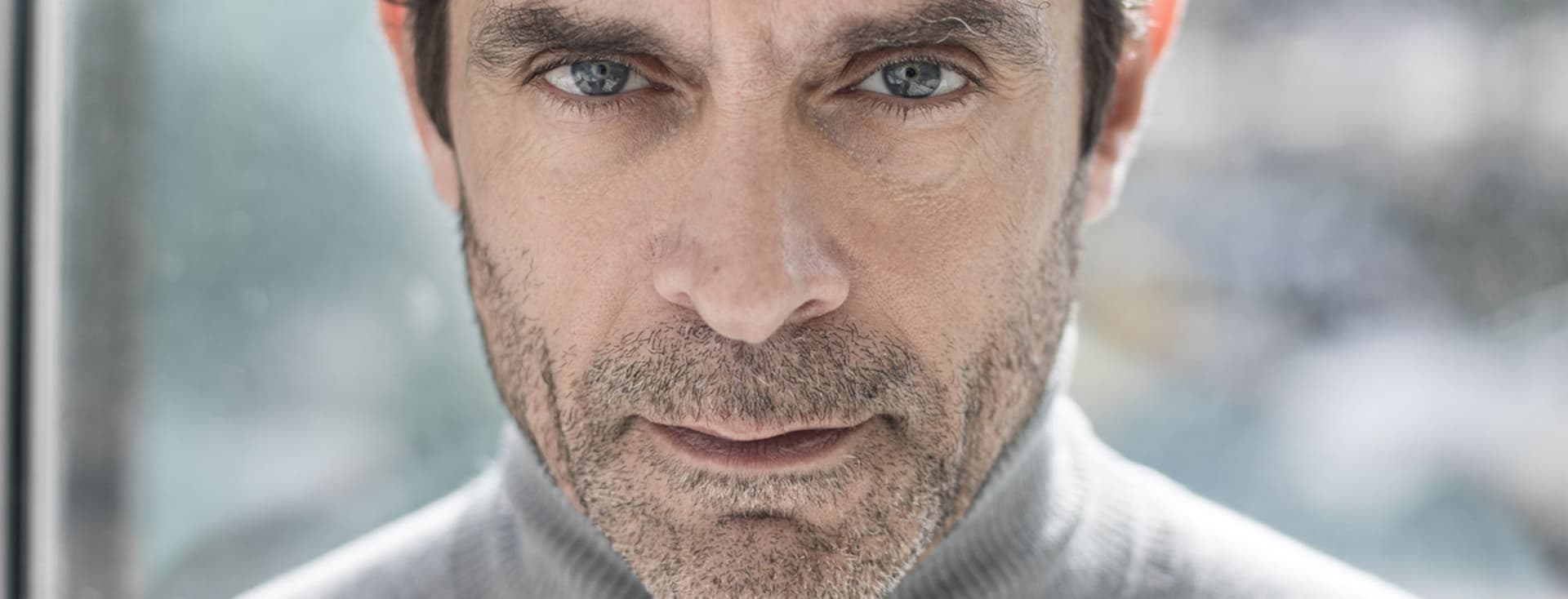
You have Konstantinos Markoulakis in front of you. In thirty-two years of career, he has given dozens - if not hundreds - of interviews. You think you know him well; after all, he has entered your home, kept you company for many evenings.
Even on stage, just a few meters in front of you, you have watched him lay his soul bare for nearly two hours, countless times.
This is the illusion of familiarity
You realize it, decide to ground the questions you had prepared in advance, and begin asking what you would ask a remarkably interesting person you had just met by chance.
A child of summer, born in July, extroverted, with an incredible sense of humor, he manages to radiate the warmth he himself needs to feel. He loves blue in all its shades. He enjoys the sensation of walking barefoot on wood, warm beneath the skin. He often catches himself repeating the phrase, "Life is problem-solving."
Perhaps because within him the emotional and the rational coexist. The faster he resolves each issue that arises and makes the next decision, the sooner he can enjoy what comes after. And so time enters the conversation - its beautiful, not necessarily correct, management - the eternal pursuit.
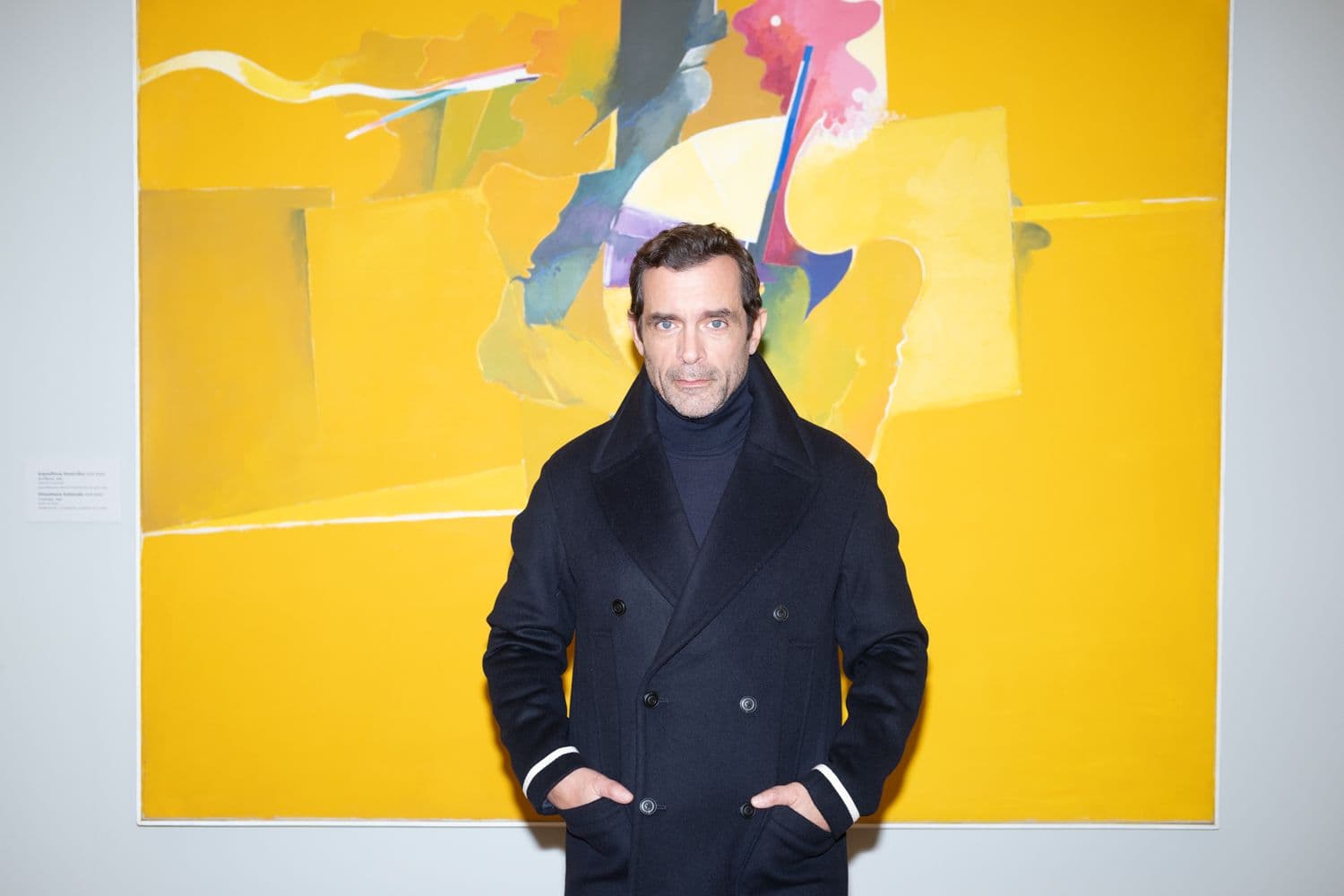
A genuine old-fashioned guy
He believes that the most stylish man who ever walked the earth was probably Cary Grant - as seen through the lens of Alfred Hitchcock. He constantly listens to music when he is alone, whether in the car or at home, always the same vast playlist on an endless loop. The Doors, Pink Floyd, The Beatles, interwoven with countless film soundtracks and, occasionally, classical music.
As a child, he identified with Tintin - later with The Little Fighter. During that same period, under the guidance of his teacher Olympia Karagiorga - yes, that fortunate - he took part in the school performances she directed. He still remembers in remarkable detail the production she signed, "A Thousand Moons."
An incorrigible bookworm, if you want to make him pause, ask him about his favorite writers. He adores Michel Houellebecq - who often irritates him, yet he cannot imagine life without The Elementary Particles - Fyodor Dostoevsky, Anton Chekhov, and Andreas Embirikos.
But the book that most likely changed his life was Laurence Olivier’s autobiography, Confessions of an Actor, published seven years before his death, in 1982. By the final page at the latest, he knew within himself that this was exactly what he wanted to shape himself into.
David Hockney, Lucian Freud, Johannes Vermeer - in a parallel universe, the walls of his home would be adorned with their works. Artists from different eras, with entirely different backgrounds, who once loved their subjects deeply. Portraits of complex human beings.
The man who keeps a diary every day
He keeps everything - he rarely throws anything away. He does it for himself. None of these texts will ever be published; he has decided that. He envies primary creators deeply - he wishes he had that gift for writing. He simply likes to articulate his life, to observe it in order to understand it better.
His father is partly responsible for this. Shortly before passing away at the age of 72, he wrote his autobiography. It was never published - that was never the intention. He wrote it because he wanted his children to read it, because he felt the need for his life to be recorded, to mean something.
Clearly a lover of words, Mr. Markoulakis is far from a man of few words. Ask him to describe himself in three words and he will burst into laughter and freeze again. On the contrary, he enjoys discussing, exchanging views, even disagreeing deeply. Optimistic - not always cautiously so - with an exceptionally low level of suspicion, he likes to ask questions, genuinely curious about everything.
And he firmly believes that although, at their core, people cannot truly change over time, they can improve, they can become a better version of themselves.
People fall into two categories: those who can love and be loved, and those who cannot. From the first minutes of conversation with him, it is clear that this is a man who has both given and received a great deal of love. His mother enters the conversation - and what she lived through during the frozen winter of ’41 in Athens - as does his son, now eighteen and studying Medicine.
Perhaps that is why he deeply enjoys telling stories that move him profoundly. One such story is The Humans by Stephen Karam, staged at the Mousouri Theatre - a play that Chekhov himself could have written. And during the same season, he visited every home through The Doctor on Alpha - a story about a man who once had everything, watched it all disappear, and begins again from scratch, this time transformed internally, emotionally open.
"People are clearly not their ideas - those do not even define the way one lives." A person is a constellation of what they desired, what they needed, what they said, what they felt, what they did. "And what they lost," he adds. "They are their stories, in expansion - the love we gave and the love we received."vsky, Anton Chekhov, and Andreas Embirikos.
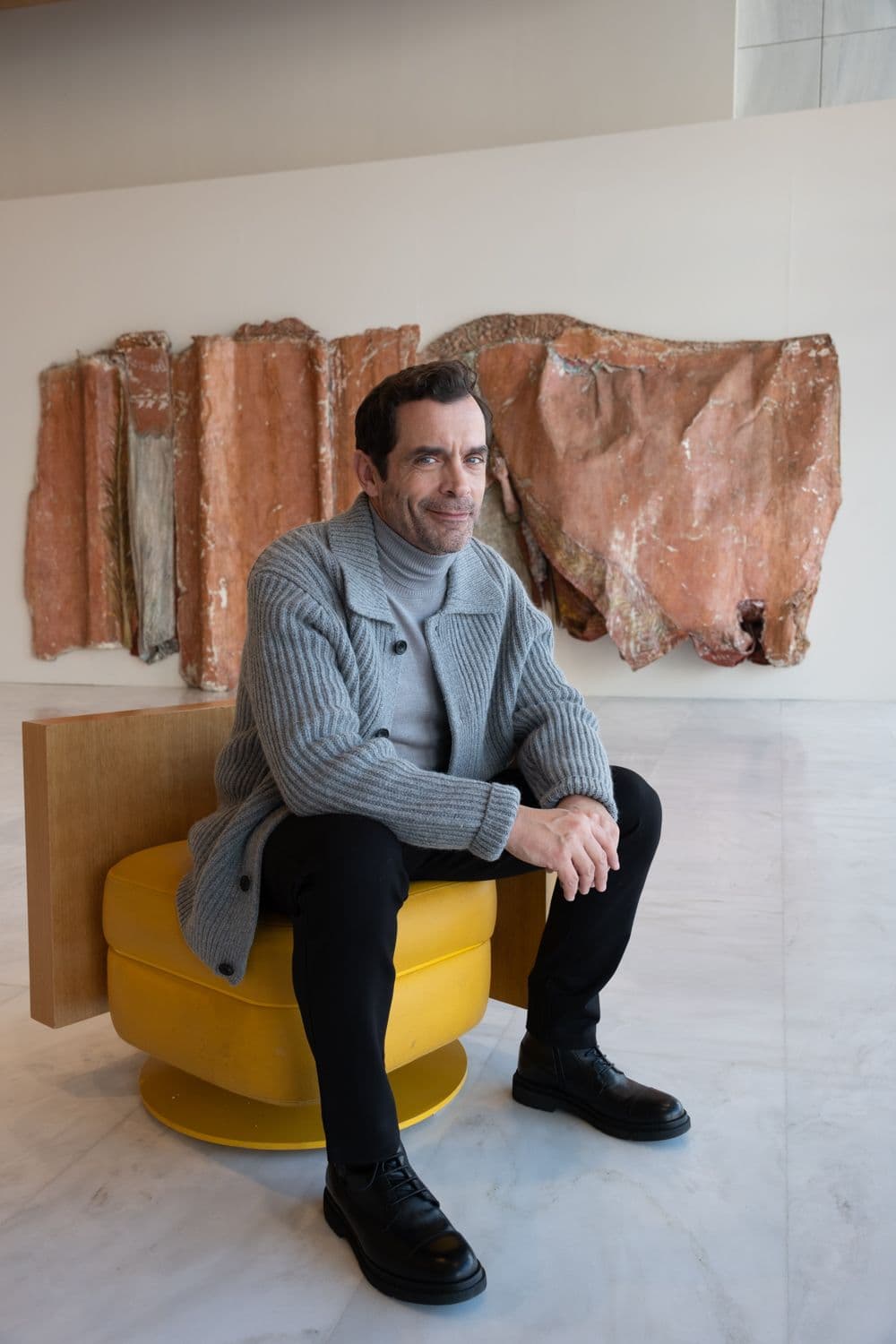
On second thought, perhaps that is also why he has feared death so inexplicably since childhood. From a need for "just a little more." To manage to create and leave behind one more thing of value. He calls it an "existential terror of disappearance." Personally, I prefer to call it a driving force.
It was therefore only a matter of time before translating plays and directing entered his life - they offer him deep fulfillment. The purely constructive aspect of a performance suits his temperament. Directing, in particular, carries something deeply creative, intellectual. Like the fairy tale of Hansel and Gretel - the breadcrumbs marking the path. That is how he likes to guide each work toward something profoundly human: the realization that we are full of flaws and shortcomings.
Through what he knowingly - and, as he admits, inaccurately - calls a "loving gaze." Because love includes forgiveness.
He admits that as an actor he feels fulfilled; he no longer seeks to tick boxes of great roles and remarkable performances waiting to be checked off. For him, that is spiritually unproductive. It is more a matter of: you have the talent - fine - but can you now tell us a story that concerns us, that penetrates us deeply?
No surprise - he regrets nothing when looking back. "As long as the decision and the path you walk are your own, then it is a false dilemma. Even a mistake becomes right, because it is the stone you stepped on to cross the stream and reach the other side."
Joy is always on the opposite bank - another one of his favorite phrases.
There have been moments of pride, however, when even briefly he felt exactly where he was meant to be. Professionally speaking, one such moment came when he stepped off the stage after performing in the first suspense thriller - arguably the first existential work in world dramaturgy - Oedipus (all three times he encountered it - twice as an actor, once as a director).
"Who am I?"
The same question again. To answer it, the hero uses reason.
Yes, it is the only tool we have. But it does not come without danger. Because when you ask that question, you must be prepared for the answer. And that answer, "is given only in the face of death," as Odysseas Elytis taught us in The Dark Verb.
His next step is the National Theatre of Northern Greece, where, directed by Guy Cassiers, he will perform a monologue based on Claude Philippe’s book, Monsieur Linh and His Child.
GG Magazine exclusive content
GG is an independent magazine at the highest level. Exploring the world of architecture, lifestyle, design, fashion, yachting, luxury living and travel. We seek out the most exciting topics and personalities for you and invite you to get to know them from a fresh new angle. In GG, you will meet successful architects, interesting designers and exciting artists who are the talk of the town from London to New York and Berlin to Hong Kong.
See original article