NewExclusive
Puerto de Mogán, Canary Islands, Spain
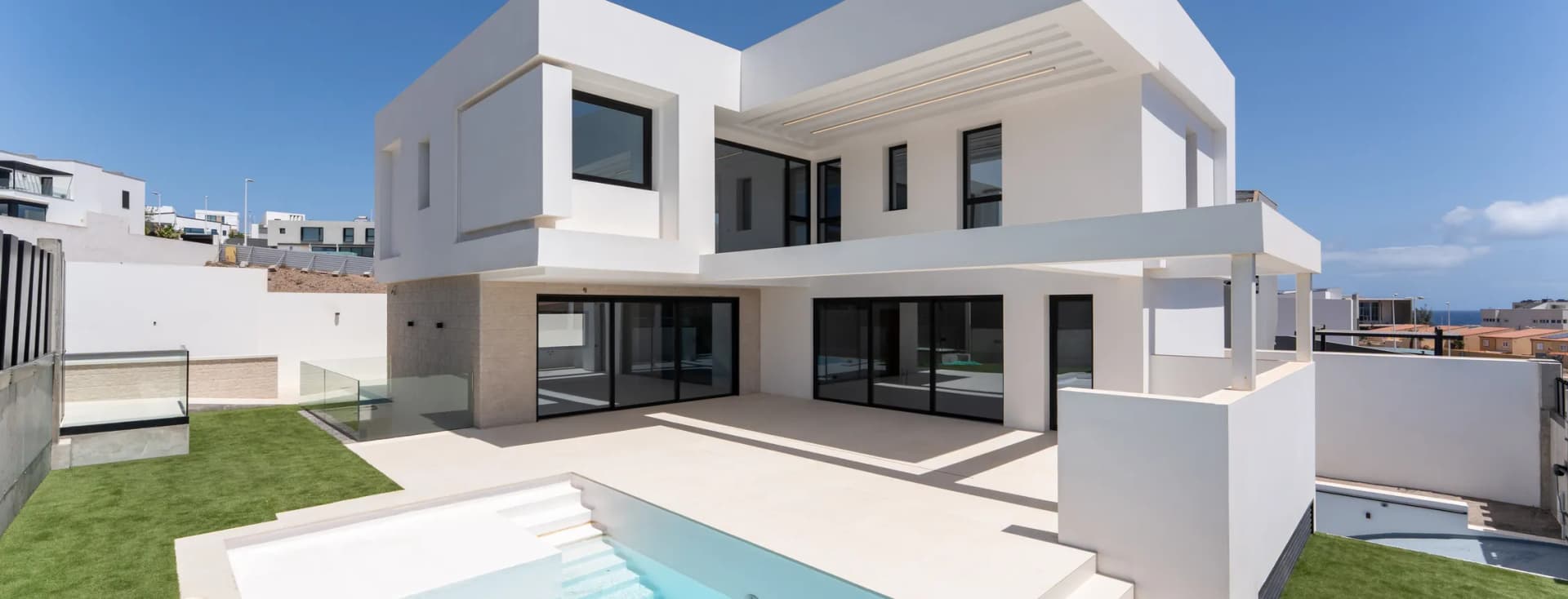
Where time stands still: Exclusive country villa with pool and panoramic views in southern Gran Canaria
Price
€1,590,000
- 4 Bedrooms
- 4 Bathrooms
- ~125 m² Total surface
- ~4,836 m² Plot surface
Dawn breaks over Las Canteras and the water takes on that glassy, mild colour found nowhere else. At that very same hour, less than 45 minutes away by car, the sun is already warming the golden sand of Maspalomas as the trade wind starts shifting the dunes grain by grain. It's the same island, the same moment, yet two landscapes that seem to belong to different worlds.
That contrast — city and coast, north and south, tradition and contemporary luxury — isn't just geography. It's, figure by figure, the clearest picture of the Gran Canaria real estate market in 2026.
Notarised sale-purchase data — the most objective source there is, because it records what was actually paid before a notary, not what was asked for in the listing — confirms what anyone familiar with the island already senses: the price of housing in Gran Canaria can't be summed up in a single figure. It depends, heavily, on which municipality you look at.
Table of Content
The three property markets of Gran Canaria: south, capital and interior
House prices in Gran Canaria by municipality
The most expensive areas in Gran Canaria: Maspalomas, Puerto-Canteras and Playa del Inglés
Foreign buyers in Gran Canaria: who's buying, and where?
Where have house prices risen most in Gran Canaria?
Mortgages and the most in-demand property type in Gran Canaria
What every profile should know: buyer, owner and investor
Why buy a property in Gran Canaria in 2026?
Frequently asked questions
The tourist south — San Bartolomé de Tirajana and Mogán — runs on non-resident foreign buyers and holiday rentals. The capital and its metropolitan area — Las Palmas de Gran Canaria and Telde — runs on primary residences financed with a mortgage. The interior and north — represented here by Arucas — starts from low prices and is growing fast in percentage terms. And the transitional southeast — Agüimes and Santa Lucía de Tirajana — combines both logics, with an industrial and airport-driven backdrop alongside a growing investment component.
This framework isn't just a curiosity: it's the key to understanding why a home in Telde doesn't compete with one in Mogán, even on the same island. Treating them as a single market — the most common mistake when discussing house prices in Gran Canaria — leads to the wrong conclusions for both buyers and sellers.
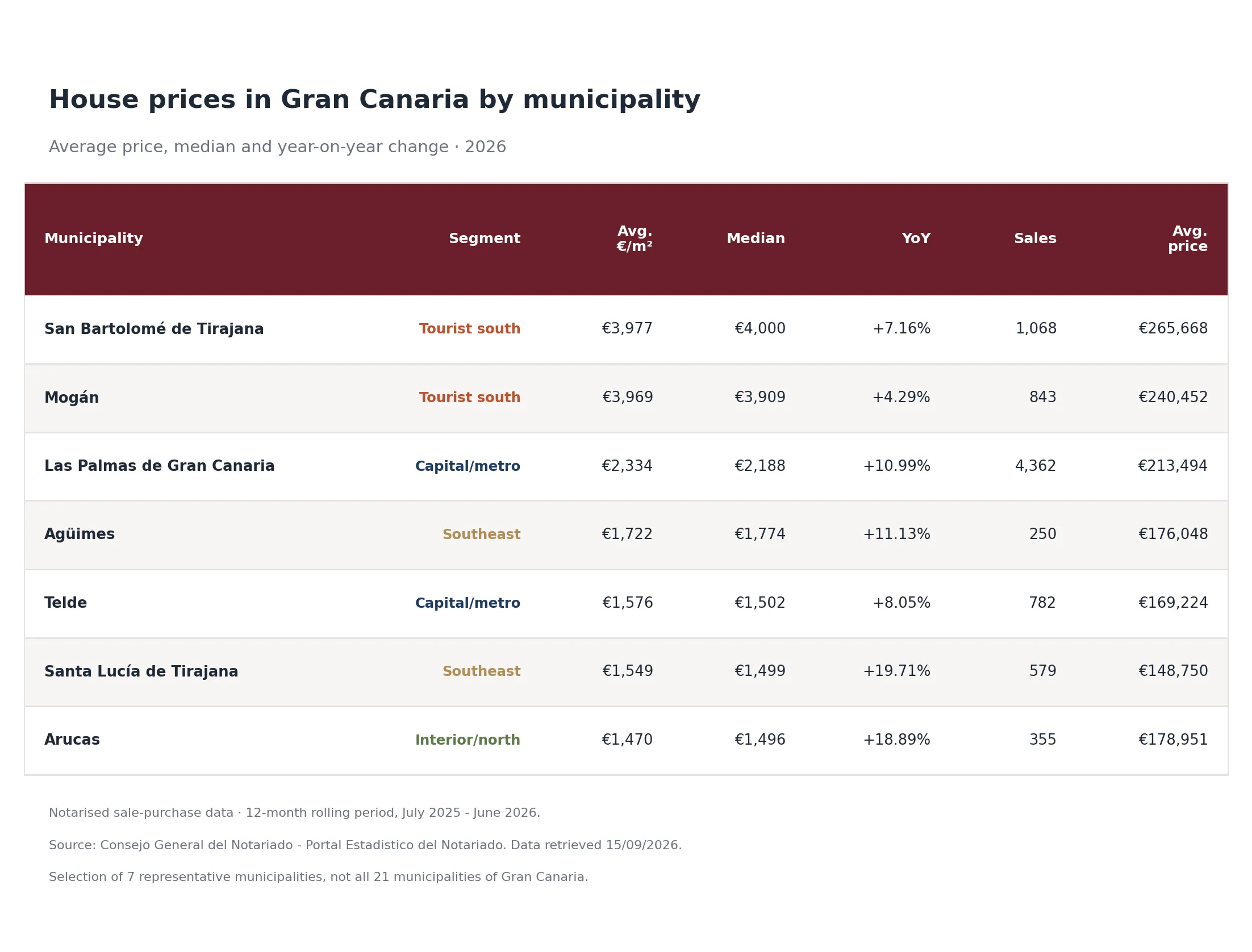
The following figures correspond to notarised sale-purchase transactions — according to the Portal Estadístico del Notariado, not asking prices — over the 12-month rolling period July 2025 – June 2026, for seven selected municipalities on the island:
Together, the seven municipalities account for 8,239 transactions over twelve months, worth €1,743.7 million. Housing in San Bartolomé de Tirajana (€3,977/m²) costs 2.7 times more than in Arucas (€1,470/m²), the widest price gap within this sample of the island.
Las Palmas de Gran Canaria alone accounts for 53% of all transactions in the group (4,362 of 8,239): by far the highest-volume market — and the one least dependent on foreign buyers, as the next section shows.
Methodological note: these seven municipalities are a representative selection of the island's three market types, not the full set of Gran Canaria's 21 municipalities. Every year-on-year change in this table exceeds the minimum threshold of 30 annual transactions this analysis requires before publishing without reservation.
Within these municipalities, prices vary even more by neighbourhood. According to Engel & Völkers' own market report — with closed 2024 figures, a year before the notarial period above, so they're presented here as additional context and shouldn't be added to the table above —:
Within San Bartolomé de Tirajana, the Maspalomas-Meloneras and Playa del Inglés areas already outpaced the municipal average back in 2024, at €4,604/m² and €4,535/m² respectively, while San Fernando was the most affordable area of the municipality (€2,925/m²).
Within Las Palmas de Gran Canaria, the Puerto-Canteras neighbourhood stood out as the most expensive in the capital (€3,448/m² in 2024), well above areas like Ciudad Alta or Tafira.
It's a good reminder that, even within the same municipality, an "average price" hides very different realities depending on the exact neighbourhood.
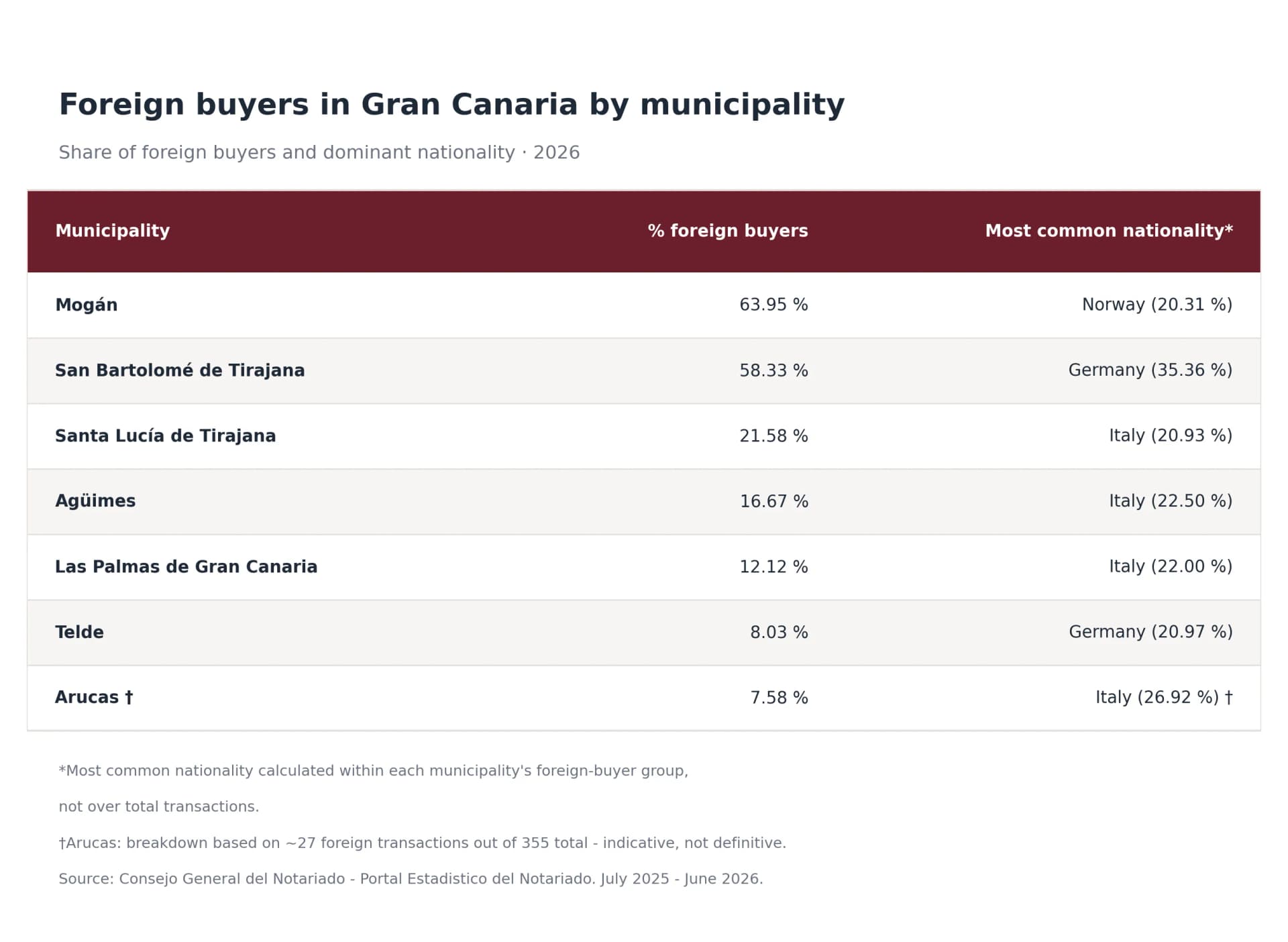
The share of foreign buyers varies dramatically from one municipality to the next:
Most common nationality calculated within each municipality's group of foreign buyers, not over total transactions. Arucas: breakdown based on roughly 27 foreign transactions out of 355 total — indicative, not definitive.
Important: these nationality percentages are calculated over the group of foreign buyers in each municipality, not over total transactions. The fact that 35.36% of foreign buyers in San Bartolomé de Tirajana are German doesn't mean one in three buyers in the municipality is German — over total transactions, the real figure is closer to two in ten.
With that caveat in mind, the pattern is clear: 6 out of 10 buyers in Mogán are foreign (63.95%), against barely 1 in 8 in Las Palmas de Gran Canaria (12.12%). German buyers dominate foreign demand in the tourist south and in Telde; Norwegian buyers lead in Mogán; and Italian buyers are the top foreign nationality in the rest of the municipalities in the sample.
From highest to lowest year-on-year change:
Santa Lucía de Tirajana: +19.71% — the biggest increase in the group, across 579 transactions.
Arucas: +18.89% — growth consistent with starting from low price levels (€1,470/m²) rather than a local bubble.
Agüimes: +11.13% — with the largest average floor area in the group (102 m²), a sign of primary-residence housing rather than holiday apartments.
Las Palmas de Gran Canaria: +10.99% — the most significant growth in absolute terms, given the sheer volume of transactions it carries.
Telde: +8.05%
San Bartolomé de Tirajana: +7.16% — moderate, but consistent with a market that already sits at high price levels.
Mogán: +4.29% — the most contained change in the group, although it starts from the second-highest average price on the island.
Santa Lucía de Tirajana and Arucas are, among the seven municipalities analysed, the ones that have risen most over the past year — but it's worth reading that with a caveat: both start from the lowest price levels in the group, so percentage growth is easier to achieve than in an already-mature market like the tourist south.
Puerto de Mogán, Canary Islands, Spain
Price
€1,590,000
Siete Puertas, Canary Islands, Spain
Price
€355,000
Santa Brígida, Canary Islands, Spain
Price
€1,080,000
Maspalomas, Canary Islands, Spain
Price
€525,000
San Agustín, Maspalomas, Canary Islands, Spain
Price
€1,695,000
Municipality of San Bartolomé de Tirajana, Canary Islands, Spain
Price
€595,000
Los Hoyos, Canary Islands, Spain
Price
€520,000
Playa del Inglés, Maspalomas, Canary Islands, Spain
Price
€260,000
Las Palmas de Gran Canaria, Canary Islands, Spain
Price
€750,000
Beyond price by municipality, Engel & Völkers' own market report (closed 2024 figures) offers context on how people buy on the island:
Most in-demand property type: an apartment of 97 to 167 m², with 2 to 3 bedrooms, with parking and a terrace as key deciding factors; or a house of 139 to 269 m², with 3 to 5 bedrooms, with a garden.
Financing: a clear shift towards mortgages. In 2023, 55% of purchases were closed with own funds against 45% with a mortgage; in 2024, that ratio flipped: 65% with a mortgage, 35% with own funds.
Rental prices: in Las Palmas de Gran Canaria, the average price was around €14.20/m², with demand growing 65% in 2024. In San Bartolomé de Tirajana, rental prices moved at similar levels (€15.23/m²), while in Mogán they reached €37/m² — more than double the rest of the areas — reflecting the very strong holiday-rental demand on that stretch of coast.
Buying, selling or investing in Gran Canaria isn't the same conversation depending on the municipality: here's what each profile should keep in mind before taking the next step.
Think in terms of municipality, not island. The average price ranges from €1,470/m² in Arucas to €3,977/m² in San Bartolomé de Tirajana: the gap between the two defines completely different budgets.
If you're looking at the capital, plan for financing. With 65% of purchases already closed with a mortgage, having bank pre-approval ready speeds up the process considerably in a market with strong competition for available stock.
Weigh the neighbourhood, not just the municipality. Within Las Palmas de Gran Canaria or San Bartolomé de Tirajana, prices can double depending on the exact neighbourhood.
In Las Palmas de Gran Canaria or Telde, your buyer is mostly local and mortgage-financed: defend your price with arguments around limited stock and the opportunity cost versus renting, not tourist yield.
In Mogán or San Bartolomé de Tirajana, your buyer is foreign — German, Norwegian or Italian depending on the area — and compares your property with options back home, not just the house next door: holiday-rental yield is your strongest argument.
In Agüimes or Santa Lucía de Tirajana, pick a single message depending on who's buying: primary residence tied to the Arinaga industrial estate and the airport, or south-style investment at a lower entry price. Mixing both messages in the same listing dilutes both.
Holiday-rental yield: Mogán and San Bartolomé de Tirajana, with majority foreign demand (63.95% and 58.33%) that keeps prices supported even with moderate year-on-year growth.
Mid-term capital gains from low entry levels: Arucas and Santa Lucía de Tirajana, with the biggest year-on-year increases in the group, though with relatively lower liquidity — fewer annual transactions than the capital.
Structural demand and lower cyclical risk: Las Palmas de Gran Canaria and Telde, underpinned by limited new-build supply and mortgage financing, with less exposure to the tourism cycle or exchange-rate swings.
There's something that happens to a lot of people the first time they set foot on Gran Canaria: they leave with the feeling they've found something they weren't expecting. It's not just the climate, or the landscape, or the light over Las Canteras at dawn. It's the certainty that here, you can truly live — year-round, without giving anything up.
Gran Canaria has that quality. A pace of life that gets under your skin, a climate that never goes out of style, a UNESCO Biosphere Reserve sitting minutes from urban beaches and business districts. It's an island that works: good connections, solid infrastructure, an established international community in the south, and a real estate market that, as the figures show, keeps appreciating without losing its accessible character in the north and interior.
Thinking about buying in Gran Canaria? Whether you're after a primary residence to settle into with your family, a holiday home with rental potential, or a real estate investment in one of the most dynamic markets in the Atlantic, now is the time.
At Engel & Völkers we work on this island every day. We know the market, we know every municipality, we know the product: from villas in the south with Atlantic views to homes in the north with the charm of towns like Arucas or Teror. If you're ready to take the next step, discover the properties available now in San Bartolomé de Tirajana, Mogán or Las Palmas de Gran Canaria, and start picturing what could be yours.
Which is the most expensive municipality in Gran Canaria? San Bartolomé de Tirajana, at €3,977/m², closely followed by Mogán (€3,969/m²).
Which is the most affordable municipality among those analysed? Arucas, at €1,470/m² — 2.7 times less than San Bartolomé de Tirajana.
Where do the most foreign buyers purchase in Gran Canaria? In Mogán, where 63.95% of buyers are foreign, followed by San Bartolomé de Tirajana (58.33%). At the other end, Telde (8.03%) and Arucas (7.58%) are the municipalities with the smallest share of foreign buyers.
Which foreign nationality buys most in the south of Gran Canaria? German buyers are the most common foreign nationality in San Bartolomé de Tirajana (35.36% of that group) and in Telde (20.97%). In Mogán, Norwegian buyers lead (20.31%).
Where have house prices risen the most over the past year? Santa Lucía de Tirajana (+19.71%) and Arucas (+18.89%) recorded the largest year-on-year increases, although both start from the lowest prices in the group analysed.
Is it easier to buy with a mortgage in Gran Canaria now? The 2024 figures show a clear shift towards financing: 65% of purchases were closed with a mortgage, up from 45% the year before.
Data sources: Consejo General del Notariado — Portal Estadístico del Notariado (notarised transaction price, not asking price), 12-month rolling period July 2025 – June 2026, retrieved 15/09/2026, for the municipalities of Las Palmas de Gran Canaria, Arucas, Telde, Agüimes, Santa Lucía de Tirajana, San Bartolomé de Tirajana and Mogán. Supplementary neighbourhood, property-type, financing and rental data: Engel & Völkers' own market report, closed 2024 figures.
Contact provider
Page content provided by: Global Ichy Social, S.L.
246009710945: 246009710945
License partner of Engel & Völkers Franchise and Trademark GmbH