Issue
Online Exclusive
Location
Hamburg/Germany
Photography
Scenic Cruises
What defines luxury on the water when loudness and spectacle no longer set the tone? In modern yachting, a sense of space, tactile quality and conscious reduction are increasingly taking center stage. A voyage aboard the yacht Scenic Eclipse II from London to Hamburg.
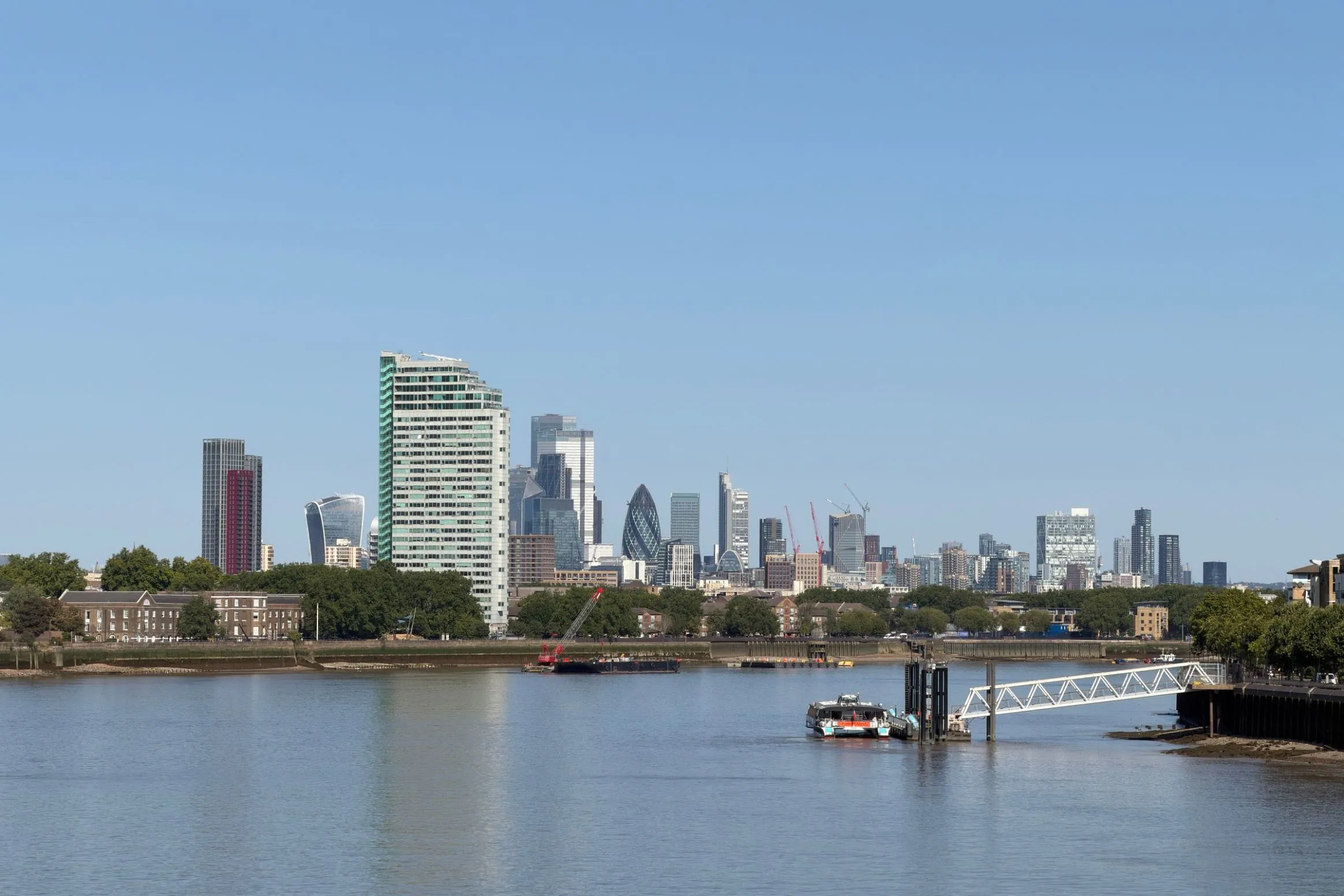
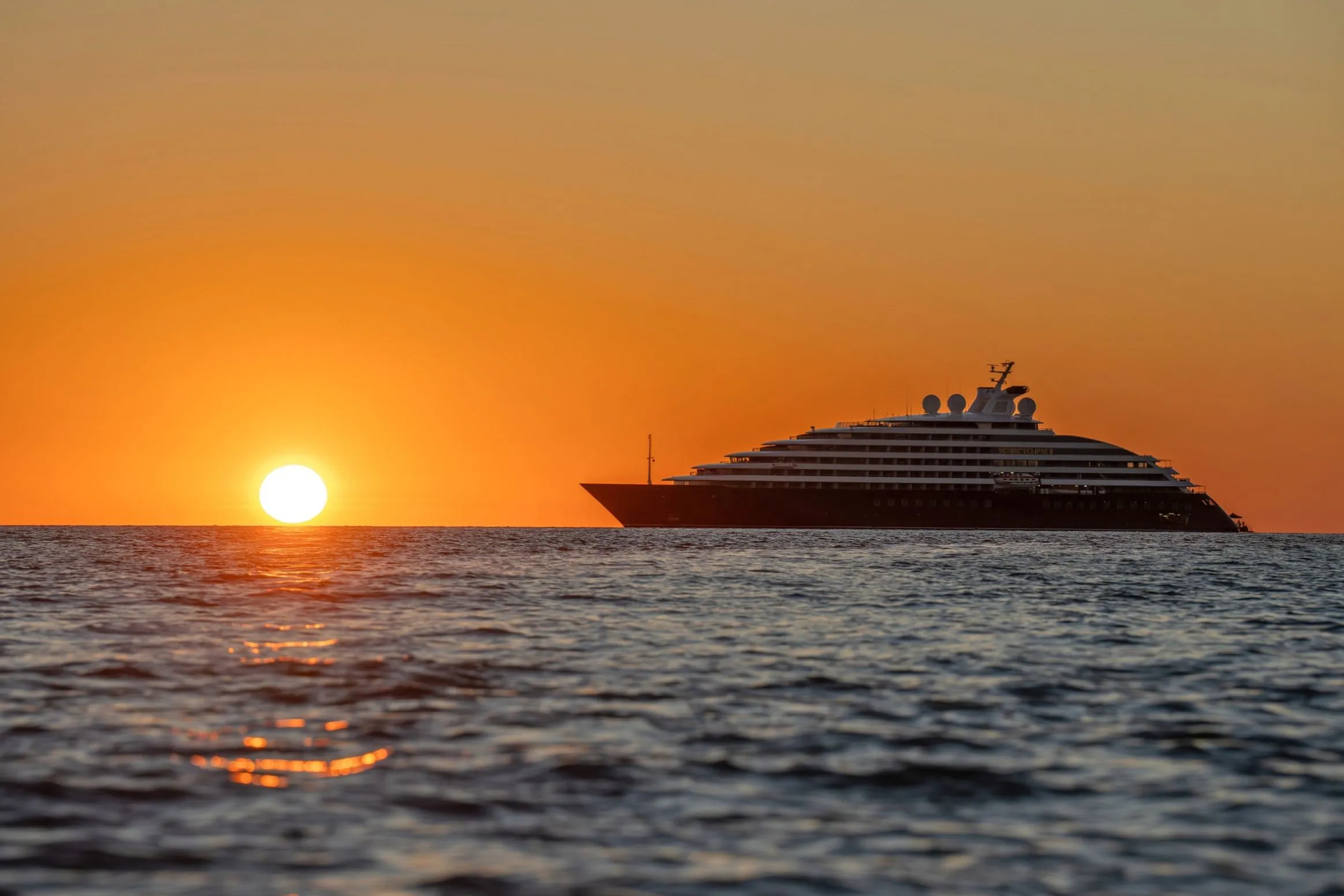
When the Scenic Eclipse II moors against the backdrop of the Old Royal Naval College in Greenwich, a compelling contrast emerges between maritime heritage and contemporary naval architecture. Setting sail on her maiden-call passage marks the prelude to a journey that brings the principle of “Quiet Luxury” to life at sea.
The route leads downriver through the Thames Estuary, across the shallow North Sea and up the Elbe to Hamburg’s Cruise Center HafenCity. Unlike on large cruise ships, the atmosphere here is not defined by multi-story atriums and tightly scheduled entertainment, but by natural materials, clean lines and an almost private sense of space.
The departure from East London takes place without loud ship horns or a staged sail-away ceremony. As the glass-fronted office complexes slowly glide past, the ambiance on board feels far more akin to a private estate or a boutique hotel than a traditional passenger vessel.
Generosity as a Philosophy
The structural dimensions of the Scenic Eclipse II follow a very different logic from conventional cruise shipbuilding, where every square meter is optimized for maximum cabin capacity. Built in 2023 at the 3. Maj shipyard in Rijeka, Croatia, by MKM Yachts, the vessel measures 168 meters in length and 21.5 meters in beam. Carrying a maximum of 228 guests – capped at 200 in sensitive polar regions – alongside a crew of nearly equal size, she combines the proportions of a megayacht with the technical capabilities of an expedition ship.
This philosophy is immediately evident in the spatial layout. While corridors on conventional cruise liners are often barely 90 centimeters wide, they are noticeably more generous here. The central lobby also boasts exceptional ceiling height rather than sacrificing that vertical volume for an additional passenger deck. Tom Götter, Vice President Hotel Operations Ocean at the Scenic Group, explains this decision pragmatically: they simply had no desire to “cram the ship full of cabins.”
Expedition Engineering and Behind-the-Scenes Access
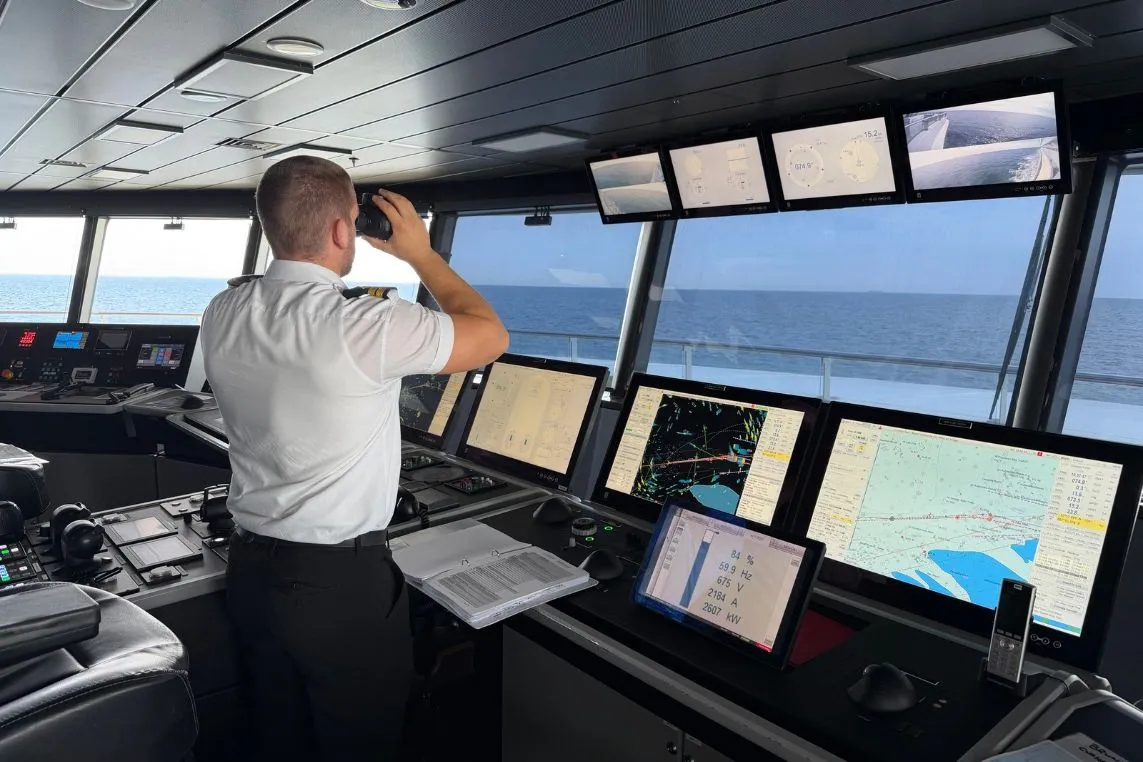
Technically, too, the ship is engineered for demanding waters: her hull meets Polar Class 6 standards. To hold position in fragile ecosystems without damaging the seabed with a heavy anchor, an electronically controlled dynamic positioning system operates via the thrusters.
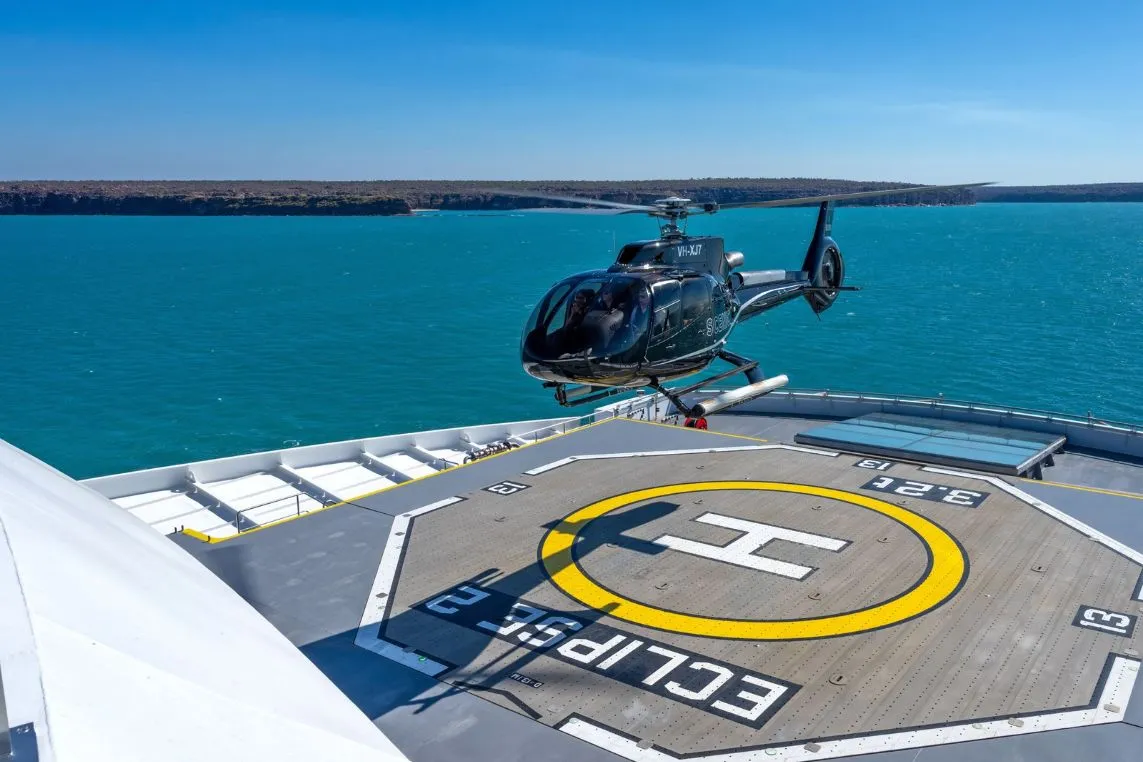
An open-bridge policy applies on board: whenever the door to the wheelhouse is open, guests are welcome to look over the officers’ shoulders and learn about maritime navigation firsthand. For exploration beyond the waterline, the yacht carries two Airbus H130-T2 helicopters on the upper deck as well as the custom-built Triton Scenic Neptune II submersible in her hull, accommodating up to eight passengers.
Curated Design Over Catalog Standard
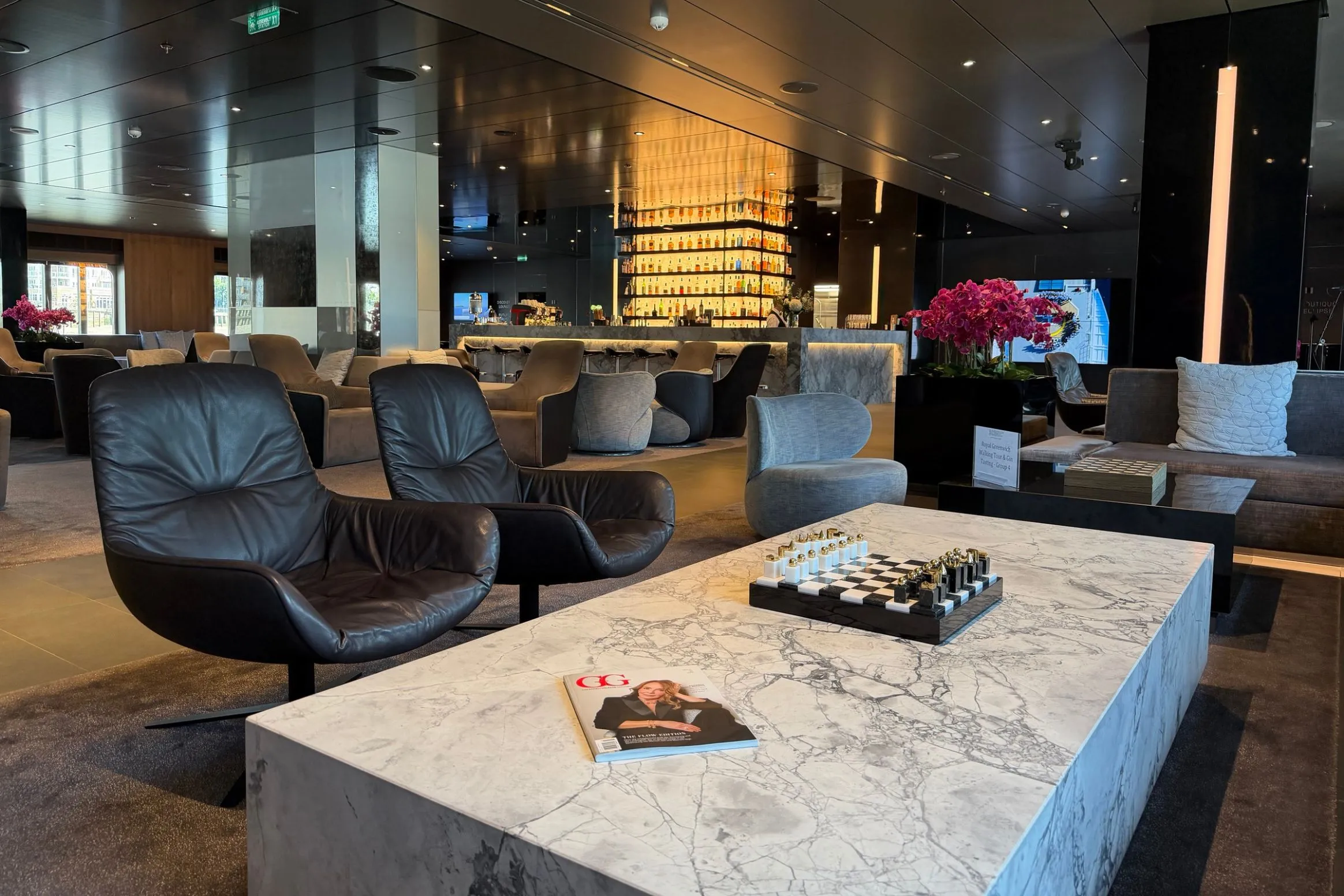
For the interior architecture, the cruise line deliberately refrained from outfitting the vessel through generic marine suppliers. Responsibility for the design rests with Karen Moroney, Co-Owner and Director of Project Design at the Scenic Group. Her concept relies on handpicked individual pieces from European design houses rather than standardized mass-market furnishings.
In the public lounges and 114 suites, furniture by B&B Italia and Walter Knoll sits alongside lighting by Tom Dixon and Jonathan Browning; the freestanding double whirlpool tubs in the Spa Suites were designed by Philippe Starck. Instead of dark wood paneling, bright surfaces, textiles by Designers Guild, finely tuned lighting concepts and merino wool accents dominate the interiors.
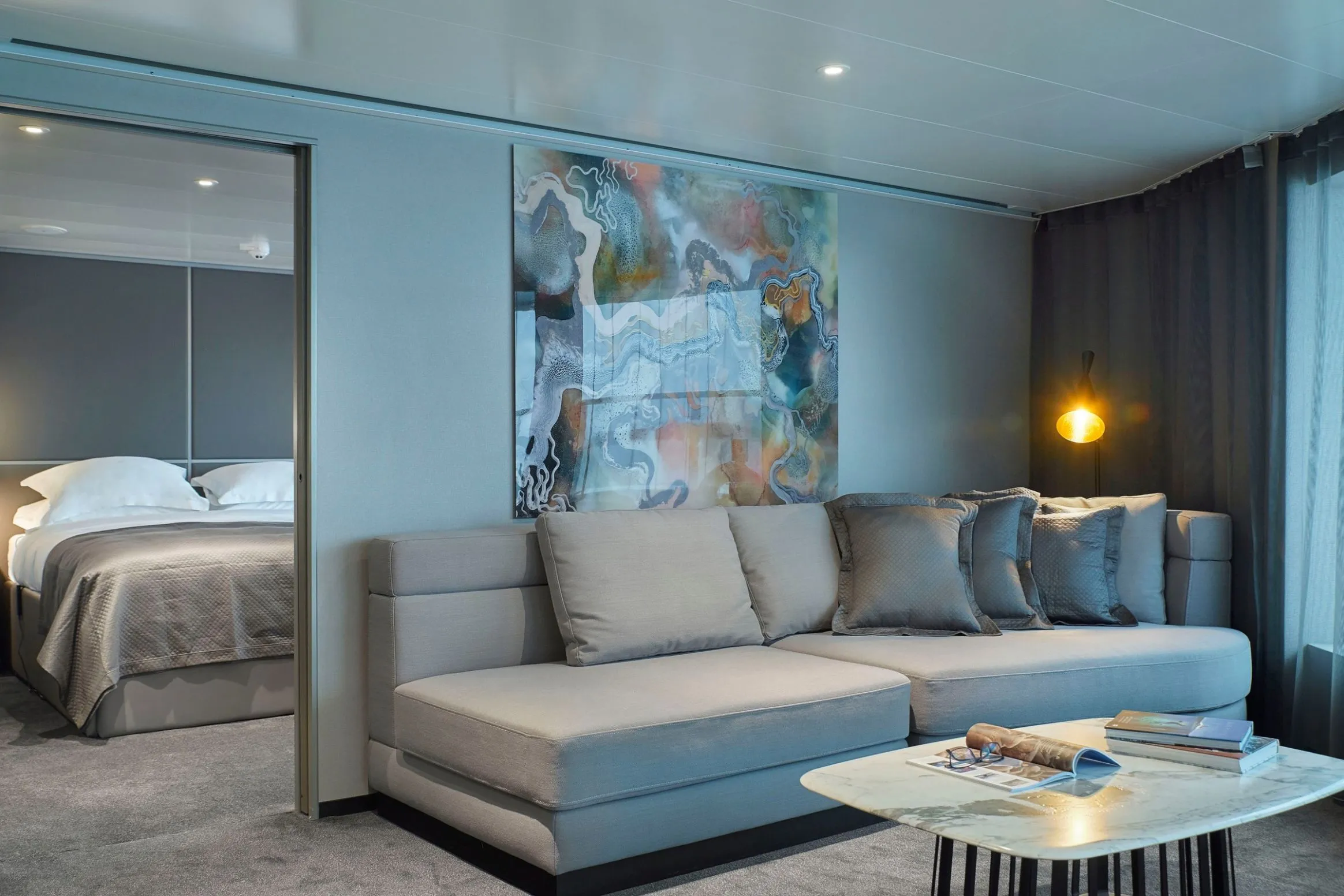
According to Tom Götter, Karen Moroney personally directed every single detail – from the exact lumen output of a lamp to the reflections cast across surfaces.
A prime example can be found in the Asian fusion restaurant Koko’s: for the sushi bar, Moroney had chairs by the Westphalian manufacturer Freifrau upholstered in fabrics by the Italian fashion house Missoni. Bespoke touches like these elevate the spaces both visually and tactually far above conventional cruise aesthetics.
The design concept also dispenses with explanatory plaques. Artworks hang on the walls as effortlessly as they would in a private collection. The main restaurant Elements showcases originals by Spanish artist Joan Miró, while Koko’s features large-scale works by Carl Hush. His geisha portraits were created under unusual circumstances: the British artist worked directly on board during the outfitting phase – surrounded by trash bags brimming with paper scraps and accompanied by loud heavy metal music, he crafted the pieces using stencil, spray-paint and collage techniques right in the midst of the shipyard workers.
Culinary Artistry Without Boundaries
This unpretentious spirit carries over into the gastronomy. Guests on board enjoy an all-inclusive concept spanning ten restaurants, whose culinary direction is overseen by Tom Götter. Born in Rheinhessen, his career led from several posts in Germany into Michelin-starred dining and appearances as a finalist on Top Chef Germany and Top Chef World All Stars. He joined Scenic as Executive Chef in 2019 and today heads the fleet’s global culinary program as Vice President Hotel Operations Ocean.

Minimizing food waste plays a central role in Götter’s kitchen philosophy. A key technique is dehydration: surplus fresh produce is dried and processed into intensely flavored powders. Roughly eight kilograms of carrot peels are reduced to a single container of vegetable powder; more than 20 kilograms of fresh mint yield a concentrated essence powder. This saves space in cold storage, shortens prep times during service and lends sauces remarkable depth. Fresh herbs for daily use are also grown on board in dedicated vertical gardens.
From French Haute Cuisine to Teppanyaki
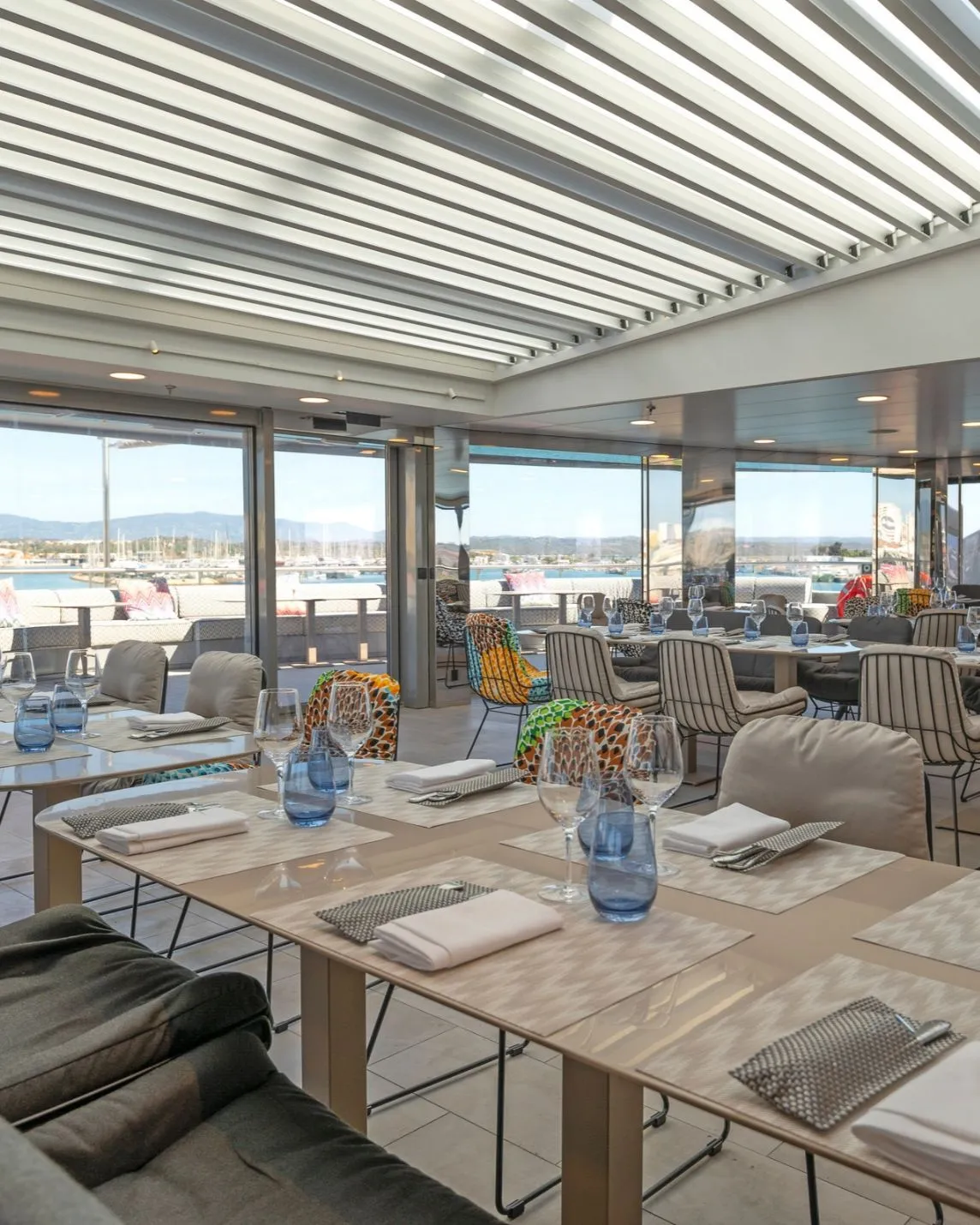
Just how varied the ten dining venues are is exemplified by Lumière on Deck 5. With its graphic black-and-white flooring, black muntin partitions and dark tables, the space is more reminiscent of a contemporary Parisian bistro than a traditional dining room at sea. The evening begins at the Champagne bar counter with oysters and caviar, followed at the table by a multi-course tasting menu – ranging from slow-cooked cauliflower soup with black truffle to Jack’s Creek beef tartare, Angus beef tenderloin with pommes duchesse and a classic rum cake to finish.
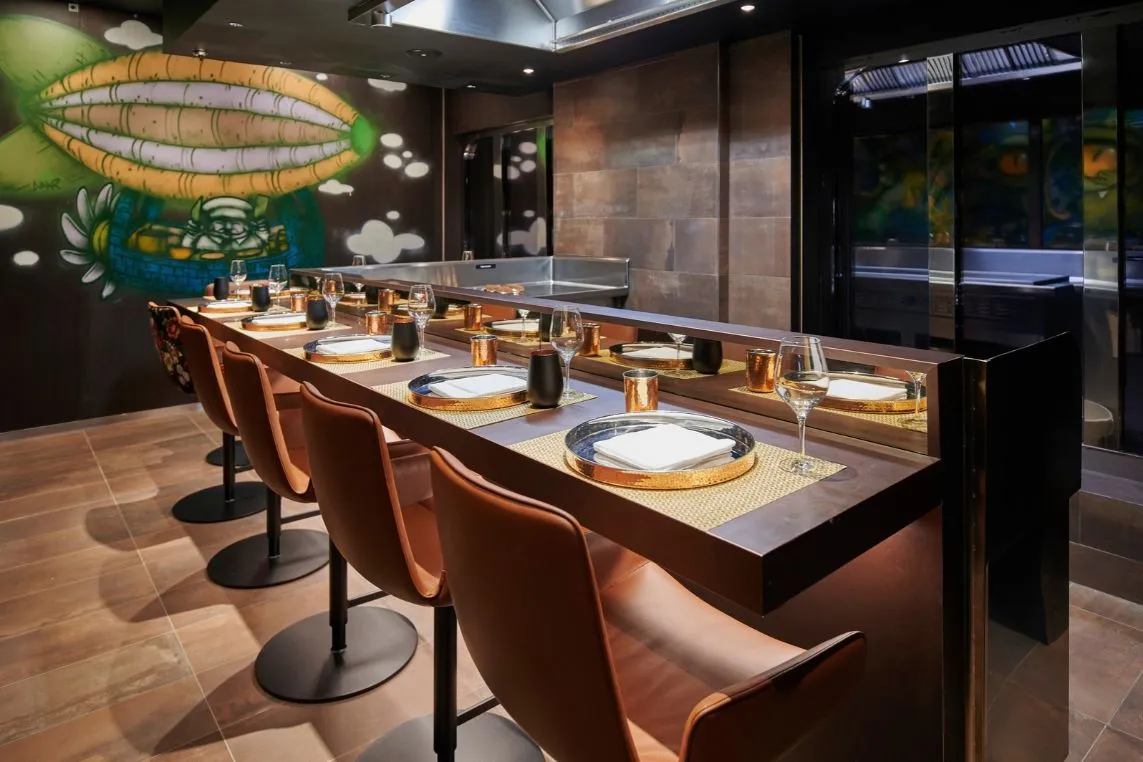
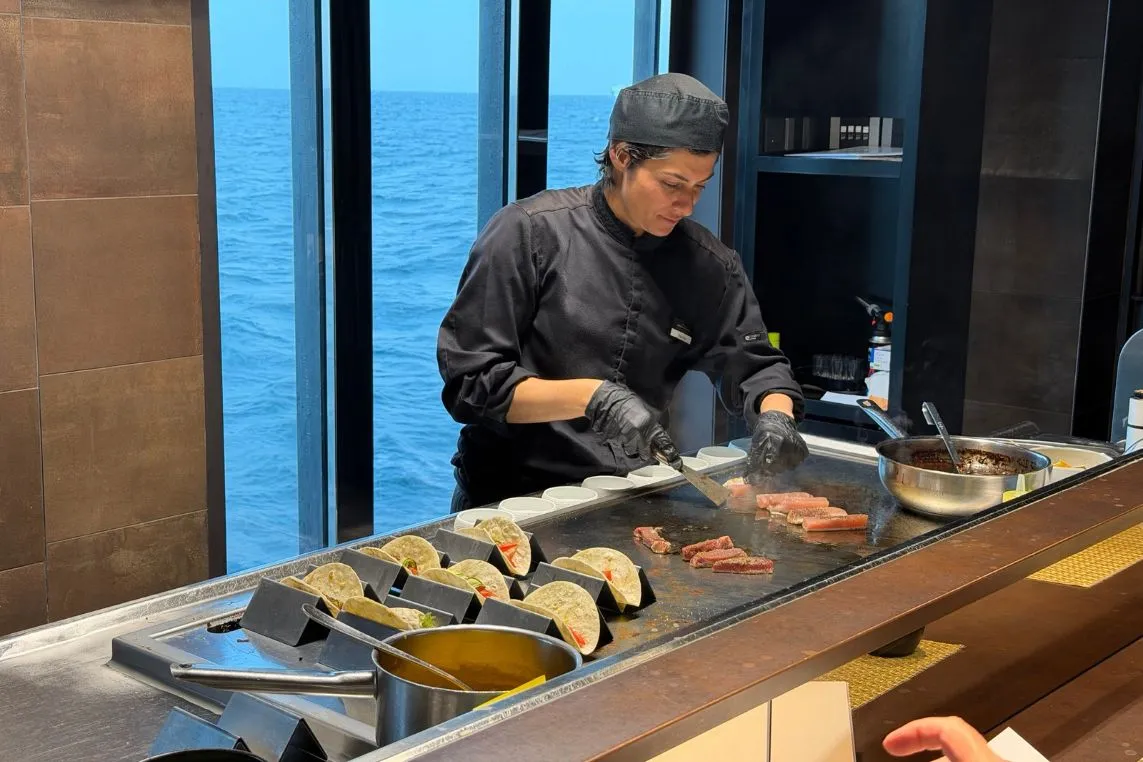
Night Market @ Koko’s sets a very different tone. Seating just eight guests around the teppanyaki grill, the intimate counter naturally sparks conversation about what is sizzling on the hotplate. The chef prepares every dish right in front of the guests while consciously foregoing the usual theatrical acrobatics of flaming oil trails or flying ingredients. Instead, the spotlight is squarely on flavors from Southeast Asia, India and the Middle East. Vibrant colors dominate the plates: crisp vegetables, scampi, fresh tacos – and in casual conversation with the chef, guests effortlessly learn more about rare spices and traditional preparation methods.
A Quiet Course Ahead
After crossing the shallow sandbanks of the North Sea, the yacht turns into the Elbe estuary at Cuxhaven. On the river passage upstream toward Hamburg, the advantage of her low-slung silhouette becomes unmistakable: thanks to her proximity to the waterline and the suites’ private verandas, views of the riverbanks remain immediate and uninterrupted.
Virtually vibration-free and whisper-quiet, the ship glides past Hamburg’s Elbe suburbs, the villas perched along the Blankenese hillside and historic parklands, while breakfast is served on private verandas or in the glass-enclosed Yacht Club.
It is precisely these tranquil hours on the river that capture the essence of this way of traveling: less about grandiose spectacle on the high seas, and far more about space, serenity and artisanal care down to the finest detail.
The research for the article was conducted in connection with a press trip to which GG was invited by Uschi Liebl PR GmbH.
Your dream property in Hamburg
Discover your new home on the banks of the Elbe
Groß Flottbek, Hamburg, Germany
Parkresidenz Alexander – Genehmigtes Wohnprojekt in Bestlage von Groß Flottbek
Price
€5,995,000
- ~2,266 m² Plot surface
Groß Flottbek, Hamburg, Germany
Parkresidenz Alexander – Genehmigtes Wohnprojekt in Bestlage von Groß Flottbek
Price
€5,995,000
- 18 Rooms
- ~1,282 m² Living area
- ~2,266 m² Plot surface
Nienstedten, Hamburg, Germany
Renovated Art Nouveau villa within walking distance of the Elbe beach
Price
€5,950,000
- 14 Rooms
- 5 Bathrooms
- ~561 m² Living area
- ~2,762 m² Plot surface
Nienstedten, Hamburg, Germany
Ein Unikat mit Charakter – modernisierte Rotklinkervilla in ihrer schönsten Form
Price
€4,500,000
- 10 Rooms
- 7 Bathrooms
- ~430 m² Living area
- ~2,887 m² Plot surface
- Exclusive
Nienstedten, Hamburg, Germany
Ein Haus mit Geschichte. Ein Zuhause für heute.
Price
€3,950,000
- 10 Rooms
- 3 Bathrooms
- ~350 m² Living area
- ~2,319 m² Plot surface
AI
NewBlankenese, Hamburg, Germany
A gem in the Staircase Quarter! Unique residential complex with views of the Elbe River
Price
€3,490,000
- 10 Rooms
- 4 Bathrooms
- ~400 m² Living area
- ~400 m² Plot surface
AI
NewBlankenese, Hamburg, Germany
Luxurious family haven in Blankenese: Arrive, breathe easy, feel at home!
Price
€3,390,000
- 8 Rooms
- 3 Bathrooms
- ~269 m² Living area
- ~2,394 m² Plot surface
AI
Othmarschen, Hamburg, Germany
Schöne Endetage im Villenensemble an der Elbe
Price
€3,150,000
- 6 Rooms
- 3 Bathrooms
- ~219 m² Living area
Othmarschen, Hamburg, Germany
Ruhig und dennoch mittendrin - Stilvolle Maisonette-Wohnung in exklusiver Lage - Wohnen auf höchstem Niveau
Price
€3,150,000
- 6 Rooms
- 3 Bathrooms
- ~219 m² Living area