- 8 min read
- 30/06/2026
What determines a property's value beyond its features?
A property's market value does not depend solely on its size, floor level, age, or energy efficiency rating. It is shaped by a combination of external factors including the neighbourhood, accessibility, and surrounding infrastructure.
Key Points
Location is one of the most important factors determining a property's market value, as it directly influences demand, liquidity, and long-term appreciation potential.
Proximity to Metro stations, the seafront, schools, infrastructure, green spaces, and retail services can significantly enhance the value of a residential property.
Conversely, noise pollution, heavy traffic, limited parking, or proximity to undesirable land uses can reduce a property's appeal.
Examples such as Kalamaria in Thessaloniki, the Athens Riviera, the Cyclades, the Ionian Islands, and selected areas of the Peloponnese demonstrate that the right micro-location is often just as important as the wider area itself.

Why location remains the most decisive factor in property value
In real estate, the phrase "location, location, location" remains as relevant as ever for one simple reason: a property's internal features can be improved, but its location cannot be changed. An apartment can be renovated, upgraded to a higher energy standard, or equipped with modern technology. It cannot, however, be moved closer to a Metro station, a beach, a school, or a quiet, tree-lined street.
A property's market value depends on far more than its size, floor level, age, or energy efficiency rating. It is shaped by a combination of external factors including the neighbourhood, accessibility, infrastructure, safety, the quality of the surrounding environment, views, noise levels, and the balance between supply and demand in the local market. Location, together with access to public transport, schools, and essential services, plays a fundamental role in determining a property's value.
In other words, two properties with the same floor area and similar technical specifications can have significantly different values if one is located on a quiet street close to a Metro station while the other sits on a busy road with constant traffic and noise. This difference is not a minor detail. It is a fundamental element of property valuation.
Access to Metro and public transport creates added value
Proximity to fixed-track public transport, such as the Metro, is one of the strongest external factors influencing property values. For buyers and tenants, it means shorter commuting times, reduced dependence on private cars, and an improved quality of everyday life. For investors, it translates into a larger pool of potential tenants, more stable demand, and stronger resale prospects.
Thessaloniki is a prime example. The Metro extension to Kalamaria includes five new stations: Nomarchia, Kalamaria, Aretsou, Nea Krini, and Mikra, along a 4.78 km underground line. According to the official Thessaloniki Metro website, the Kalamaria extension is expected to begin operating by the summer of 2026, further improving mobility, commercial activity, and quality of life across eastern Thessaloniki.
Kalamaria is already recognised as one of Thessaloniki's most desirable seaside suburbs, with strong demand for newly built and renovated apartments offering sea views, private parking, and energy-efficient features. Market data indicates an average asking price of approximately €3,000 per sq.m. during the first quarter of 2025. Newly built properties in sought-after locations such as Karabournaki and Krini typically range from approximately €3,400 to more than €4,700 per sq.m., while older homes or properties without sea views generally range between €2,200 and €2,700 per sq.m.
The addition of new Metro stations does not increase prices uniformly across every neighbourhood. Instead, it creates new micro-markets. A property located close to a station, with convenient access to schools, shopping areas, and the seafront, can enjoy a clear competitive advantage over another property in the same district but in a less functional location. This illustrates the true importance of micro-location.
Free, confidential and non-binding
Receive your digital valuation instantly
- Over 265,000 properties sold globally in the last 5 years
- 49 years of industry expertise
Based on data by Engel & Völkers
Sea views, coastal access, and the waterfront
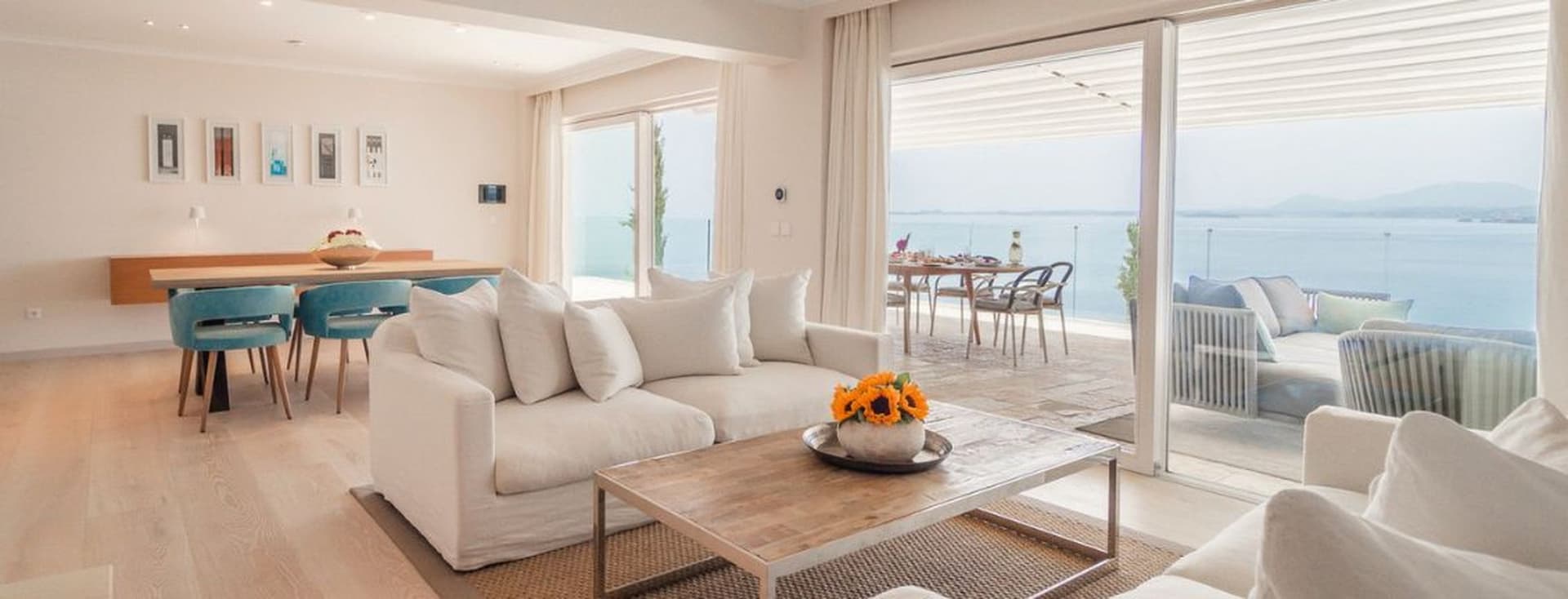
Access to the sea remains one of the strongest drivers of property value in Greece. This applies not only to holiday homes but also to urban markets that successfully combine everyday convenience with a premium lifestyle. The Athens Riviera is the clearest example, where areas such as Glyfada, Voula, Vouliagmeni, Elliniko, and Varkiza command premium values thanks to their combination of coastal living, modern infrastructure, vibrant retail districts, international appeal, and major development projects.
The same principle applies, on a smaller scale, to coastal districts of Thessaloniki such as Kalamaria, as well as destinations across the Peloponnese, the Ionian Islands, and the Cyclades. In the Peloponnese, locations including Porto Heli, Nafplio, and Kalamata benefit from the combined value of seaside living, accessibility, and quality of life. In the Ionian Islands, Corfu, Lefkada, and Paxos enjoy strong international recognition, where sea views, privacy, and direct access to beaches have a significant impact on pricing. In the Cyclades, destinations such as Mykonos and Paros demonstrate how a rare location, exceptional views, architectural quality, and sustained tourism demand can substantially increase property values.
The downside of location: noise, traffic, and environmental disturbance
Location does not always work in a property's favour. A home situated on a busy road, close to nightlife venues, in an area with limited parking, or near sources of environmental disturbance may command a lower value even if it is located within a highly desirable district. Noise pollution, air pollution, and concerns about safety all influence buyer perception.
Research focusing on the wider Thessaloniki area has specifically examined the relationship between noise pollution and residential property values, concluding that noise can have a measurable impact on prices, although the degree of influence varies between neighbourhoods. In practice, this means that a central location is not necessarily a disadvantage if it offers strong commercial appeal or excellent accessibility. It becomes a drawback when the inconvenience outweighs the benefits.
For example, an apartment located just a few minutes from a Metro station on a quiet side street may prove more marketable than an equivalent property directly overlooking a major avenue. Similarly, a home with uninterrupted sea views but difficult access, limited parking, or severe seasonal congestion may not achieve the price its owner expects.
Services, schools, green spaces, and everyday convenience
A property's value increases when the surrounding area supports a high quality of daily life. Schools, supermarkets, pharmacies, sports facilities, parks, public squares, healthcare services, and safe pedestrian routes create an environment that appeals to families, professionals, and long-term tenants alike.
This explains why well-established residential areas such as Pylaia, Thermi, Panorama, Alimos, Nea Smyrni, and Chalandri continue to experience consistent demand. A neighbourhood's reputation alone is not enough. It must also support the lifestyle priorities of its residents. For families, proximity to schools and parks may be more important than distance from the city centre. For investors, access to universities, hospitals, or business districts may be the deciding factor. For buyers of second homes, sea views, privacy, and direct beach access are often the primary considerations.
Value lies in the micro-location
Today's property market has become increasingly selective. Buyers evaluate not only the city or municipality but also the exact location, including the street, distance from public transport, noise levels, views, parking availability, green spaces, safety, and future development prospects.
For this reason, an accurate property valuation cannot rely solely on an average price per square metre. Average prices provide a useful starting point, but they do not tell the whole story. True market value emerges when a property's individual characteristics are assessed alongside the specific dynamics of its micro-market.
A property close to the Kalamaria Metro extension, an apartment overlooking the Athens Riviera, a residence near a beach in Paros, or a private villa in Paxos is not valued solely according to its floor area. Its value reflects the lifestyle it offers, the rarity of its location, and its long-term potential.
In a market where demand remains strong but increasingly discerning, location is not simply one factor among many. It is the foundation that gives meaning and value to every other characteristic of a property.
Contact
Contact your personal advisor


Engel & Völkers Greece
Athens Tower 2-4, Mesogeion Avenue (10th Floor)
11527 Athens, Greece
Tel: +30 211 105 500 0