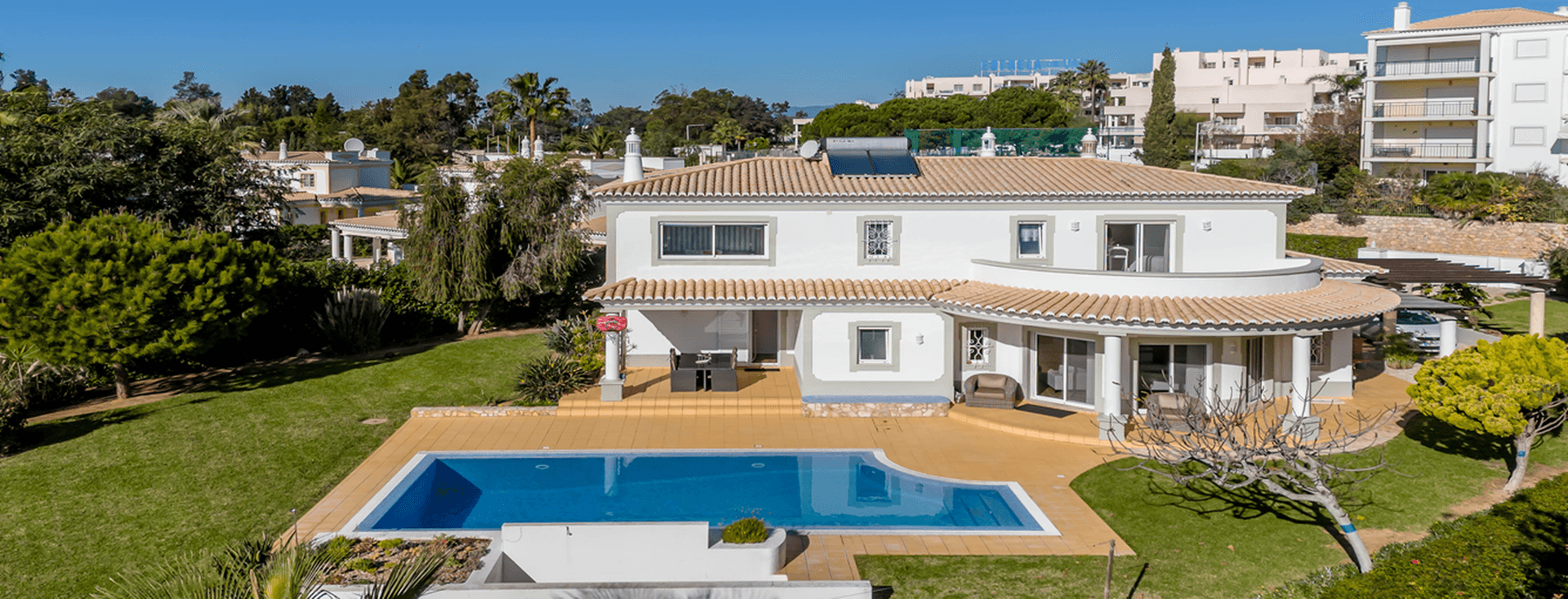
Meia Praia, Lagos, Odiáxere, Faro District, Portugal
Stunnig Design in Prime location facing the Sea
Price
€4,125,000
- 4 Bedrooms
- 5 Bathrooms
- ~340 m² Living area
- ~2,755 m² Plot surface
The hardest decision has been made – you’re going to sell your house! But now you need to address other complex questions to determine the price of the property and list it for sale, preferably at a value that is attractive both to you and the potential buyer!
Of course, your home is fantastic, and you want to sell it for the best price! But the best price, no matter how high, is always a fair, accurate, and market-appropriate price. This value is calculated based on a variety of factors used by property owners and real estate consultants to determine the price of a property.
Table of Content
It’s no use holding a calculator in your hand because there isn’t a single formula to define the price of a house. The most accurate value depends on several objective and subjective factors, which we will list below.
Start by researching online on real estate agency websites to discover the price of a property similar to yours, in terms of the number of rooms, location, and construction year. Take note of the value, but don’t get too attached to it because, even if they belong to the same category, not all houses are the same. There are differences in construction and layout that can influence the price. This is why you should proceed to consider the other elements in this list when determining the price of a property.
PROPERTIES IN PORTIMÃO
Meia Praia, Lagos, Odiáxere, Faro District, Portugal
Price
€4,125,000
Odiáxere, Faro District, Portugal
Price
€3,890,000
Alvor, Faro District, Portugal
Price
€3,300,000
Odiáxere, Faro District, Portugal
Price
€2,990,000
Odiáxere, Faro District, Portugal
Price
€2,950,000
Mexilhoeira Grande, Faro District, Portugal
Price
€2,500,000
Lagos, Faro District, Portugal
Price
€2,100,000
Alvor, Faro District, Portugal
Price
€1,995,000
Portimão, Faro District, Portugal
Price
€1,700,000
It’s not worth comparing prices of homes located in different areas, but you also can’t forget that location is a decisive factor in determining the price. However, it’s more complex than it first appears. Even within the same location, homes can be more expensive or cheaper depending on the neighbourhood or parish they are in and their proximity to key amenities. For example, a property is valued higher when located in safe neighbourhoods with green spaces and close to public transport, schools, hospitals, shops, and shopping centres.
In addition to location, the construction year of a property is crucial for setting a fair price. The rule is simple: the older the house, the lower its market value; the newer the house, the higher the market value. However, there are exceptions to this rule, such as location (a house in a privileged area may be more expensive than a newer home in a less desirable area). Not only that, the condition of the property also influences the price. A house that has undergone renovations can be sold at a higher price because new and refurbished properties provide more security for potential buyers.
When it comes to property type, comparing it with other properties is easier, and therefore, setting the price is more straightforward. T0, T1, T2, T3, T4… the number of rooms and living spaces is easy to measure, but the size of these areas can influence the final price. This is why you should proceed to the next element for determining the price of a property.
As you know, to establish the value of a house, you must calculate the area dimensions (length and width) and use the price per square metre (m²). The first task is relatively simple since the property’s floor plan provides the total area and the specific areas of each room, including terraces, balconies, and gardens. However, calculating the price per square metre can be more complicated, so here are two tips:
Measure the length and width of the area, then multiply them (m² = length x width). Once you have an exact number, research the sale price of properties with similar measurements.
Use online calculators or tools to obtain average price per m² for apartments and houses.
However, defining the price per m² alone isn’t enough to obtain the best value. Why? Because the price per m² is directly influenced by supply and demand. This means your house may be worth more (or less) than a house of the same size, either because it has been recently renovated, is well-located, or is part of a gated community with many facilities, for example. Speaking of which…
Free, confidential and non-binding
Receive your digital valuation instantly
Based on data by Engel & Völkers
Apartments and houses in gated communities tend to have higher selling prices because residents can benefit from various useful and leisure spaces (such as a garage, swimming pool, playground, gym, and garden) and security features, all of which are reflected in the price per square metre.
Whether they want as much natural light as possible or want to avoid astronomical energy costs for heating their home in the winter, buyers prefer properties with good solar exposure, ideally facing east/west. Therefore, this characteristic is enough to increase (or decrease) the value of your home!
Needless to say, if your home offers a panoramic view, a view of the sea, a view of the mountains, or at least an unobstructed view, it may have a higher selling price than a similar property with a view of the neighbouring building.
High-quality building materials and top finishes are also an advantage when determining the price of a property.
Another factor to consider is the time/price relationship – that is, the higher the selling price, the longer the average time it takes to sell a property. Conversely, the lower the selling price, the quicker the sale. Therefore, if you are in a hurry to sell, you need to set a price equal to or below the market average. But if you can afford to wait, you might risk pricing it higher than the average value.
According to the law in Portugal (*), property valuation must be carried out by a qualified Property Appraiser with the appropriate qualifications, skills, and professional experience. This appraiser must hold a degree, postgraduate qualification, or a master's relevant to property valuation, be recognised by the CMVM (Portuguese Securities Market Commission), and have Civil Liability Insurance. Of course, if you request an appraisal from a professional with these qualifications, there will be a cost for you. Real estate consultants, however, by having in-depth knowledge of the market they operate in and extensive experience with what is currently for sale or has been sold recently in the area, have a unique and valuable "know-how" that can provide an equivalent valuation, free of charge. Ultimately, these consultants understand they are contributing to getting your property on the market.
(*) Law No. 153/2015 of the Official Gazette No. 179/2015, Series I, dated 2015/09/14
In summary, a real estate agency can help you sell your house more quickly and without any issues. So, don’t waste any more time! The price at which you list your property is crucial for the success of the sale! Book a free appraisal with Engel & Völkers Portimão now.
You may also be interested in



&w=1920&q=75)


Contact provider
Page content provided by: Soho Algarve, Lda.
License partner of Engel & Völkers Franchise and Trademark GmbH