
Sell Successfully – with Engel & Völkers
Promising: Our global network of registered prospective buyers.
Three people. Three success stories. Get to know them. Discover now.
The most important tax questions regarding your real estate.
&w=1920&q=75)
Key Points at a Glance
Owning, buying, selling, or using real estate in Switzerland may involve various taxes—including income tax, wealth tax, real estate gains tax, transfer tax, and property tax.
The tax treatment of real estate varies significantly depending on the canton and, in some cases, the municipality.
With the abolition of the imputed rental value as of January 1, 2029, the taxation of owner-occupied residential property and various tax deductions will change.
Whether a property is classified as personal or business assets has a significant impact on its tax treatment—particularly upon sale.
Given the differences between cantons and individual circumstances, it is advisable to conduct a tax review early on—especially before purchasing, selling, or transferring real estate.
Real estate held as part of private assets may be subject to various types of taxes:
Income from real estate in private assets is subject to income tax. This tax is levied by the federal government, the cantons, and the municipalities. Taxable income includes, in particular, rental income as well as, for owner-occupied properties through the end of 2028, the so-called imputed rental value.
In return, through the end of 2028, maintenance and financing costs—in particular mortgage interest and costs for the early termination of a mortgage—can be deducted for tax purposes.
Starting in 2029, the rules for mortgage interest deductions will change significantly. For owner-occupied residential property, the general mortgage interest deduction will no longer be available to the same extent as before. A deduction limited in both duration and amount will remain in place for first-time homebuyers. Value-enhancing expenses are generally not deductible as maintenance costs. However, they may be considered as investment costs in the event of a subsequent sale subject to real estate gains tax.
Energy and environmental protection measures may constitute an exception. Despite a potential increase in value, these may be deductible for income tax purposes in accordance with the respective cantonal regulations. The applicable cantonal regulations must be reviewed in each case.
Real estate held as part of one’s private assets is subject to wealth tax. Debts related to the property may generally be deducted from taxable assets.
Wealth tax is levied at the cantonal and municipal levels. The federal government does not levy a wealth tax.
Real estate capital gains tax is a cantonal and, in some cases, municipal tax levied on the profit realized upon the sale of a property.
In general, the realized capital gain is taxed, although the tax rate and the calculation of the taxable gain may vary by canton. At the federal level, a private capital gain from the sale of a property is generally not subject to federal direct tax. Real estate held as part of a private estate is therefore generally subject to real estate gains tax.
Under certain conditions, the real estate gains tax can be deferred. Possible grounds for tax deferral include, for example, inheritance, the division of marital property, or the replacement of the property. In these cases, taxation is not waived but rather deferred to a later date.
Promising: Our global network of registered prospective buyers.
Real estate that is in the process of being transferred may be subject to the following types of taxes:
The real estate transfer tax is a cantonal or municipal tax levied when ownership of a property changes from the previous owner to the new owner. The regulations vary from canton to canton. All cantons recognize various tax-exempt or preferentially taxed transfers of ownership. These include, for example, inheritance, the division of marital property, or the replacement of a property.
Some cantons do not levy a real estate transfer tax. Other cantons levy a fee in accordance with the fee schedule in lieu of or in addition to the real estate transfer tax. This fee is intended to cover administrative costs and is not a tax.
Property tax is also a cantonal or municipal tax. It is levied annually in individual cantons and municipalities based on the value of a property. Unlike wealth tax, debts encumbering the property cannot be deducted. In principle, the full tax-assessed value of the property is subject to taxation.
With the elimination of the imputed rental value effective January 1, 2029, cantons may also introduce a special property tax on owner-occupied second homes. This tax must be distinguished conceptually from the existing general cantonal or municipal property tax.
If a property is used exclusively for private purposes, no value-added tax is generally due on either the sale or the rental. Accordingly, no input tax credit may be claimed for investment, operating, or administrative costs.
For new construction projects, the timing of the sale is particularly relevant. If the property is sold before construction begins, this may constitute a taxable real estate transaction. If the sale or the contract for services is concluded only after construction has begun, the transaction is generally exempt from value-added tax.
However, the specific assessment depends on various factors, including the terms of the contract, economic control, and the roles of the parties involved. Each case must therefore be examined on its own merits.
If real estate is used for business purposes and the tenant or buyer is subject to value-added tax, the lease or sale may, under certain conditions, be voluntarily subject to value-added tax. In this case, an input tax credit may be available. Input tax credits may also be claimed when the property is used for business purposes by the owner, provided the owner is subject to value-added tax. The extent of the input tax deduction depends on the applicable input tax rate.
Value-added tax (VAT) law as it relates to real estate is complex. Seeking early guidance from a tax specialist can help you accurately assess the tax implications and, depending on the situation, avoid significant costs.
Real Estate Transfer Tax
Tax on a Change of Ownership
Property Tax
Annual tax on the value of the property
Value-Added Tax
Particularly relevant for business use and certain real estate transactions
The following is a brief explanation of the most important tax events related to real estate held as part of personal assets.
Income from real estate is generally subject to income tax in the location where the property is situated. For owner-occupied properties, the imputed rental value is also taxable as notional income through the end of 2028. In return, mortgage interest and maintenance costs, among other things, are tax-deductible through the end of 2028.
Starting in 2029, the rules for mortgage interest deductions will change significantly. For owner-occupied residential property, the general mortgage interest deduction will no longer be available to the same extent as before. A deduction limited in both duration and amount will remain in place for first-time homebuyers.
Value-enhancing investments are generally not deductible as maintenance costs. However, in the event of a subsequent sale, they may be taken into account as investment costs when calculating real estate gains tax. Energy-efficiency and environmental protection measures may constitute an exception. Despite a potential increase in value, these measures may be deductible for income tax purposes in accordance with the respective cantonal regulations. In addition, the tax value of the property, less any deductible debts, is subject to wealth tax. Some cantons also have a separate real estate tax that may be levied in addition to or in lieu of the wealth tax.
When selling a property from their personal assets, the seller generally realizes a tax-free personal capital gain at the federal level. Any loss cannot be claimed as a deduction for tax purposes at the federal level.
However, the profit realized is generally subject to cantonal real estate gains tax. The specific calculation and amount of the tax are determined by the respective cantonal regulations.
Ownership of a property that is part of one’s private assets may be transferred through a purchase, exchange, gift, inheritance, or transfer of ownership between spouses or registered partners. The purchase of a property generally does not trigger a direct income tax liability. However, depending on the canton, a transfer tax may apply.
When making a purchase, it is also important to consider the potential liability risk for existing tax claims. Many cantonal laws provide for joint and several liability on the part of the buyer or a statutory mortgage for real estate gains tax and, in some cases, also for transfer tax. Accordingly, it is advisable to include appropriate contractual safeguards. For example, a portion of the purchase price—equal to the previously determined maximum real estate gains tax—can be paid directly to the relevant tax authority. The rules governing a purchase apply mutatis mutandis to the exchange of real estate, which is generally treated for tax purposes as a double purchase.
In the case of an inheritance or a gift, the real estate gains tax is generally deferred. This results in a deferred tax liability for the new owner, which may become relevant upon a subsequent sale of the property.
In addition to real estate gains tax, cantonal inheritance and gift taxes must also be taken into account. However, the vast majority of cantons do not levy such taxes on transfers to descendants, spouses, or registered partners. For real estate, tax jurisdiction generally lies with the location of the property, that is, where the property is situated.
In the case of a new construction, the construction costs can generally be taken into account only when the property is subsequently sold. During the construction phase, no imputed rental value is generally subject to taxation for a property that is not yet habitable. With the elimination of the imputed rental value effective January 1, 2029, this taxation will cease to apply to owner-occupied residential property in any case.
Significant work performed by the owner during construction or renovation may have tax and social security implications. These should be clarified early on in each individual case.
When carrying out a renovation or remodeling project, a distinction must be made between expenses that preserve value and those that increase value. Maintenance costs that preserve value are generally deductible for income tax purposes through the end of 2028. Value-enhancing investments, on the other hand, are considered capital expenditures and can generally only be taken into account upon a subsequent sale subject to real estate gains tax. Depending on cantonal legislation, taxpayers may choose between deducting the actual, documented costs or claiming a flat-rate maintenance allowance for maintenance expenses.
Good to know: For larger investments intended to preserve value, it may make tax sense to spread the work over several tax periods through the end of 2028. However, each specific situation should be evaluated on a case-by-case basis.
For rental properties, rental income is subject to income tax. For owner-occupied properties, however, the imputed rental value is taxable as notional income until the end of 2028. Until the end of 2028, maintenance costs and interest on debt can generally be claimed as deductions within the framework of statutory provisions. With the elimination of the imputed rental value effective January 1, 2029, this system will change significantly.
The assessed value of the property is also taken into account for property tax purposes. The associated debts can generally be deducted from taxable assets.
Abolition at the end of 2028
The imputed rental value is a notional income for owner-occupied residential property. It is subject to income tax through the end of 2028 and generally applies to owner-occupied vacation homes and second homes in Switzerland as well.
The imputed rental value is calculated or estimated by the relevant cantonal tax authorities in accordance with the respective cantonal guidelines and communicated to the owners. The imputed rental value is generally lower than the rental value that could be obtained on the market. With the abolition of the imputed rental value effective January 1, 2029, the corresponding taxation on owner-occupied residential property will be eliminated.
The value of a property is part of taxable assets and is subject to cantonal and municipal property taxes. For property tax purposes, the cantonal assessed value is generally the determining factor. This does not necessarily correspond to the current market value. Since the cantons use different valuation methods when determining the assessed value, the tax assessment of a property may vary from canton to canton.
Mortgages and other debts secured by real property that encumber a property may generally be deducted from taxable assets. Unlike the deduction of interest on debt for income tax purposes, there is no comparable cap on the deduction of debt for wealth tax purposes.
For real estate held as part of a private estate, maintenance costs intended to preserve value, insurance premiums, administrative costs, and certain repair costs are generally tax-deductible. Depending on cantonal regulations, taxpayers may choose annually between deducting the actual, documented costs or claiming a flat-rate deduction for maintenance costs.
As a general rule, expenses related to personal living expenses are not tax-deductible. For owner-occupied properties, these include, for example, electricity, water, and property management fees.
With the elimination of the imputed rental value as of January 1, 2029, the previous deductibility of maintenance costs for owner-occupied residential property will generally no longer apply. The following continues to apply to value-enhancing investments: They are generally treated as capital expenditures and may be taken into account for property gains tax purposes upon a subsequent sale.
When it comes to real estate expenses, the distinction between costs that preserve value and costs that increase value is of central importance.
Expenses incurred to maintain value serve to preserve the current condition and value of a property.
In contrast, value-enhancing investments lead to an improvement or appreciation of the property and are generally considered capital expenditures.
In the case of mixed expenses, an appropriate allocation must be made. This may be the case, for example, with a comprehensive bathroom renovation, when existing components are replaced and the standard is significantly improved. The same distinction applies to repair work on newly acquired properties.
Free, confidential and non-binding
Receive your digital valuation instantly
Based on data by Engel & Völkers
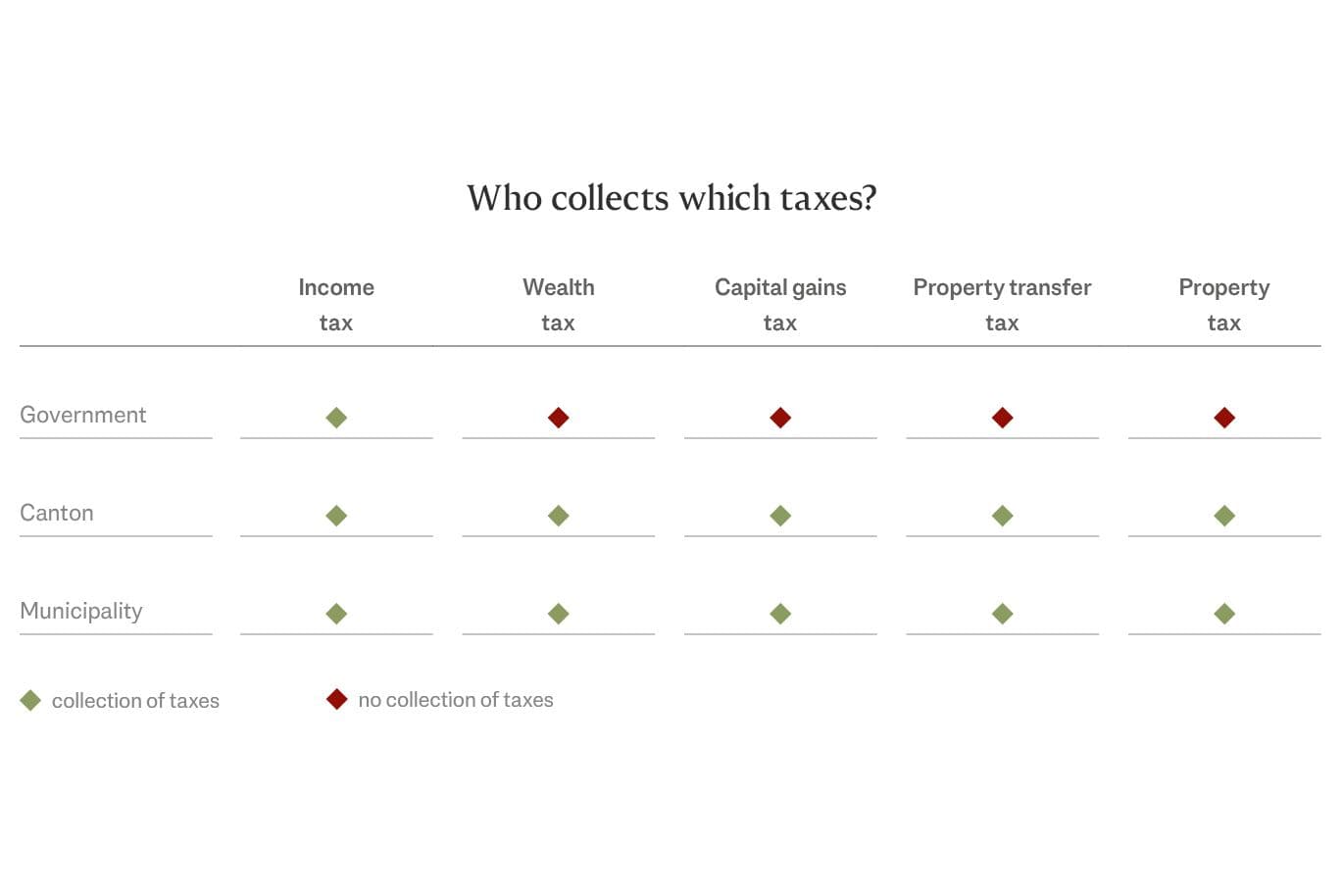
As a general rule, property gains tax is levied only by the cantons; in some cantons, it is also levied by the municipalities. In the cantons of Zug and Zurich, it is levied only by the municipalities.
The structure of the transfer tax and property tax varies by canton and, in some cases, by municipality. In certain cantons and municipalities, these taxes are not levied.
Under certain conditions, an individual may be classified by the tax authorities as a commercial real estate dealer. In this case, the real estate is generally treated as business assets for tax purposes.
Such a classification can have significant implications for the tax burden and may also have consequences under social security law.
There is no universally applicable definition of “commercial activity.” The assessment is based on various criteria and indicators developed through Federal Supreme Court case law. In each case, the tax authorities examine the overall circumstances of the individual case and have a certain degree of discretion.
The following, in particular, are considered possible indications:
Number of purchases and sales
Short period of ownership of the properties
Excessive Debt Financing
Relevance to one's professional or business activities or specialized expertise, such as that possessed by architects, real estate agents, or property managers
Using Profits from Real Estate Transactions to Cover Living Expenses
Extensive real estate activities aimed at generating a profit can be particularly problematic. These include, for example, the completion of a comprehensive project followed by the establishment of condominium ownership and the sale of the individual units. The sale of several apartment buildings or condominium units within a short period of time can also lead to an examination of whether the activity is conducted on a commercial basis.
However, what is always decisive is the overall assessment of the specific circumstances. The existence of individual pieces of evidence does not automatically lead to a classification as a commercial real estate dealer.
If real estate is held by a legal entity or by an individual as part of business assets, different tax rules generally apply than for real estate held as part of personal assets. Legal entities are generally subject to income and capital gains tax on their real estate. For individuals, the corresponding income is taxed under the income and wealth tax system.
If real estate is held in multiple cantons, a tax apportionment is also required.
When it comes to taxing profits from the sale of real estate, the cantons generally distinguish between a dualistic and a monistic system.
Under the dualistic system, capital gains on real estate held as business assets are generally subject to ordinary income tax. This system applies in the following cantons: Lucerne, Obwalden, Glarus, Zug, Fribourg, Solothurn, Schaffhausen, Appenzell Ausserrhoden, Appenzell Innerrhoden, St. Gallen, Graubünden, Aargau, Thurgau, Vaud, Valais, and Neuchâtel.
Under the monistic system, capital gains on real estate are generally subject to the real estate capital gains tax. This system applies in the following cantons: Zurich, Bern, Uri, Schwyz, Nidwalden, Basel-Stadt, Basel-Landschaft, Ticino, and Jura. The canton of Geneva has a special regulation.
Even in the monistic cantons, reversed depreciation is generally subject to income tax.
For real estate held as business assets, depreciation may generally be claimed based on the actual loss in value or at the tax-allowable depreciation rates.
For real estate held by a legal entity, all transactions between the company and its owners or persons related to them must be conducted on arm's-length terms.
Tax planning options—such as leasing the property to the owner at a rent significantly below market rate or transferring the property to one’s personal assets at an undervalued price—are therefore only possible to a very limited extent.
Profits of a legal entity that are distributed to the owners in the form of dividends are generally subject to income tax for the owners. If real estate is transferred from a natural person’s business assets to their personal assets, this may trigger a tax realization. The corresponding hidden reserves may be recognized for tax purposes in this process.
Whether a property should be held as part of one’s personal assets or through a legal entity depends on various factors. These include, in particular, the ownership strategy, the planned holding period, financing, use, and personal or business circumstances.
Such a structure should therefore be carefully reviewed and evaluated from a tax perspective on a case-by-case basis.
According to the law, land includes property, individual and permanent rights listed in the land registry, mines and co-ownership shares of land.
If a plot of land is meant, a property can also be called land.
Taxation takes place at a later date. Tax is not exempt but deferred to a later date.
A potential tax liability that the new owner assumes with tax deferral mechanisms in conjunction with capital gains tax (e.g. inheritance).
The cantons are exempt from applying the monistic or dualistic systemfor profits made from land. In the monistic system, every sale is subject to capital gains tax, regardless of whether the land is held as a private or business asset or belongs to a legal person. However, recontributed depreciation is taxed as a business asset, or as profits or income tax for legal persons. In the dualistic system, gains made from land are subject to different taxation strategies. Land held privately is subject to capital gains tax, while land held as a business asset or by a legal person is taxed with profit or income. Property and tax are a very complex area of Swiss tax law. This guide aims to answer the major questions but cannot replace expert assessments of specific situations. If you have any questions, please ask for a consultation. Your Engel & Völkers real estate agent will be happy to advise you.
Disclaimer: Real estate and its tax implications are a complex area of Swiss tax law. This guide is intended to answer your most important questions on this topic, but it cannot replace a concrete assessment of your specific situation. We would be happy to advise you personally on your matter.
This guide was produced in collaboration with Fidura Treuhand AG.
All information is current as of September 2026 and is provided without warranty. In particular, the exact tax implications related to the reform of home ownership taxation—which will take effect on January 1, 2029—and the possible introduction of a property tax on second homes at the cantonal level are not yet sufficiently known at this time.
You may also be interested in

&w=1920&q=75)








Contact


Engel & Völkers Switzerland
Poststrasse 26
6300 Zug | Switzerland
Tel: +41 41 500 06 06