Santiago de Compostela, Galicia, Spain
Engel&Völkers sells historic building in Algalia de Arriba, for housing or university residence.
Price on request
- ~2,000 m² Total surface
Santiago de Compostela, Galicia, Spain
&w=1920&q=75)
Walking through the Old Town of Santiago de Compostela offers a unique and refreshing experience, perhaps triggered by the sight of the ecstatic pilgrims arriving after their long journey along the Camino de Santiago, or by the expressions of admiration and awe on the faces of tourists as they closely observe the vast and majestic architectural works, art pieces, historical artifacts, and the stories behind each medieval wall and hallway. The vibrant atmosphere, temperate climate, and pedestrian-friendly layout of the city make it a perfect place for a walking tour.
Click here to view the map of the walking tour.
Table of Content
Tourism in Santiago: an ideal starting point
Exploring the Arch of Mazarelos and the Praza de Mazarelos
Convento de las Mercedarias Descalzas: an impressive baroque example
Iglesia de San Fiz de Solovio and the Mercado de Abastos
Iglesia de San Agustín and Praza de Cervantes
Capela de Ánimas and Convent of San Domingo de Bonaval
Centro Galego de Arte Contemporánea and Capilla de San Roque
Mirador de Costa Vella and Convent of San Francisco
Cathedral of Santiago de Compostela: an imposing monument
Santiago's Squares and their living history
End of the tour: souvenirs and Galician restaurants
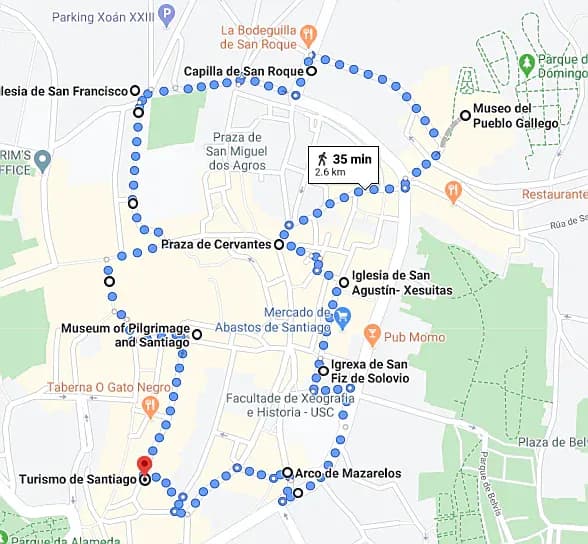
Let’s begin by visiting the Tourist Information Office of Santiago, located on Rúa do Vilar. This office will provide you with an overview of what the city has to offer: what to see, where to eat, and how to behave in churches and other religious buildings. The staff are friendly, multilingual, and ready to offer directions and practical advice. Additionally, they will provide you with free maps of the city, transport networks, and a list of points of interest. In the meantime, hold onto your maps and brochures for future reference, as we have prepared an interesting 2.6 km route that will take you to several unique and inspiring locations in the Old Town.
From the Tourist Office, turn right onto Callejón de Entrerruas, then turn right again onto Rúa Nova and Cantón do Toural, continuing along Rúa do Cardeal Payá until you reach Praza de Mazarelos. This small square is surrounded by the Faculty of Geography and History of the University of Santiago de Compostela, the University Church, and the statue of the Spanish judge Eugenio Montero Ríos. In one corner of the square, you will find the historically significant Arco de Mazarelos, the last remaining entrance from Santiago's medieval city walls.
Cross the arch and you will find yourself in front of the Convent of the Barefoot Mercedarians, a 16th-century Baroque-Neoclassical church and convent founded by Archbishop Antonio Girón. The imposing granite walls, gargoyles above the projecting cornice, Corinthian pilasters, and the relief of the Annunciation are just a few of the prominent features of this historical structure.
Let’s continue north along Rúa da Ensinanza, and upon reaching the Colexio Compañía de María Santiago, take the elevated path towards Praza San Félix, a small square in front of the University Library. Here you will find the Igrexa de San Fiz de Solovio, a Romanesque church of great historical importance. It is believed that this church was built by Santiago the Greater and was his home while he preached in Galicia.
A few steps away is the famous Mercado de Abastos de Santiago, a traditional market where you can find fresh seafood, fruits, vegetables, cheeses, bread, and other local products. The colourful outdoor stalls, cafés, and restaurants make this place a fun stop to enjoy a cold drink or a quick snack.
Next to the market is the Iglesia de San Agustín-Xesuitas, a Baroque church built in the 17th century, with a Neoclassical façade and an image of the Virgin of the Cerca. Its name refers to the ancient city wall from where the image was taken.
Continue along Cantón de San Bieito and turn left onto Rúa de San Bieito until you reach Praza de Cervantes, a famous meeting point where, in ancient times, the town crier would announce municipal decrees. At one end of the square is the Igrexa de San Bieito do Campo, a Neoclassical church with a linear structure, a single tower, and a nave.
Continue along Rúa das Casas Reais and turn left onto Rúa de Aller Ulloa. Upon reaching Costa de San Domingos, you will see the Convent of San Domingo de Bonaval on your right, a beautiful 13th-century convent, declared a National Monument for its unique Romanesque-Gothic architecture and Baroque façade. Inside the temple, known as the Pantheon of Galicia, you will find the tomb of Rosalía de Castro, the famous Galician novelist. Additionally, inside the convent is the Museum of the Galician People, which houses artifacts from Galician culture dating back to prehistory.
Directly opposite the convent is the Centro Galego de Arte Contemporánea, designed by Portuguese architect Álvaro Siza. This museum hosts exhibitions by contemporary artists from around the world. If you are interested in modern art, this is a place you cannot miss.
A few steps away is the Capilla de San Roque, a small church with Gothic elements. Its entrance is one of the most exquisite examples of Galician art.
Follow Rúa do Hospitaliño, turn left onto Rúa da Porta da Pena, and then right onto Rúa Costa Vella. Upon reaching the top of a staircase, you will find a viewpoint with panoramic views of the city. On one side, there is the Convent and Church of San Francisco, a Baroque and Neoclassical church founded in 1214 by Saint Francis of Assisi. Next to the convent is the Museo Terra Santa, which exhibits religious artifacts from sacred sites around the world.
Next, continue along Rúa do Campiño de San Francisco towards Rúa do Val de Deus. On your left, you will see the impressive Igrexa de San Martín Pinario, a Benedictine church and monastery that stands out for its impressive façade, ribbed dome, Latin cross plan, and magnificent Baroque altarpieces.
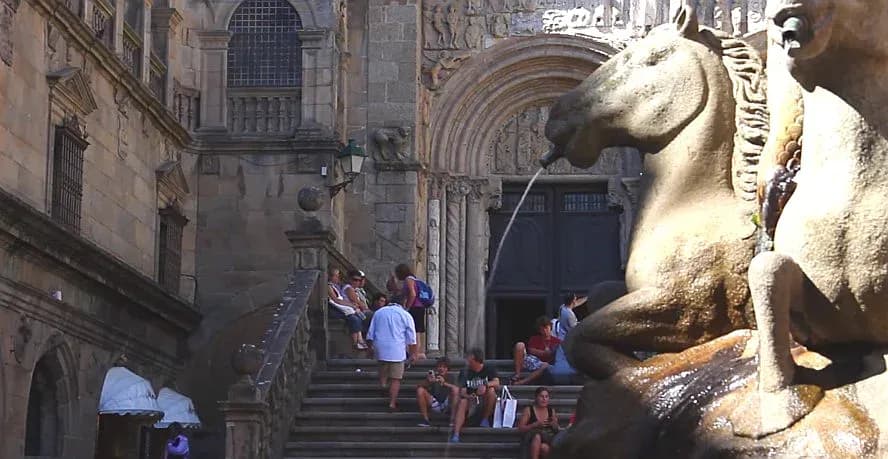
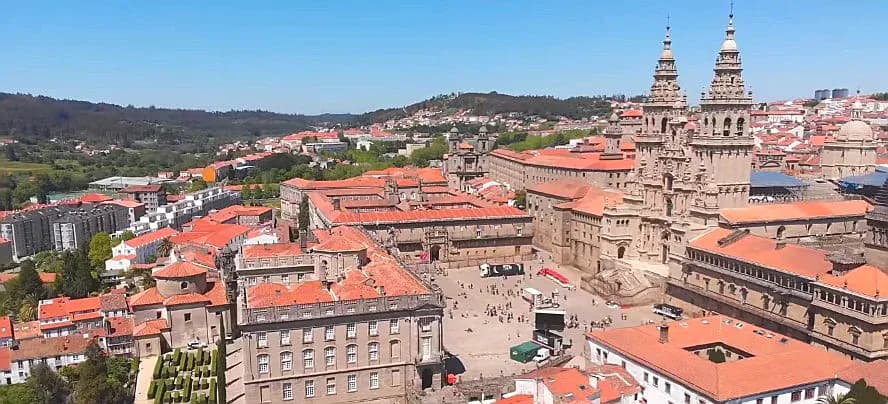
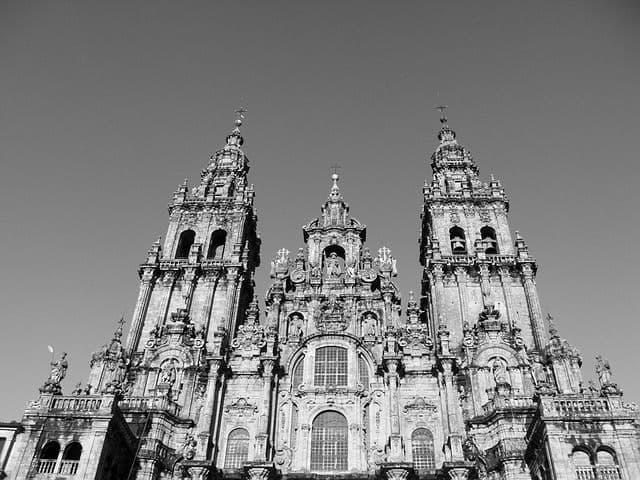
Finally, continue straight to Travesía das Dúas Portas and arrive at the majestic complex of the Cathedral of Santiago de Compostela, a Romanesque monument built in 1075. The cathedral is surrounded by four squares: Obradoiro, Quintana, Inmaculada, and Praterías, each with its own unique charm.
Praza do Obradoiro is the main square of the Cathedral, surrounded by medieval buildings such as the Palacio de Raxoi and the Colexio de San Xerome. Be sure to explore the cathedral's cloisters, where you will find the Cathedral Museum, and see the Pórtico da Gloria, the nave, the crypt, and the Botafumeiro.
Praza da Quintana is famous for being the place where pilgrims pass through the Holy Door in the Holy Years. Take a break at the cafés and enjoy the street performers.
Praza da Inmaculada has a beautiful garden and an imposing view of the entrance to the Monastery of San Martiño Pinario.
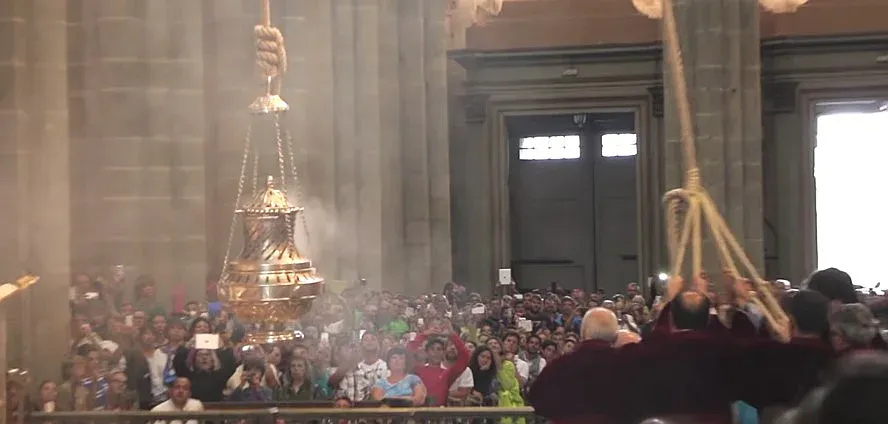
At the end of your tour, return to Rúa do Vilar, where the tour began, and explore the boutiques offering souvenirs and local crafts. Choose a restaurant to enjoy a delicious Galician meal.
PROPERTIES IN SANTIAGO DE COMPOSTELA
Santiago de Compostela, Galicia, Spain
Price on request
Santiago de Compostela, Galicia, Spain
Price on request
Santiago de Compostela, Galicia, Spain
Price
€2,900,000
Santiago de Compostela, Galicia, Spain
Price
€2,600,000
Santiago de Compostela, Galicia, Spain
Price
€2,000,000
A Peregrina, Galicia, Spain
Price
€1,990,000
Contact provider
Page content provided by: Kupula Proyectos e Inversiones SL
License partner of Engel & Völkers Franchise and Trademark GmbH