New
Puerto de la Cruz, Canary Islands, Spain
An exceptional investment opportunity in Martiánez: entire building with five apartments in Puerto de la Cruz
Price
€850,000
- 5 Bedrooms
- 5 Bathrooms
- ~230 m² Living area
- ~143 m² Plot surface
The new GG website: Inspiring personalities, extraordinary places and exceptional properties Discover now
In Tenerife, few family meals end without a plate of papas arrugadas with mojo in the middle of the table. We see it often at Engel & Völkers Puerto de la Cruz and in our Santa Cruz office: many people who come to the island looking for a home ask us where to find good papas con mojo almost before they ask about neighbourhoods.
This guide explains what they are, how to make them at home, how red and green mojo differ, where to buy the best potatoes, and why this simple dish says so much about life in Tenerife.
Table of Content
What are papas arrugadas with mojo?
Papas antiguas: the secret behind the dish
How to make papas arrugadas step by step
Red and green mojo: the sauces for papas arrugadas
Tips for papas arrugadas like a local
Where to eat papas arrugadas with mojo in northern Tenerife
Beyond papas arrugadas: what it is like to live in Tenerife
Living in northern Tenerife with Engel & Völkers
Frequently asked questions about papas arrugadas with mojo
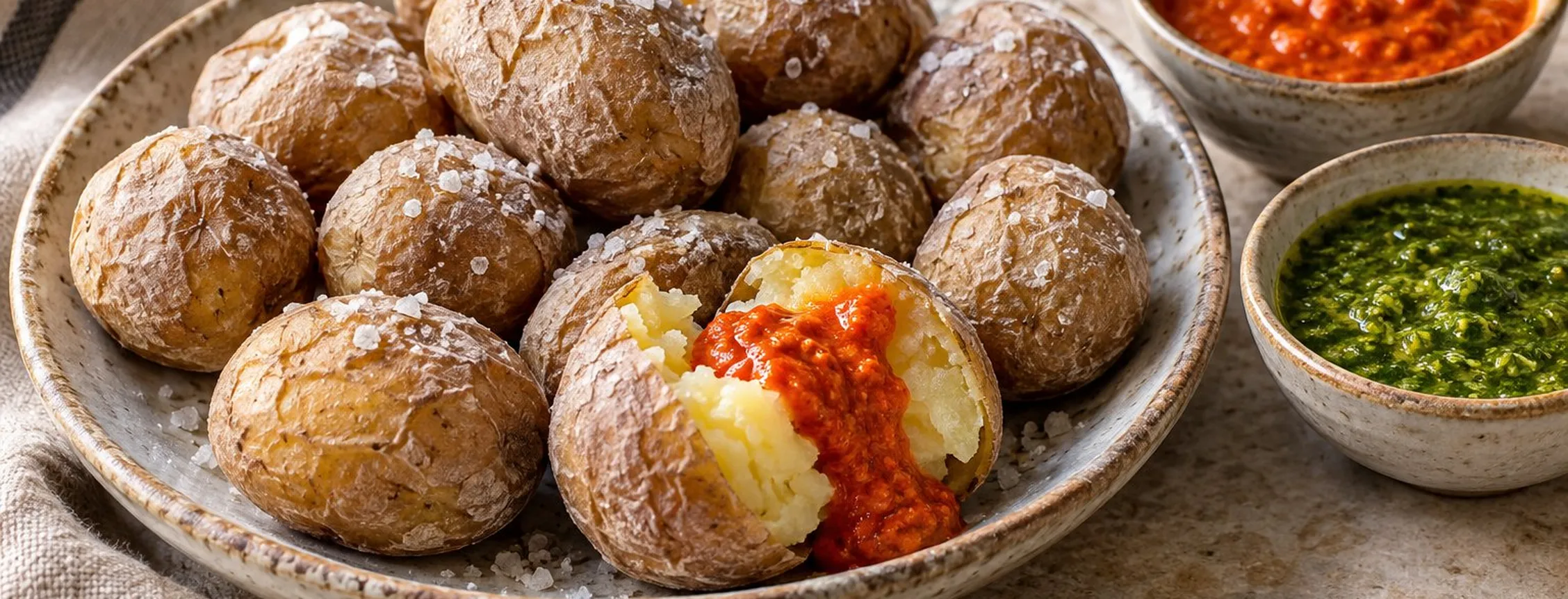
Papas arrugadas, literally “wrinkled potatoes”, are small potatoes boiled in their skins in very salty water. At the end of cooking they are left to dry in the same pot until the skin wrinkles and is coated with a fine white layer of salt.
They are served with mojo, the classic Canarian sauce made with garlic, oil, vinegar and spices. The two most common versions are red mojo, also known as mojo picón, and green mojo.
Tradition has it that farmers and fishermen boiled their potatoes in seawater. As the water evaporated, the salt clung to the skins. Today we use water and coarse salt, but the method is the same one Canarian kitchens have followed for generations.
Not every potato gives the same result. The islands grow papas antiguas de Canarias, heritage varieties that arrived from the Americas in the 16th century and adapted to the volcanic soil. Since 2012 they have held Protected Designation of Origin status.
In Tenerife, the stars are the papa negra, the papa bonita and the papa colorada, with yellow, creamy flesh and a distinctive flavour. The Cabildo de Tenerife describes them in its guide to the island’s heritage potatoes (in Spanish).
The upper slopes of La Orotava, Los Realejos and Tacoronte are potato country. For freshly harvested papas, head to the farmers’ markets, such as the Mercadillo de Tegueste or the Mercadillo del Agricultor de Tacoronte, where you buy straight from the grower and can ask which variety is in season. In Santa Cruz, the Mercado de Nuestra Señora de África is another good option.
Tegueste and Tacoronte are also quiet, rural municipalities, with houses with land and country estates just minutes from La Laguna and Tenerife North airport. A Saturday morning at their markets is a good way to get a feel for life in this part of the island.
This is the traditional way to prepare papas arrugadas with mojo, just as it is done in Canarian homes.
1 kg small potatoes of similar size
150 g coarse sea salt
Water
1. Wash the potatoes well without peeling them. The skin is an essential part of the dish.
2. Place them in a wide pot and add water until they are just covered. Add the coarse salt.
3. Cook over medium heat for 20 to 25 minutes, until a knife slides in easily.
4. Drain off most of the water and return the pot to low heat, uncovered. Shake it now and then until the water evaporates and the potatoes are wrinkled and white with salt.
5. Serve them hot, with the mojos on the side.
Both mojos start from the same base but have different personalities. Red mojo is bolder and can be spicy; green mojo is milder and fresher.
2 dried peppers (pimienta palmera or ñora), seeded and soaked
4 garlic cloves
1 teaspoon cumin
1 tablespoon sweet or hot paprika
100 ml extra virgin olive oil
2 tablespoons vinegar
Coarse salt
Crush the garlic with the cumin and salt in a mortar. Add the pepper and paprika and keep going until you have a paste. Stir in the vinegar, then the oil a little at a time, until the sauce thickens. A blender is quicker, although many Canarian households still prefer the mortar.
It is made the same way, but instead of dried pepper and paprika it uses a bunch of fresh coriander (or parsley) and a small green pepper. It usually goes with fish, but it is just as common with potatoes.
A few details make all the difference:
Use potatoes of the same size so they cook evenly.
Don’t skimp on the salt. It forms the crust and wrinkles the skin.
Make the mojos ahead. A few hours in the fridge improves the flavour.
Eat them with the skin on. That is where the salt, and much of the character, lies.
Papas arrugadas with mojo are on the menu of almost every traditional Canarian restaurant. If you would also like to see how local chefs reinterpret island produce, here are two addresses we like:
Silbo Gomero, in San Cristóbal de La Laguna, a UNESCO World Heritage city. Contemporary Canarian cooking based on local produce (Michelin Guide listing).
El Taller Seve Díaz, in Puerto de la Cruz, a few steps from Plaza del Charco. Tasting menus built around seasonal Canarian ingredients (Michelin Guide listing).
La Laguna and Puerto de la Cruz are also two of the most sought-after places to live in the north. The first combines university life, pedestrian streets and historic houses; the second offers the sea, a seafront promenade and a long international tradition. To see what is available, browse our properties for sale in Tenerife.
People who come for the food tend to stay for everything else. Tenerife is the largest of the Canary Islands and fits very different landscapes and lifestyles into a few kilometres.
Temperatures are pleasant in every season, so you can have lunch on the terrace in January and spend time outdoors twelve months a year.
Mount Teide, Spain’s highest peak, rises above a national park inscribed on UNESCO’s World Heritage List. To the north-east, the Anaga massif, a Biosphere Reserve since 2015, offers trails through laurel forest. The coastline alternates black-sand beaches, natural rock pools and small fishing harbours.
The north, where we work every day, is greener and more traditional: banana-growing valleys, vineyards, villages of Canarian houses and Atlantic views. The south is drier and sunnier, with large resorts and golf courses. In between, Santa Cruz offers the life of a capital city, with a port, culture and shopping.
Two international airports with direct flights to major European cities, international schools and good healthcare make everyday life easy, whether you work remotely, are moving with your family or are looking for a second home.
Papas arrugadas with mojo capture the rhythm of the island well: local produce, long lunches and life outdoors. It is something many of our clients discover once they settle here.
At Engel & Völkers we know the north of Tenerife neighbourhood by neighbourhood: where the best market is, which areas get the most sunshine, or which terrace looks out on Mount Teide. If you are thinking of making the move, our team at Engel & Völkers Puerto de la Cruz will help you find your home on the island.
Why are they called papas arrugadas?
Because when they are boiled in very salty water and dried in the pot at the end, the skin shrinks, wrinkles and is left coated in salt.
Which potatoes are best for papas arrugadas?
Papas antiguas de Canarias, such as papa negra or papa bonita. Outside the islands, small thin-skinned potatoes work well.
What is the difference between red and green mojo?
Red mojo is made with dried pepper and paprika and can be spicy. Green mojo uses coriander or parsley and green pepper, and is milder.
How long does mojo keep in the fridge?
Well covered, about four or five days. The oil helps preserve it.
Puerto de la Cruz, Canary Islands, Spain
Price
€850,000
Puerto de la Cruz, Canary Islands, Spain
Price
€649,000
El Durazno, Canary Islands, Spain
Price
€299,000
Puerto de la Cruz, Canary Islands, Spain
Price
€320,000
Puerto de la Cruz, Canary Islands, Spain
Price
€299,000
San Nicolás, Canary Islands, Spain
Price
€699,000
Puerto de la Cruz, Canary Islands, Spain
Price
€895,000
You may also be interested in
Contact provider
Page content provided by: EV Tenerife Norte S.L.
License partner of Engel & Völkers Franchise and Trademark GmbH