New
- 8 min read
- 4.12.2025
- by Christian Aust
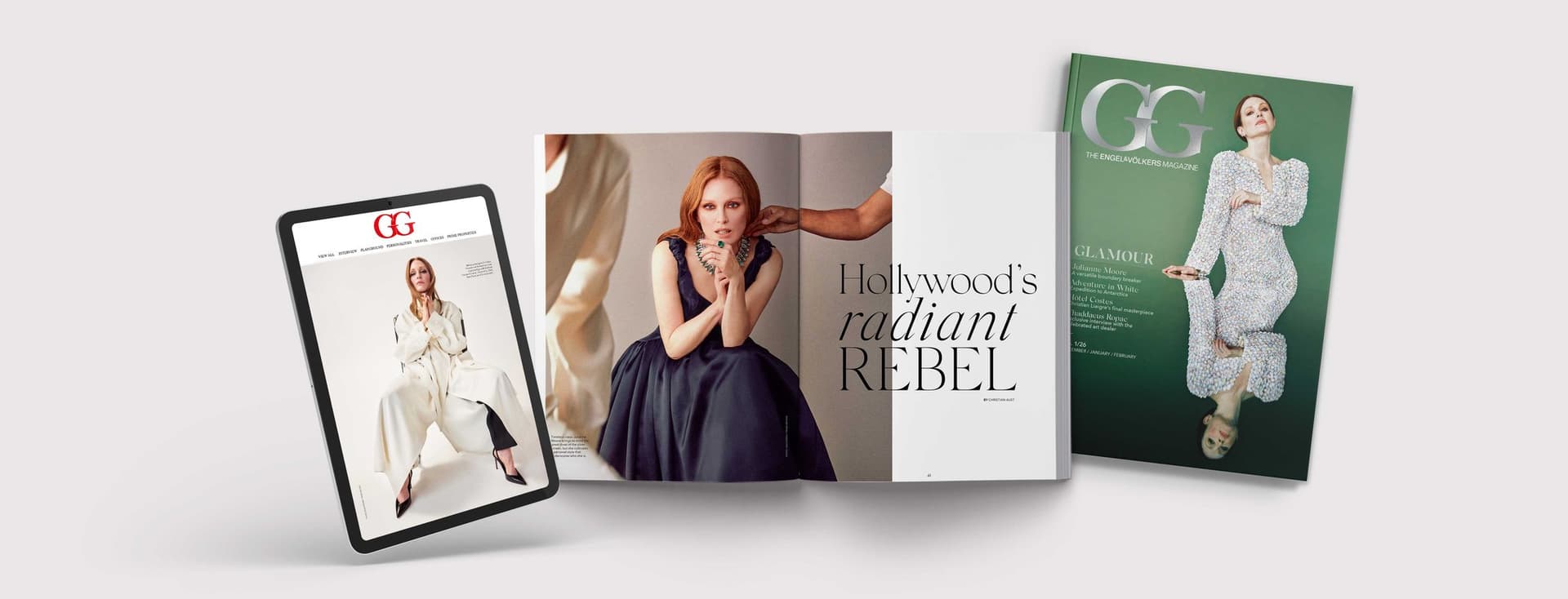
Julianne Moore – Hollywood’s radiant Rebel
Issue
01/26
Location
Los Angeles, California
Photography
Trunk Archive
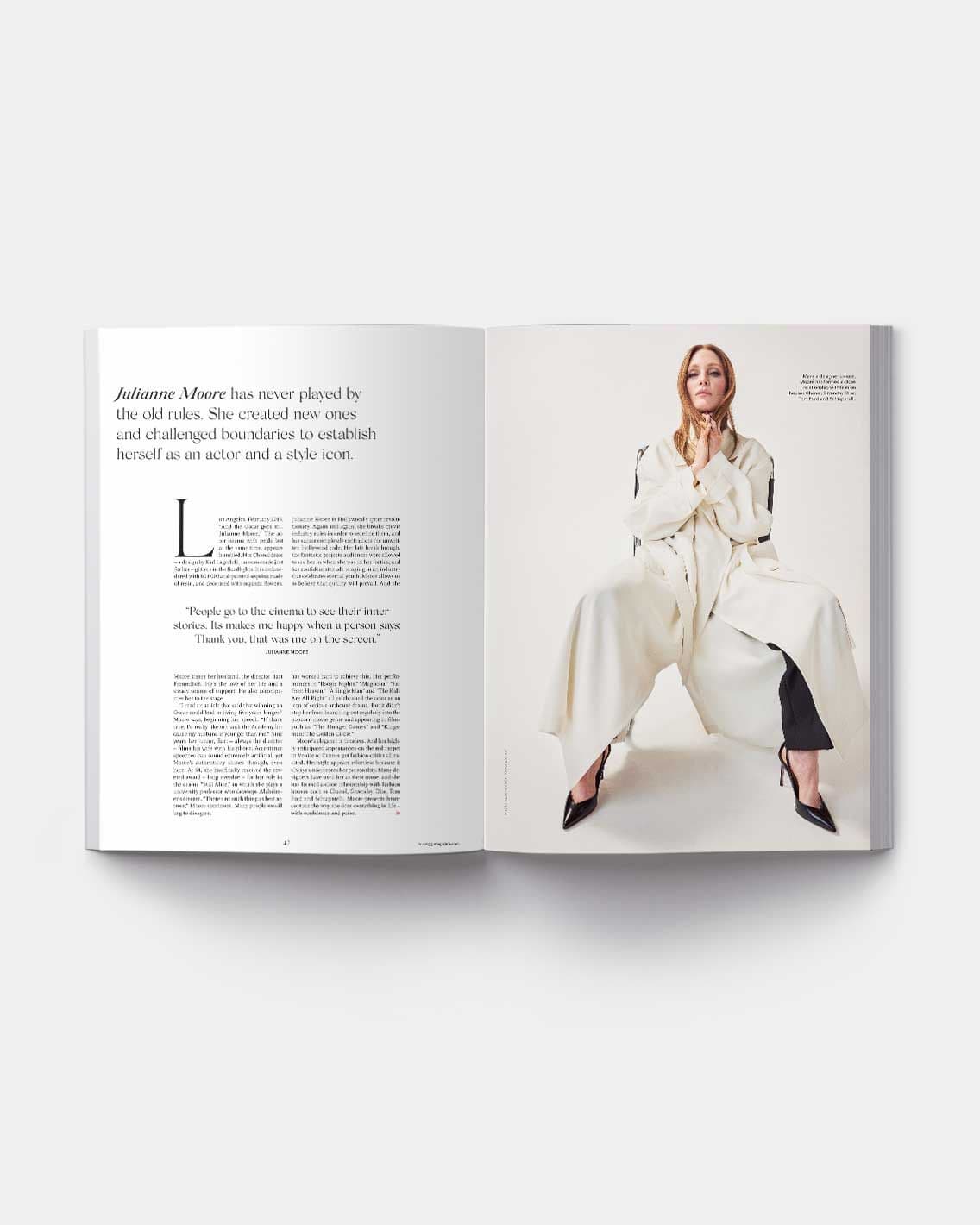
Julianne Moore has never played by the old rules. She created new ones and challenged boundaries to establishherself as an actor and a style icon.
Table of Content
Her most beautiful Hollywood moment
Los Angeles, February 2015. “And the Oscar goes to... Julianne Moore.” The actor beams with pride but at the same time, appears humbled. Her Chanel dress – a design by Karl Lagerfeld, custom-made just for her – glitters in the floodlights. It is embroidered with 80,000 hand-painted sequins made of resin, and decorated with organza flowers. Moore kisses her husband, the director Bart Freundlich. He’s the love of her life and a steady source of support. He also accompanies her to the stage.
“I read an article that said that winning an Oscar could lead to living five years longer,” Moore says, beginning her speech. “If that’s true, I’d really like to thank the Academy because my husband is younger than me.” Nine years her junior, Bart – always the director – films his wife with his phone. Acceptance speeches can sound extremely artificial, yet Moore’s authenticity shines through, even here. At 54, she has finally received the coveted award – long overdue – for her role in the drama “Still Alice,” in which she plays a university professor who develops Alzheimer’s disease. “There’s no such thing as best actress,” Moore continues. Many people would beg to disagree.
People go to the cinema to see their inner stories. Its makes me happy when a person says: Thank you, that was me on the screen.
Julianne Moore
The gentle revolutionary
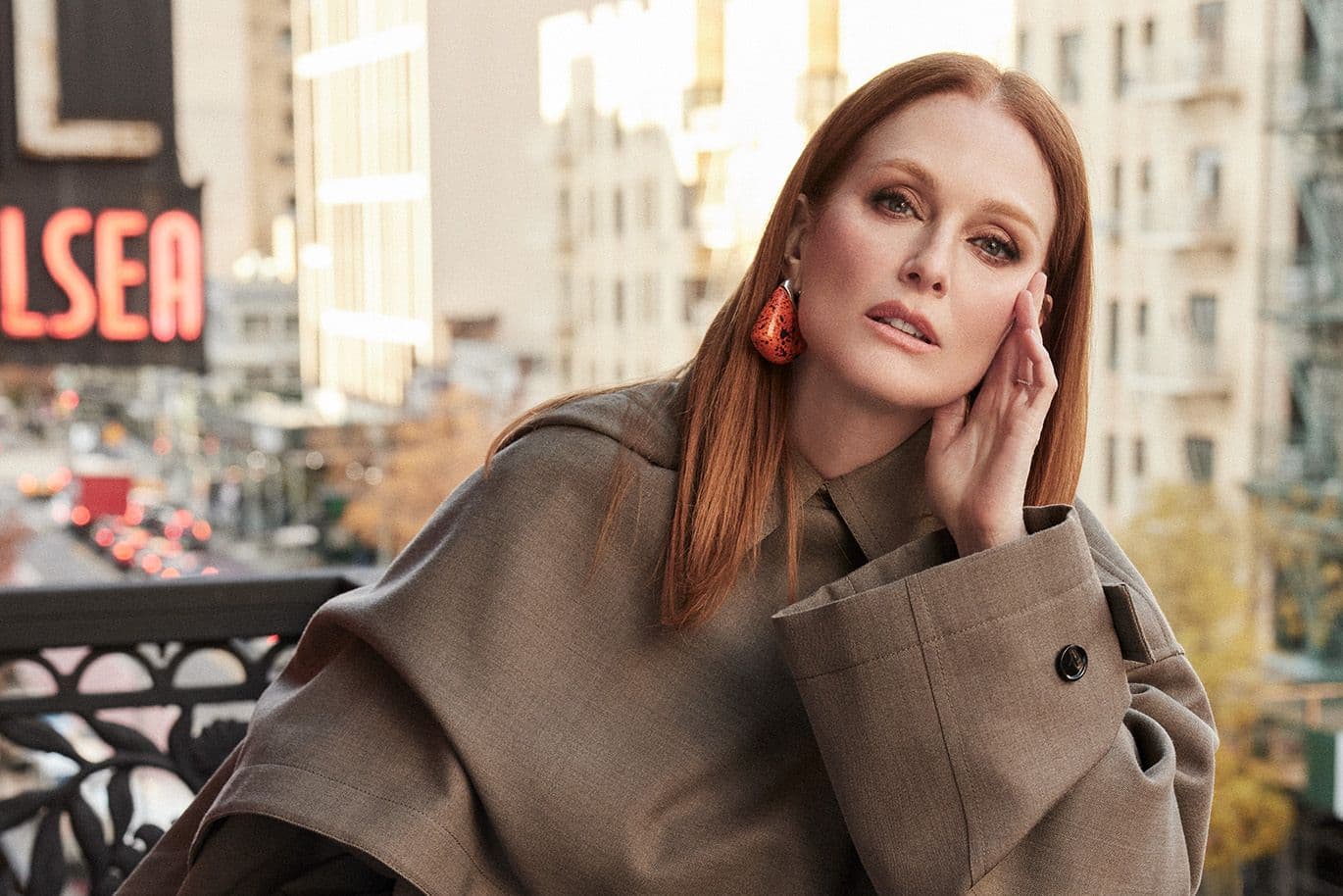
Julianne Moore is Hollywood’s quiet revolutionary. Again and again, she breaks movie industry rules in order to redefine them, and her career completely contradicts the unwritten Hollywood code. Her late breakthrough, the fantastic projects audiences were allowed to see her in when she was in her forties, and her confident attitude to aging in an industry that celebrates eternal youth. Moore allows us to believe that quality will prevail. And she has worked hard to achieve this. Her performances in “Boogie Nights,” “Magnolia,” “Far from Heaven,” “A Single Man” and “The Kids Are All Right” all established the actor as an icon of serious arthouse drama. But it didn’t stop her from branching out regularly into the popcorn movie genre and appearing in films such as “The Hunger Games” and “Kingsman: The Golden Circle.”
Moore’s elegance is timeless. And her highly anticipated appearances on the red carpet in Venice or Cannes get fashion critics all excited. Her style appears effortless because it always underscores her personality. Many designers have used her as their muse, and she has formed a close relationship with fashion houses such as Chanel, Givenchy, Dior, Tom Ford and Schiaparelli. Moore presents haute couture the way she does everything in life – with confidence and poise.

The magic of an encounter
When Julianne Moore steps in front of the camera, the enchantment begins. The onscreen result is pure magic. Emotions intensify in the space between her and the lens. The resulting cinematic experience is filled with intimate moments and gives rise to unforgettable scenes. In movies like “Far from Heaven” and “Still Alice” Moore’s character appears so unguarded that you feel you can see right through to the bottom of her soul.
I have interviewed Julianne Moore quite a few times over the years, but one of my briefest encounters was perhaps the most telling, because it revealed her character in such highly concentrated form.
Location: the third floor of the legendary Carlton Hotel on the Boulevard de la Croisette, during the Cannes film festival. Accompanied by my wife and colleague, I was walking down the corridor on my way to an appointment when the doors of the elevator ahead of us opened and a woman in a wide-brimmed straw hat and big sunglasses stepped out. She had a certain radiance about her, but otherwise, there was nothing that identified her to me at first glance. Probably a film star who doesn’t wish to be recognized, I thought. Just before we turned the corner into another hallway, we heard a voice say: “How nice to see both of you. What a happy coincidence.”
It was Julianne Moore, greeting us as cordially and enthusiastically as if we were the celebrities. And she didn’t even have a film showing at Cannes that year, meaning she was “off duty,” so to speak.
When I discovered acting, it was a small revolution. All of a sudden, there was the path that I wanted to take.
Julianne Moore
Julianne Moore: Intimacy that touches the heart
The warmth and sincerity that she exudes in interviews appears perfectly real, and she has an infectious laugh. This is almost surprising given that so many of the characters she plays are sad. I once asked her in jest if she could even guess how many liters of tears she had shed in front of the camera over the course of her career, and she replied: “Some days I really do ask myself why I’m the one who’s always crying?! It seems to be one of my hallmarks and written into my contract. What’s even worse is when I’m doing a comedy and am still expected to cry. That’s when I say: People, you can’t be serious.”
For an actor, playing very emotional scenes means that audiences often project their dreams and desires onto you. I wanted to know from Moore whether this gave her a good feeling or perhaps made her feel uncomfortable. She considered the question for a moment, then replied: “It’s a fascinating subject, which I think about a lot. I’m very aware that audiences project intimate things – fantasies – onto me as an object. To a certain extent, people go the cinema to see their inner stories play out the screen, which puts a huge responsibility on an actor. It makes me happy after a movie when somebody says: Thank you, that was me on the screen.”
From Frankfurt to the world of film
Her family moved around a lot when she was growing up because her father, Peter, a U.S. military judge, was regularly posted to new places. Julianne had to reinvent herself in each new environment – a solid foundation for her later career. When she was a teenager, her father was stationed in Frankfurt, where she attended the Frankfurt American High School. Moore still speaks a little bit of German and has vivid memories of Germany, as she told me in one conversation: “I loved my time in Frankfurt. And I still remember taking the train through the city and the hearing the announcement: ‘Nächste Haltestelle Marbachweg’ (next stop, Marbachweg). I heard it so often, it burned itself into my brain.”
Originally, Moore had wanted to become a doctor, but luckily for us, she gave up the idea after participating in a number of school plays. Moore once described this as a defining moment in her life: “I was always crazy about reading. I loved books. But honestly, I still had no idea what to do with this passion. When I discovered acting, it was a small revolution. All of a sudden, there was the path that I wanted to take. It changed my whole life.”
Find your dream property in Los Angeles.
Offered properties
- New
- Reserved
- New
- Reserved
- Reserved
37 years old and ready for the breakthrough
She studied acting at Boston University’s College of Fine Arts. After graduating, Julie Anne Smith, as she still called herself, moved to Manhattan, where she found work waiting tables. Later, when she registered with the actors’ union, she put her name down as Julianne Moore. “It’s actually horrible to change your name,“ she said later. “I didn’t want to. But too many actors already had the same name. My father’s middle name was Moore, so I was able to compromise and not hurt my family’s feelings.”
Moore’s first roles were in off-Broadway theaters. Appearances in television and feature films followed. When the legendary director Robert Altman saw her in a stage production of “Uncle Vanya,” the Chekhov classic, he cast her in his ensemble film “Short Cuts.” That’s when the critics started taking note. But Moore’s breakthrough performance as a character actor was in Paul Thomas Anderson’s “Boogie Nights.” She was 37 years old.
Moore earned her first Oscar nomination for her portrayal of porno star Amber Waves in that movie. Now she could pick and choose whom she wanted to work with, and went on to collaborate with directors such as Todd Haynes, Ridley Scott, Pedro Almodóvar and Tom Ford. Four further Oscar nominations followed. Moore also earned ten Golden Globe nominations, winning two of those prestigious awards.
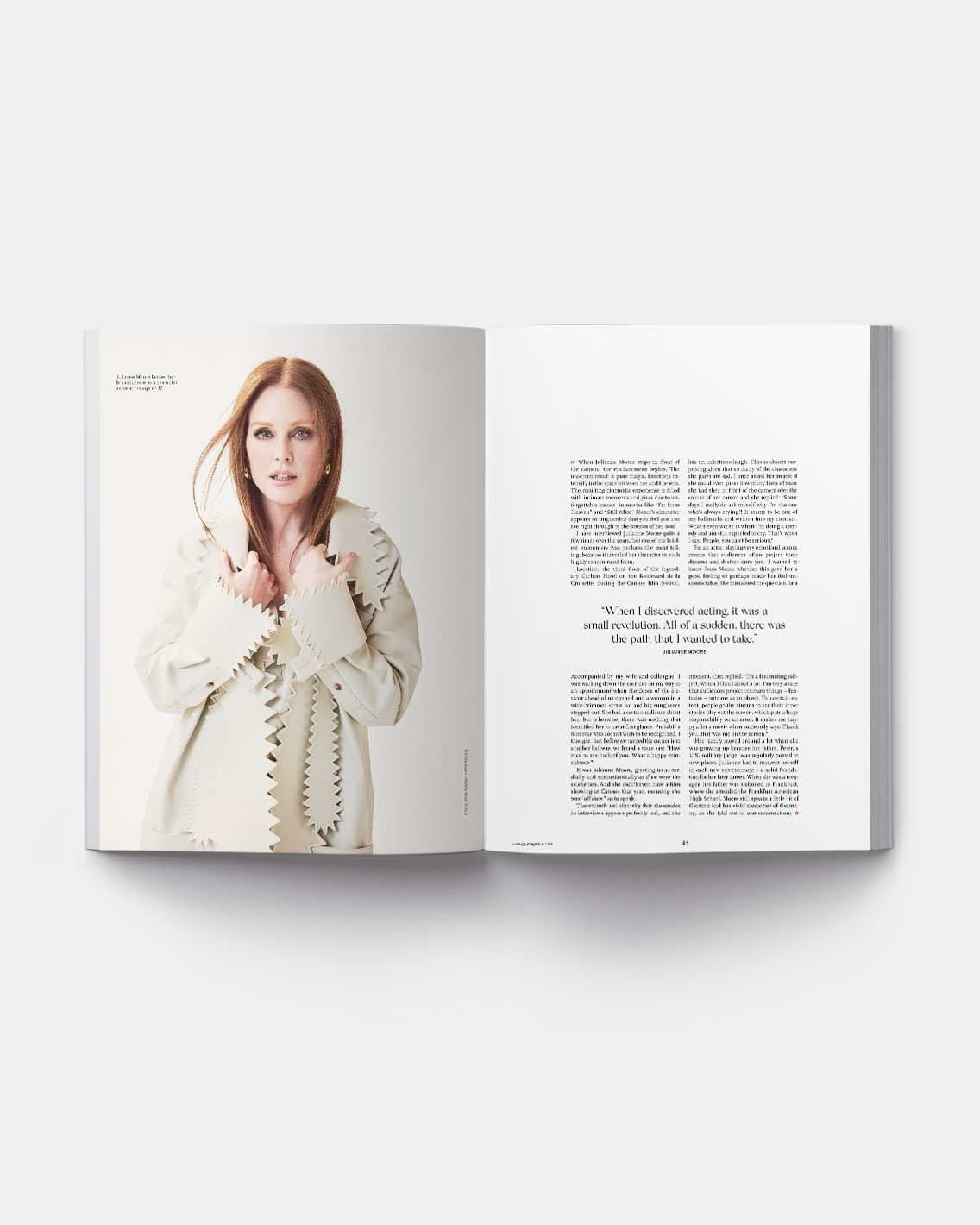
Hollywood star, mum, author: Julianne Moore lives her life
Her red hair and freckles would become her hallmark. “I was teased about my hair and freckles as a child,“ Moore recalls. “Today I can laugh about it, but back then, it hurt.” Her son Caleb inherited her hair color and freckles. When she witnessed him struggling to come to terms with his looks, she decided to write a children’s book, “Freckleface Strawberry” – a semi-autobiographical story about a girl who learns to accept her freckles. Another five Freckleface books followed to make up a series. Moore also wrote a very personal picture book entitled “My Mom is a Foreigner, But Not to Me,” about her late mother, Anne, who had immigrated to the United States from Scotland. “It helped me through the mourning process,” she told me at the time.
When playing a woman with Alzheimer’s (“Still Alice”) or a drug-addicted porno star (“Boogie Nights”) Moore often went to very dark places emotionally. “I imagine how terrible it would be to return home after a day of of work and have nobody be there,” she says. “That would be bad for me. Having the support of my family helps me maintain balance in my life.”
No matter when I’ve seen her in the company of her husband Bart, the two of them always look like they’ve just fallen in love. I once interviewed him about one of his films and got to know him a little bit better. He is a very youthful person who radiates the optimism of a teenager. Moore met him in 1996 while filming “The Myth of Fingerprints,” which he directed. They married in 2003. Their children, Caleb (28), and Liv (23), have embarked on creative paths too: her son is a musician, her daughter, after trying out acting and modeling, is now working with one of the big talent agencies.
The support of my family helps me maintain balance in my life.
Julianne Moore
An icon beyond the red carpets
An important part of Moore’s life balance is the physical distance she maintains from Hollywood and her work. In the U.S., she lives in New York – as far from Los Angeles as she can possibly get. “This job is somehow unreal,” she said when I was interviewing her in Cannes. “There’s something surreal about the whole thing. I feel this way even after all my years in the industry. Just look around you. Movies themselves are somewhat unreal, but this whole situation – my glamorous outfit, it’s just crazy, isn’t it? And then I drive home and change into jeans and a T-shirt. It’s usually lots of fun, but it’s also insane.”
On Instagram, she regularly posts unedited pictures of herself – just as she is, without any makeup. An absolute exception in an industry where Botox treatments and facial cosmetic surgery are the norm. “Okay, so nobody is thrilled about getting wrinkles,” she says. “But a frozen face is even less attractive. I don’t want to see a mask, I want to see a face that’s alive.”
It’s this mindset that has made Moore an icon off the red carpet as well. She’s a woman who associates femininity, elegance and poise not with youth but with authenticity. In the hit Netflix series “Sirens” the 65-year-old plays the ice-cold, manipulative socialite and billionaire’s wife Michaela “Kiki” Kell – and is currently winning over a new, younger audience. As Julianne Moore continues to test boundaries, she shows us that it’s possible to age with confidence without losing radiance or poise.
You may also be interested in
 Philippine Leroy-Beaulieu: “I wish I could have enjoyed that moment sooner.”
 Beaded Beauty – an interview with Marijke de Cock
- 2 min.
- 05.06.2026
 Going deep – an interview with freediver Guillaume Néry
- 2 min.
- 5.6.2026
 Mariko Mori – The Visionary of Light
- 8 min.
- 05.06.2026
 Francis Kéré – What really matters
- 9 min.
- 16.06.2026
 The fashion label Zeus+Dione: Threads of Force
- 5 min.
- 26.05.2026
 The Hand of the Visionary – Designer Kelly Wearstler
- 5 min.
- 14.04.2026
 Art in Karat – Up-and-coming goldsmith Luca Sonnentag on his passion
GG Magazine exclusive content
GG is an independent magazine at the highest level. Exploring the world of architecture, lifestyle, design, fashion, yachting, luxury living and travel. We seek out the most exciting topics and personalities for you and invite you to get to know them from a fresh new angle. In GG, you will meet successful architects, interesting designers and exciting artists who are the talk of the town from London to New York and Berlin to Hong Kong.