- 3 min read
- 05.08.2026
- by Aissatou Frisch-Baldé
Office Real Estate in Berlin's Outlying Areas: Why Rent Reductions Don't Solve the Vacancy Problem
Why across-the-board rent reductions fail and how you should strategically reposition your office space in the market.
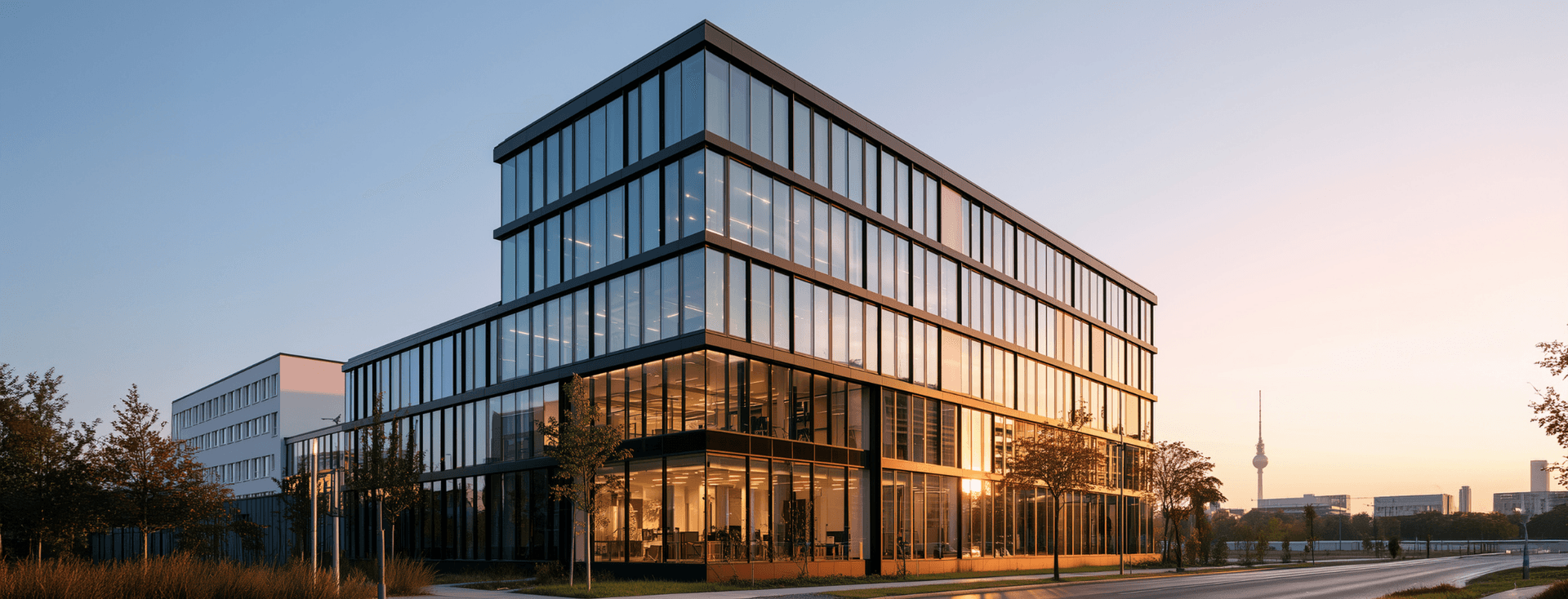
In Berlin’s commercial real estate market, office properties in outlying areas are coming under increasing pressure. Vacancy rates are rising, and it’s taking noticeably longer to lease them. Many owners react instinctively by offering rent reductions. But that is often precisely where the mistake lies.
Traditional single-tenant concepts are losing their appeal outside of the coveted core locations. At the same time, prospective tenants are scrutinizing properties much more closely today. A property in a peripheral location must quickly and clearly demonstrate why it can hold its own in the competition for rental space. The more clearly it succeeds in doing so, the more likely it is to be successfully leased.
Selective Demand Meets Interchangeable Supply
Many office properties no longer have a clear profile and therefore compete almost exclusively on rent. In a Berlin market with selective demand, that simply isn’t enough anymore.
Today, companies evaluate locations in a much more nuanced way:
In addition to location, the quality of the fit-out and flexibility are the primary considerations.
What’s required is a clear benefit in terms of use: Does the location fit the team’s modern way of working?
Vacant Space Becomes Market Position
The central problem for many owners lies in a lack of strategic engagement with their own property. The crucial question is: What role can my building play in the market going forward?
It is precisely this question that is often not asked until the pressure to act is already high. Decisions are then made purely reactively, which increases the risk of poor investments and further prolongs marketing processes.
The 5 Building Blocks for Product Refinement
Not every property in a peripheral location is necessarily attractive to traditional corporate headquarters or particularly image-conscious office tenants. However, it may be of interest to companies that place less emphasis on maximum centrality and instead prioritize, for example, operational efficiency and easy access for employees.
Users want to know whether the space can be adapted as the business grows or downsized, and what standards are already in place. Key factors therefore include the quality of the fit-out, the ability to subdivide the space, technical amenities, and additional services such as reception and food and beverage facilities.
Positioning means establishing a clear market profile: Is the property an efficient workplace for cost-conscious companies? A flexible headquarters for growing teams? An easily accessible location for service-oriented users? Only once this role is clear can the property be marketed in a targeted manner and set itself apart from the competition.
Not every property can be made marketable again using a traditional single-tenant model. Depending on the location, building quality, and tenant profile, smaller units or complementary usage concepts may be more appropriate. It is crucial to conduct a financial analysis of these options well in advance.
Finally, alternative uses should be explored at an early stage. Even if a change of use is not planned in the short term, a thorough analysis creates room for maneuver. Those who wait until vacancy rates are high to begin such assessments often lose valuable time.
Alternative Uses, New Obstacles
When an office property cannot be sufficiently differentiated through traditional marketing, the question of alternative uses quickly arises. On paper, concepts such as furnished housing or long-term care often seem like obvious solutions because they appear to convert vacant office space into new demand.
In practice, however, structural and legal realities determine feasibility:
Building codes & permits: Fire safety, parking space requirements, soundproofing, and building code restrictions can significantly increase project costs or prevent them from moving forward.
Building DNA: Building depth, floor plan structure, natural lighting, and technical infrastructure place tight limits on the scope for action.
What is quickly touted in marketing as a potential for repurposing must be thoroughly examined in advance for the specific property.
Anyone who tries to combat vacancy in Berlin’s outlying office properties by offering rent discounts is merely treating the symptom. Successful marketing doesn’t start with price, but with a clear product focus and flexible space concepts.

Lack of clarity is the real risk
Office leasing in Berlin’s outlying areas is now purely a matter of positioning. Problems arise when a property can no longer provide a compelling reason why a tenant should choose that particular building.
Properties without a clear profile lose bargaining power and, in the long run, value. Successful owners are those who define early on what role their property should play in the market going forward—and use that to develop a robust, marketable product.

Is your office property about to undergo a restructuring?
Uncertainty costs time and rental income. Let’s work together to determine which market role and tenant mix will be the most economically sustainable for your property in Berlin’s outlying areas.
Schedule an initial consultation now