Commercial Property Valuation Across All Sectors
Use our digital valuation tool for apartment-buildings or request a personal consultation for all other asset classes.
Commercial Property Valuation Across All Sectors
Use our digital valuation tool for apartment-buildings or request a personal consultation for all other asset classes.


Commercial Property Valuation Across All Sectors
Valuate commercial real estate
Whether it’s a multi-family building, office complex, logistics property, or hotel, a professional valuation is essential for sound investment decisions. We look beyond square footage and rental income, assessing income potential, market opportunities, and risk factors in equal measure. The result is a clear, reliable basis for buying, selling, or strategically optimizing your property portfolio.
Choose your approach to valuation
Every property type has its own value drivers — from tenant quality and location to operational specifics. That’s why we offer tailored valuation solutions across all investment and commercial real estate. From a fast online initial assessment designed specifically for multi-family properties to a personal expert valuation for every segment. Our expert-led approach covers multi-family buildings as well as complex commercial assets, including office, logistics, retail, and hotel properties.
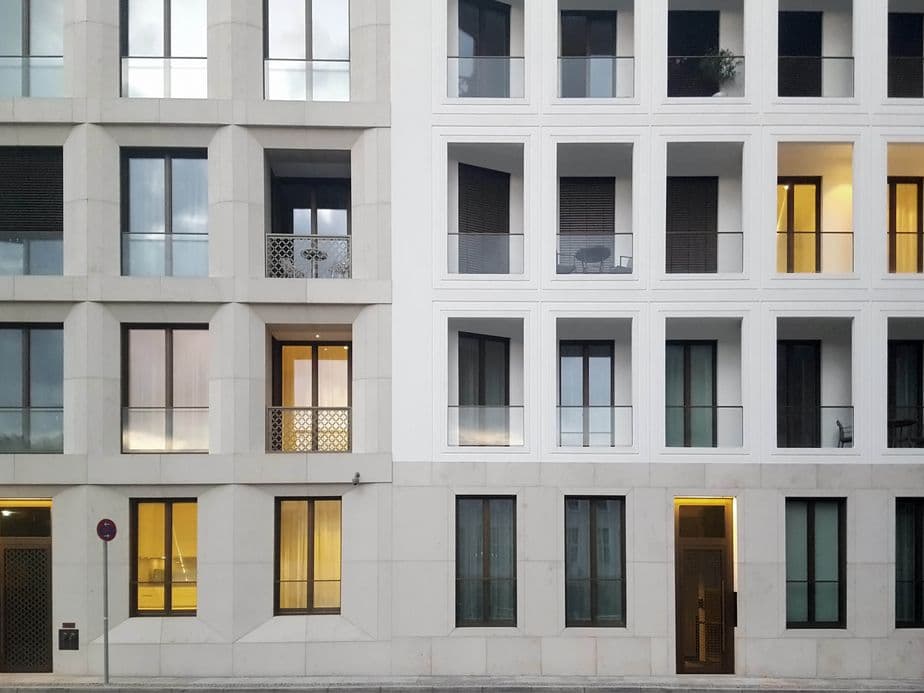

The value of a commercial property is directly tied to the future income it can generate. Accordingly, commercial real estate is primarily valued using the income approach, which bases the assessment on sustainable rental income while accounting for operating costs and property-specific financing expenses.

This is the key factor. We assess lease terms (WALT), tenant creditworthiness, and rent indexation. A secure, predictable cash flow remains the most significant driver of value.

How flexible is your property? Can the office space be easily repurposed? High third-party usability minimizes the risk of vacancies and increases the value.

In commercial real estate valuation, location is synonymous with economic efficiency. It is determined by measurable factors such as direct access to infrastructure (e.g., highways, public transport) and market viability (e.g., foot traffic or logistical advantages).

ESG compliance, particularly energy efficiency, is becoming increasingly critical for the positive value development of commercial properties. Non-compliant buildings may face significant devaluation.
1 out of 4
What you need to know about the valuation of your commercial property
Beyond the key facts — property type, year of construction, size, and rentable area — a valuation also considers individual characteristics that can positively or negatively impact value. These include features such as period details, balconies, apartment layouts, renovation status, heating systems, preservation restrictions, elevators, and full occupancy.
If you own a mixed-use building, the question is how to protect its value while modernizing effectively. Engel & Völkers Commercial provides an initial energy assessment and, if desired, a full optimization consultation through our partner, Purpose Green. They evaluate the building’s energy performance and create a forward-looking renovation plan, prioritizing measures, integrating available subsidies, and showing clearly how value, lettability, and appeal can be enhanced while reducing operating costs.Learn more about the renovation advisory with Purpose Green.
To establish the realistic market value of your multi-family building, it’s essential to include relevant comparable transactions in the analysis. These show the prices and key factors — such as location and condition — at which similar properties are traded. This provides a solid basis for recommending a well-founded price.
The choice of method depends on the type of commercial property. For standard investment assets, such as offices or logistics facilities, the income approach (Ertragswertverfahren) is the primary method. For leased operator-run properties, rent serves as the income metric. For complex investments and international investors, the discounted cash flow (DCF) method is standard. We apply the method best suited to your property to ensure a precise, reliable valuation.
Valuing commercial real estate is far more complex than residential properties. Factors such as alternative use potential and detailed lease analysis require specialized expertise. In addition, municipal planning regulations, tax frameworks, and market trends must be accurately accounted for to determine a realistic property value.
A commercial property valuation provides a strategic basis for your sales or financing decisions. A full, legally binding expert appraisal (according to § 194 BauGB) is prepared by a certified surveyor and is required for legal proceedings or specific documentation obligations. We guide you on which type of assessment best suits your needs.
Expected returns on commercial properties depend heavily on location, asset class, property quality, and tenant creditworthiness. There is no one-size-fits-all figure, as yields can vary significantly — for example, between core assets and value-add investments. Anticipated returns are therefore closely tied to your chosen investment strategy. We provide comprehensive advice and outline all options for your investment.
Taxes are a critical factor in valuation. Unlike private assets, which often benefit from a 10-year exemption, commercial properties are usually classified as business assets. Gains (“hidden reserves”) are therefore almost always taxable upon sale. An accurate valuation is essential for effective tax planning, helping to optimize your tax burden and structure reinvestment strategies, such as those under § 6b EStG.
Your Shop

Page content provided by: Engel & Völkers Franchise and Trademark GmbH