- 4 min read
- 16.09.2026
- by Rackham F. Schröder
Stefan Evers in conversation with Rackham F. Schröder
Berlin’s Senator for Finance and the Berlin CDU’s lead candidate for the 2026 House of Representatives election speaks on security, education, housing, the economy and the strategic direction to be taken in the forthcoming election.
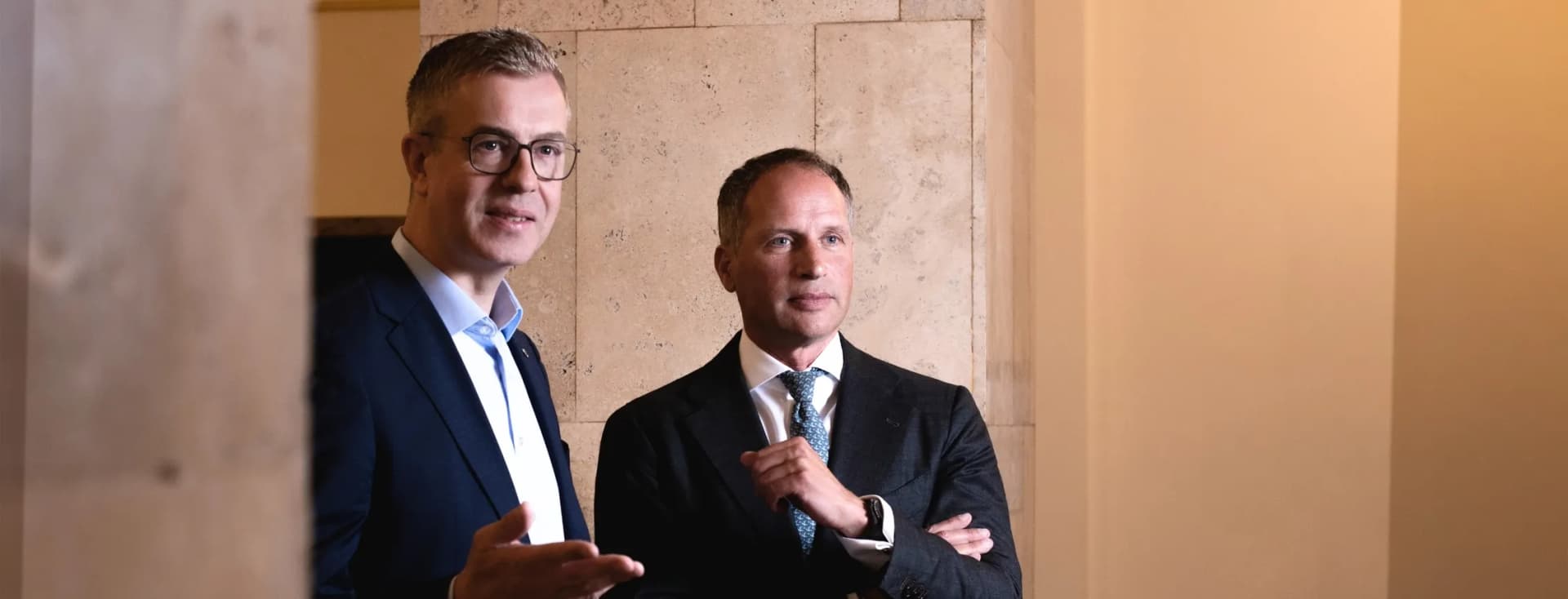
Rackham F. Schröder talks to Stefan Evers about the Berlin CDU’s track record, necessary reforms and his vision for the city’s future. The discussion focuses on specific measures to tackle crime and littering, strengthening Berlin as a centre of education, speeding up housing construction and the capital’s economic development.
Many citizens feel they have lost confidence in the state’s ability to take effective action. Specifically, with regard to the growing city of Berlin, this concerns the Senate’s ability to take effective action.
On some issues, we do not see the improvement we had hoped for: to put it bluntly, cleanliness, crime – including clan-related crime – and homelessness in the city seem to be getting worse rather than better. Why is it so difficult to get these issues under control, and what will the CDU do better?
Stefan Evers: Trust is built when the state functions effectively in everyday life. That has not always been the case in Berlin. In just three short years in government, we have proved that change is possible even in difficult times: appointments at the Citizens’ Office are once again available at short notice; we have strengthened the police; and the number of criminal offences is at its lowest level in ten years. But of course there is still a great deal to be done.
We must tackle the littering of the city. Berlin is too dirty; that really grates on me. We have stepped up our efforts to keep the city clean: we have drastically increased fines for litterers and expanded checks. We are also taking decisive action against organised crime groups, particularly where it hurts them most: their finances. The total value of illegally obtained assets seized has risen from just under five million euros in 2023 to just under 22 million euros in 2025. My aim is clear: Berlin must be a clean, safe and well-functioning city. That is what people expect of us.
Education: We read that over 30 per cent of primary school pupils prioritise Sharia law over the Basic Law. How alarming is that? And what are the key priorities in education in general? We need excellence if we are to compete at national and international level. If the CDU shares this view, how do we get there?
Stefan Evers: If young people prioritise religious rules over the rules of our constitutional state, then something is going thoroughly wrong. Schools must equip children and young people for the future. For me, this includes imparting the fundamental values of our society. Respect for one another and for our free and democratic order must be at the heart of this. I also advocate for religion as a compulsory elective subject. This would allow, for example, Islamic religious education to take place under state supervision and be taught by state-certified teachers. And we must also strengthen the authority of our teachers. Where boundaries are crossed, tangible consequences must follow immediately.
At the same time, we must not reduce education to merely tackling problems. Berlin must have the ambition to be among the best once again. We are now a rising star in nationwide educational comparisons. This shows that change is possible. We must build on this.
For me, education means, above all, social advancement through one’s own achievements. It should make no difference whether a child grows up on Sonnenallee or on the Ku’damm.
Property: How will the CDU help to ease the situation on the housing market? How will the CDU support home ownership for broad sections of the population? In your view, does Berlin need more supply or more regulation?
Stefan Evers: Berlin needs one thing above all else: more affordable housing. This can only be solved by building more homes. To do this, we need faster planning permissions, less bureaucracy and reliable conditions for state-owned companies, housing co-operatives and private investors. The city’s population has grown by around 240,000 people in the last ten years, yet the current vacancy rate stands at just 1.6 per cent. That is far too low for a healthy housing market.
We have passed the Faster Building Act and the Simpler Building Act, and streamlined the building regulations. With success: after eight years of decline, the number of building permits is rising significantly once again. This must continue. Expropriations, such as those planned by the Left Party, would, by contrast, be devastating for tenants. They do not create a single new flat, cost billions and ultimately lead to rising rents.
I therefore say quite clearly: we must make use of every opportunity for housing construction – rooftops, infill development, the conversion of office buildings, new neighbourhoods and also the edge of Tempelhofer Feld. There, 50,000 Berliners could be provided with an affordable home, whilst 200 hectares in the centre would be preserved as open space. That is equivalent to the size of the whole of Monaco.
Business hub: If you were only allowed to implement three measures to boost Berlin’s economy, what would they be?
Stefan Evers: Three things. Firstly, cutting red tape. I want to turn the principle on its head: it is not the removal of regulations that needs to be justified, but their continued existence. Secondly, making it easier to invest – through faster approvals, digital procedures and a reliable regulatory framework. Thirdly: strengthening education and the skilled workforce. Berlin has more than 5,000 start-ups, and in 2025 the economy grew by 1.1 per cent – significantly faster than the national average. We have enormous potential. Berlin must be a city where entrepreneurs and investors with a good idea are asked: ‘How can we make this happen quickly? Where can policymakers provide support?’
Election campaign: Many centre-right voters fear that fragmentation across the political spectrum will ultimately favour left-wing majorities. How do you view this argument? And what would you say to a frustrated CDU voter who is toying with the idea of voting for the AfD instead?
Stefan Evers: Berlin is facing a decisive election. This election is about whether the CDU or a radical Berlin Left will move into the Rotes Rathaus. The polls show that every single vote really does count.
The Berlin Left wants to abolish the Office for the Protection of the Constitution; it courts those who are hostile to the police and those who hate Jews within its ranks; it wants mass expropriations, thereby jeopardising investment and housing construction. Such people must not be allowed to call the shots in our city of freedom. Anyone who shares this view must vote for the CDU this time.
But for me, there is much more at stake. The CDU is not just a bulwark against political extremes. It is the force that can and will hold Berlin together and drive it forward. We cannot work magic, but we will work with all our might. I’m not promising castles in the air. I promise to identify problems clearly, to take the necessary decisions and to stand by my word. The Berlin CDU has shown in a very short space of time what is possible, even in difficult times. I am convinced that Berlin’s best years are still ahead of it. That is what I want to work towards – and that is why I am campaigning for every single vote.

Rackham F. Schröder
In conversation with Stefan Evers, it became clear that the answers to Berlin’s major issues do not lie in individual measures, but in a long-term strategy for the development of our capital. Regardless of one’s political perspective, one thing is certain: a strong city requires open dialogue between politics, business and society. Only by clearly identifying problems and consistently implementing solutions can Berlin continue to build on its reputation as one of Europe’s most important cities. I would like to thank Stefan Evers for the frank discussion and for sharing his vision for Berlin’s future.
Editor’s note
This dossier is intended to provide information and context on housing, economic and urban development policy issues in the context of the 2026 Berlin elections. The content, analyses and assessments presented herein do not claim to be exhaustive and do not constitute a voting recommendation or an endorsement of any particular party or candidate. The aim is to provide an objective presentation and analysis of political positions, as well as their potential implications for the Berlin property market and Berlin as a business location.