Urban logistics and light industry in Berlin remain in demand
Why new-build projects are stalling, why demand for last-mile services is growing – and what opportunities this presents for investors and property owners.
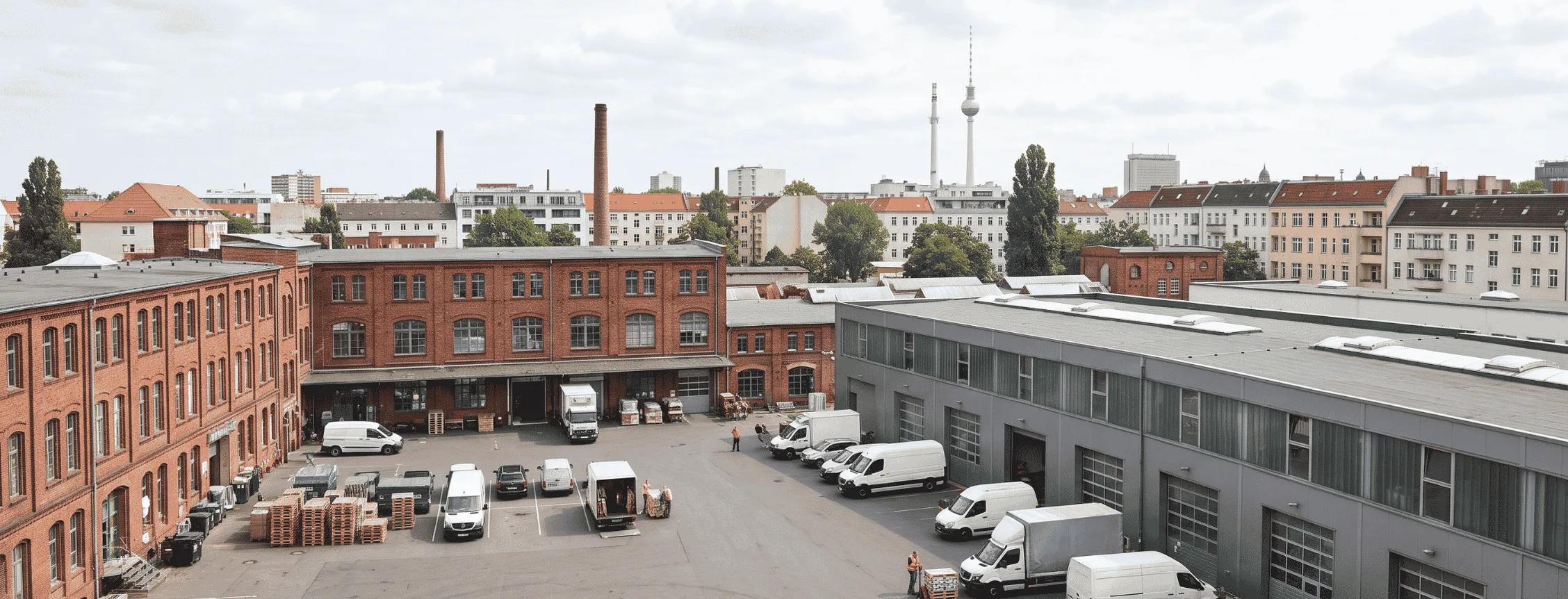
In Berlin, demand for commercial and logistics space close to the city centre significantly outstrips the available supply. This shortage is set to become even more acute in the coming years. This opens up new strategic opportunities for investors and owners of industrial estates.
Why inner-city logistics space in Berlin remains in short supply
High financing costs, rising construction costs and tight budgets are currently holding back many property development projects. For urban logistics and light industrial use in Berlin, this reluctance has a direct consequence: in the coming years, fewer new sites will come onto a market where inner-city locations are already in short supply.
At the same time, demand is growing for short delivery routes, rapid supply and services close to the city centre. For investors and project developers, therefore, it is not just a question of how challenging a development is today. Equally important is the question of what market a project will face upon completion.
Large logistics properties are more likely to find alternative locations on the outskirts or in the surrounding areas. For urban logistics and many light industrial uses, however, proximity to customers and operational sites is a key location factor.
This applies to the last mile as well as to time-critical deliveries and service chains. The further a site is from inner-city destinations, the longer the distances and response times become. A site outside Berlin is therefore only a limited substitute for a suitable location within the city limits.
Within the city limits, however, supply is limited. New plots for logistics, industrial estates and light industrial use are rarely coming onto the market. This high barrier to market entry strengthens the position of existing sites and suitable development areas.
Today’s construction activity determines tomorrow’s supply
Several years elapse between the purchase of a plot and the completion of a project. Investors must therefore look beyond the current market phase.
If projects are postponed due to high interest rates or construction costs, the corresponding sites will be lacking later on. Projects that are being pursued today are likely to face less new competition upon completion. If demand for logistics and commercial sites close to the city remains high, the choice available to users will continue to narrow.
This does not mean ignoring current costs and risks. Financing, construction costs and project duration must still be calculated on a viable basis. However, the foreseeable supply at the end of the development phase must also be factored in. Particularly in the case of inner-city sites where land cannot easily be expanded, this factor can be the deciding factor for an investment.
Existing commercial properties are gaining in importance
The market is not limited to undeveloped plots. Commercial estates, as well as existing industrial and logistics properties, can also be of interest to investors and developers.
Depending on the property, repositioning, infill development or more intensive use may be options. This gives existing properties access to a market segment in which new sites rarely emerge.
For owners, this raises the question of whether the current use still fully reflects the value of the site. A commercial estate that has been used in the same way for many years may now be of interest to different groups of buyers than it was a few years ago. Development potential can also influence the valuation.
A market price assessment should therefore not only take into account the existing buildings and rental income. Equally relevant are the location, the current use and the potential of the site.
Anyone investing in urban logistics or light industrial property in Berlin today is not basing their calculations on today’s market, but on tomorrow’s scarce supply. As new-build projects are currently being postponed and inner-city land is virtually impossible to expand, existing properties and industrial estates with potential for redensification or repositioning are gaining significant strategic value.

What property owners should consider now
Four questions in particular are helpful for an initial assessment:
Is the current use still appropriate for the location and in line with demand?
Are there areas that could be used more intensively or redeveloped?
Is the property suitable for repositioning?
How do investors and property developers assess these opportunities in the current market?
The answers will help determine whether it makes sense to sell, develop the property yourself or hold on to it. Particularly in a market with few available sites, it is worth carrying out a valuation that looks beyond the current portfolio.
What is your plot of land or commercial property worth?
Do you own a commercial plot, a commercial estate or a light-industrial property in Berlin? Engel & Völkers Commercial Berlin assesses how location, existing structure, current use and potential development prospects influence the current market value of your property.
You can request a free market valuation via the contact form.