
Get Your Free Investment Guide
Learn how to maximise returns and make informed decisions in Dubai’s property market.
The new GG website: Inspiring personalities, extraordinary places and exceptional properties. Discover now
Key Takeaways:
Dubai’s property market has entered a more balanced phase during 2026, with transaction volumes slowing while prices have remained comparatively resilient.
Short-term geopolitical uncertainty has affected buyer sentiment, but long-term economic and population growth continue to support demand.
Strong rental yields, international investor demand and tighter market regulation distinguish today’s market from previous speculative cycles.
Engel & Völkers helps buyers make informed, data-led investment decisions based on long-term market fundamentals.
Property prices in Dubai have experienced exceptional growth over the past five years, prompting many investors to ask the same question: is Dubai’s real estate market entering a bubble, or is the market simply evolving into a more balanced phase?
During the first half of 2026, Dubai recorded 80,509 residential sales worth AED 226.5 billion, making it the second strongest first half on record by sales value. However, activity moderated from the exceptional levels seen in 2025, buyers became more selective and price performance became increasingly varied by location and property type.
While this has inevitably fuelled speculation about a potential market correction, today’s market differs significantly from previous speculative cycles. Stronger regulation, a broader buyer base, continued population growth and healthy rental demand all provide important context.
Although nobody can predict future price movements with certainty, understanding these underlying fundamentals provides a far more useful perspective than reacting to short-term headlines.
In this guide, we examine the latest market trends, historical cycles and economic factors shaping Dubai real estate in 2026, helping investors distinguish normalisation from genuine bubble risk.
Table of Content
Historical Context: Dubai Real Estate Market Trends
Is Dubai’s Property Market Cooling in 2026?
Factors Driving Stability in Dubai’s Real Estate Market
Research Supporting Dubai’s Long-Term Market Strength
Dubai’s Resilience in Weathering Global Economic and Political Challenges
The Impact of Government Regulations and Vision 2040
How Dubai’s Real Estate Market is Positioned for Long-Term Growth
Conclusion: Is Dubai’s Real Estate Market in a Bubble?
Dubai’s real estate market has witnessed remarkable volatility, marked by periods of rapid growth and dramatic drops in both prices and transaction volumes.
2002-2008: The introduction of freehold property laws saw rapid price growth driven by foreign investment and development.
2008-2009: Global financial crisis led to a sharp downturn until April 2009.
2011–2014: Following several challenging years, prices began to recover as investor confidence returned. The lead-up to Dubai’s successful bid for Expo 2020 also fueled optimism, pushing prices up significantly, which some considered a Dubai real estate bubble.
2015–2019: As supply increased, market growth moderated, with prices seeing gradual declines - further impacted by macroeconomic factors, including low oil prices and global uncertainties.
2020-2025: Following an initial slowdown during the pandemic, Dubai experienced one of the strongest property market recoveries globally. Prices rose significantly between 2021 and 2025, supported by population growth, international investment and limited supply in key communities.
2026: During the first half of 2026, the market entered a more balanced phase, with transaction volumes moderating and price growth stabilising rather than continuing its rapid upward trajectory.
Following several years of exceptional growth, Dubai’s property market has entered a more measured phase during 2026.
Transaction volumes have slowed as buyers adopt a more cautious approach amid heightened geopolitical uncertainty and a growing pipeline of new supply. At the same time, price growth has moderated after reaching record highs across much of the emirate.
Importantly, slower transaction activity should not automatically be interpreted as evidence of a speculative bubble. Historically, transaction volumes often respond more quickly than prices as buyers take longer to make purchasing decisions and sellers adjust their expectations.
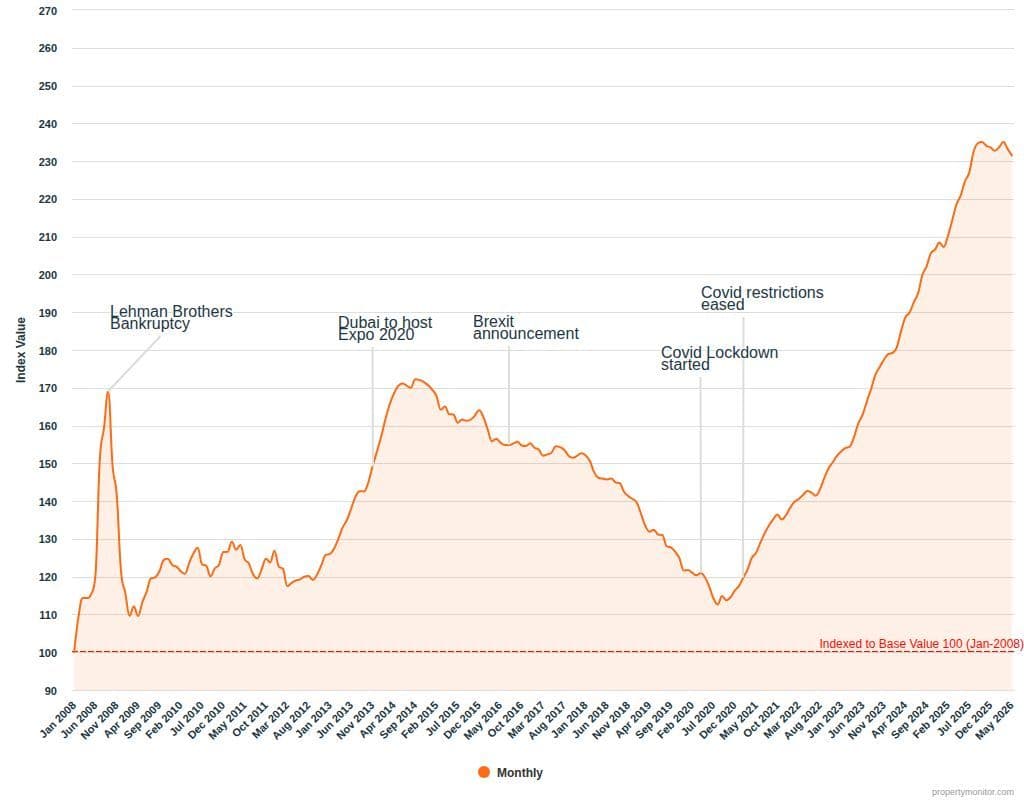
Property Monitor’s House Price Index illustrates this trend clearly. Average prices remained comparatively resilient during H1 2026, with performance increasingly varying by community and property type rather than showing the broad-based declines associated with previous market crashes.
While individual communities and property types continue to perform differently, the overall market today appears to be transitioning towards a more sustainable pace of growth rather than showing widespread signs of distress.
In recent years, Dubai’s real estate market has demonstrated remarkable growth and stability, driven by several crucial factors. These include population and economic growth, investor confidence, and government policy.
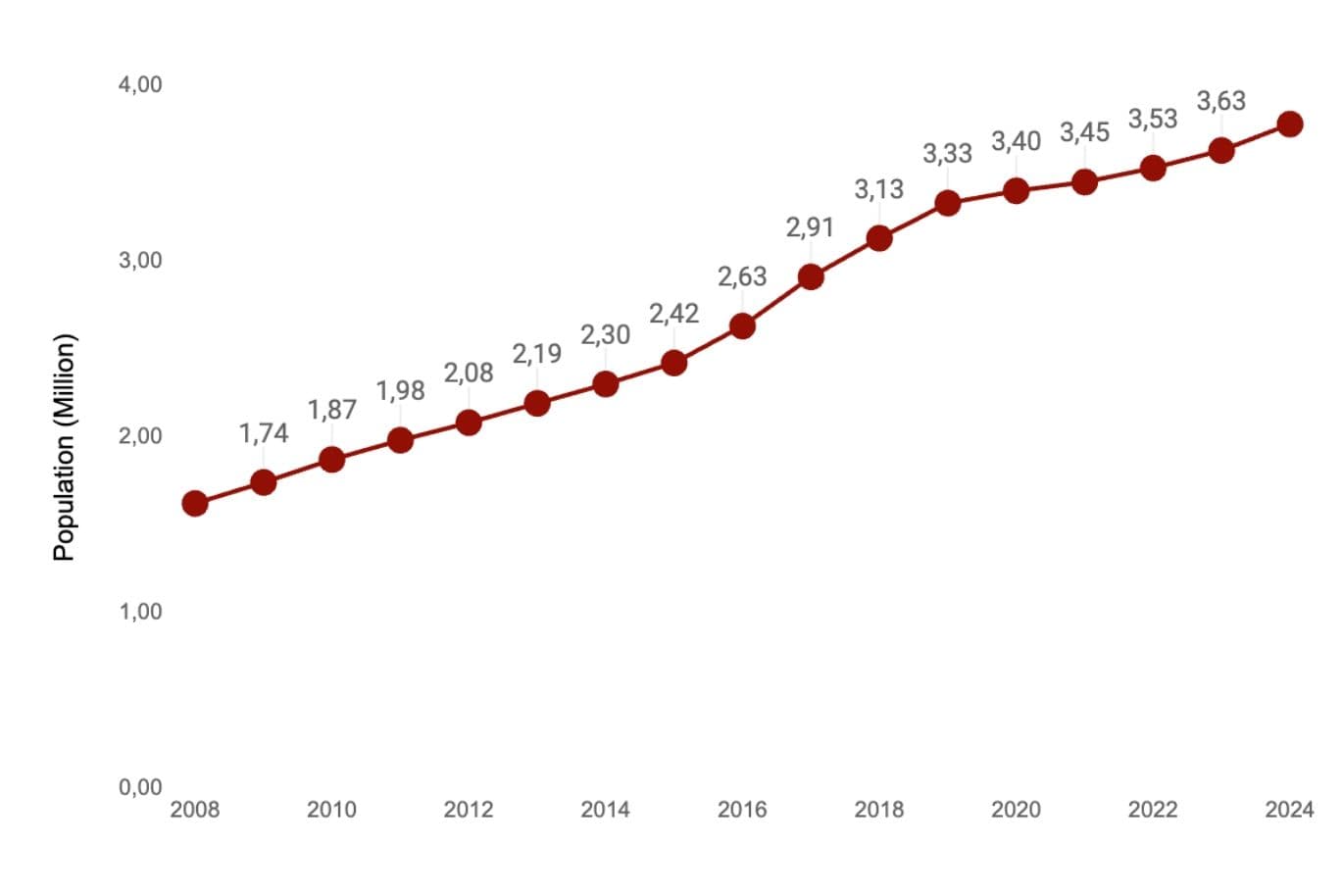
Launched by the UAE government in March 2021, the Dubai 2040 Urban Master Plan aims to balance urban areas and expand green spaces whilst ensuring excellent accessibility across the emirate. Dubai’s population officially surpassed 4 million residents, driven largely by the continued influx of expatriates moving to the city for economic opportunities.
With Dubai's population expected to continue growing in 2026, and the Emirate targetting a population of 5.8 million by 2040, the master plan is designed to accommodate growth in a sustainable manner, thereby enhancing the quality of life for all residents. It is underpinned by five key pillars: population and economic growth, land use, lifestyle, tourism, and sustainability, ensuring that every aspect of Dubai’s development is carefully considered.
Source: Dubai Land Department
Although supply is increasing across many communities, Dubai’s rapidly growing population continues to underpin long-term housing demand, helping absorb new development over time.
Dubai’s economy is expected to experience slower growth during 2026 following heightened geopolitical uncertainty across the region. However, both the World Bank and International Monetary Fund continue to forecast healthy economic expansion over the medium term, reflecting the UAE’s diversified economy, strong fiscal position and resilient financial system.
This longer-term economic outlook continues to support employment, inward investment and population growth, all of which underpin demand for residential property.
As of August 2026, the average rental yield for residential properties stood at 6.3% across Dubai. Apartments averaged 6.7%, compared with 5.1% for townhouses and 4.5% for villas. Actual returns vary significantly by location, purchase price, service charges and property type.
While investor sentiment has become more measured during 2026, Dubai continues to attract buyers from around the world thanks to competitive pricing, attractive rental yields, favourable tax policies and long-term growth prospects. The market has become increasingly diverse, with owner-occupiers, long-term investors and international residents representing a broad range of demand.
Dubai attracts a global audience of investors, residents, and second-home buyers. Its reputation as a thriving hub for business, tourism, and luxury living ensures demand comes from various sources. Whether European buyers seeking tax-free havens, Asian investors drawn by the strategic location, or residents upgrading their homes, Dubai's real estate market benefits from diverse demand streams.
Introducing favourable economic policies, including golden visas for property buyers, has boosted investor confidence. These measures encourage long-term residency and investment in Dubai, strengthening the market’s resilience against external shocks. Following the previous Dubai real estate bubble, the government implemented stringent laws and regulations to manage growth, protect investors, and create an efficient and transparent real estate market.
One of the clearest ways to assess whether a market is entering bubble territory is to examine how prices are behaving over time.
According to Property Monitor’s House Price Index, Dubai’s residential market experienced exceptional price growth between 2021 and 2025 following the pandemic, supported by strong population growth, international investment and a surge in demand from overseas buyers.
During the first half of 2026, however, the market has entered a more balanced phase. While transaction activity has slowed and price growth has moderated, average property prices have remained relatively resilient, stabilising after reaching record highs rather than experiencing the sharp declines typically associated with speculative market bubbles.
This distinction is important. Historically, periods of slowing transaction volumes do not necessarily signal a market crash. Instead, they often reflect changing buyer sentiment while sellers gradually adjust pricing expectations.
Source: Property Monitor
Although regional geopolitical uncertainty has created short-term economic headwinds during 2026, leading international institutions continue to project healthy medium-term growth for the UAE economy.
The World Bank forecasts that UAE GDP growth will moderate during 2026 before strengthening again over the following two years, reflecting the country’s diversified economy, strong sovereign balance sheet and continued investment in infrastructure and private sector development.
Similarly, the International Monetary Fund expects the UAE economy to accelerate beyond 2026 as regional conditions stabilise and non-oil sectors continue expanding.
For real estate investors, this is significant. Property markets ultimately depend on economic activity, employment, business confidence and population growth. While geopolitical events may temporarily affect sentiment, the underlying economic outlook continues to provide support for Dubai’s long-term housing market.
Looking at Dubai’s property market through a longer-term lens provides valuable context for today’s conditions.
Over the past two decades, Dubai has successfully navigated several major global events, including the Global Financial Crisis, the oil price downturn, the COVID-19 pandemic and periods of international geopolitical uncertainty. While each created temporary disruption, the market consistently adapted and returned to growth as economic conditions improved.
Research published by Engel & Völkers, Two Decades of Growth and Resilience, highlights how Dubai has evolved from an emerging property market into one of the world’s most internationally connected real estate destinations. Since the introduction of freehold ownership in 2002, sustained population growth, economic diversification, international capital inflows and pro-investment government policy have fundamentally reshaped the market.
The report also highlights that Dubai’s average residential prices have more than doubled since 2008, despite multiple periods of global disruption, while the city’s population has grown from around one million residents in the early 2000s to more than four million today. These structural drivers continue to underpin long-term housing demand.
Rather than being defined by short-term market cycles, Dubai’s property market has increasingly demonstrated the characteristics of a mature international real estate market, responding to global events while remaining supported by long-term economic and demographic fundamentals.
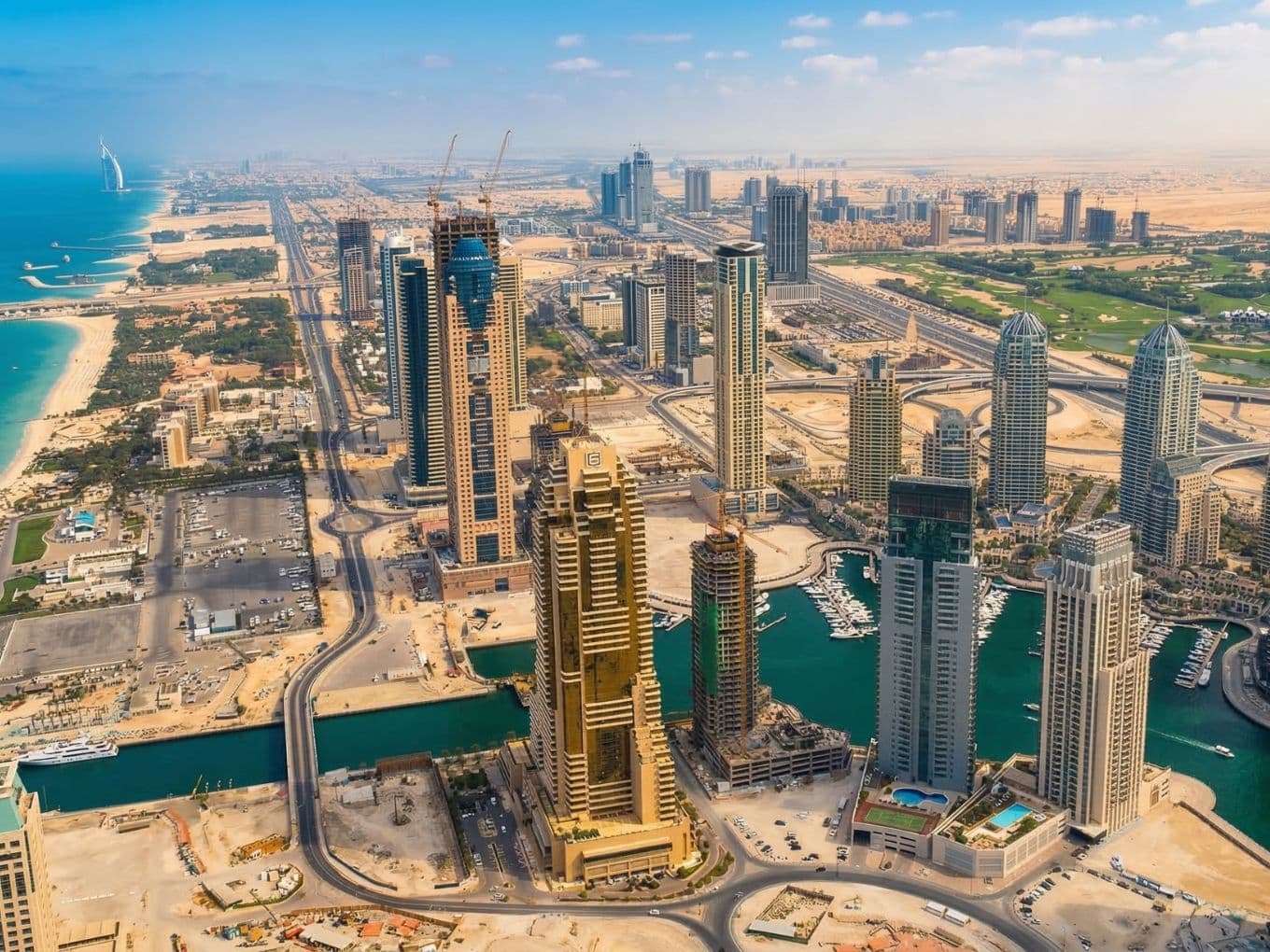
The first half of 2026 has undoubtedly marked a shift in market conditions. Transaction volumes have slowed, buyers have become more selective and price growth has moderated following several years of exceptional expansion.
However, the latest market evidence suggests this represents a period of normalisation rather than the emergence of a speculative property bubble. Strong economic fundamentals, continued population growth, attractive rental yields and ongoing government reforms continue to support Dubai’s long-term investment case, even as the market transitions towards a more balanced phase.
Get Your Free Investment Guide
Learn how to maximise returns and make informed decisions in Dubai’s property market.
Rather than being immune to global events, Dubai has consistently demonstrated an ability to recover from periods of uncertainty. The emirate’s economy has been tested by the global financial crisis, periods of oil price volatility, the COVID-19 pandemic and more recent geopolitical uncertainty across the region.
Each of these events affected sentiment and market activity in different ways. However, Dubai’s long-term growth trajectory has remained supported by economic diversification, infrastructure investment, population growth and its position as a global hub for trade, tourism, finance and technology.
For property investors, this distinction matters. Short-term uncertainty can affect transaction volumes and buyer confidence, but it does not automatically undermine the structural drivers that support long-term housing demand.
Dubai’s reputation for safety and security remains one of the city’s strongest advantages. For many international residents, families and high-net-worth individuals, the emirate offers a combination of political stability, personal safety, high-quality infrastructure and international connectivity.
This has helped Dubai attract residents from across Europe, Asia, the Middle East, Africa and the Americas. In turn, this diverse resident base supports demand across a wide range of property segments, from prime waterfront villas to apartments in established residential communities.
Dubai’s geographic position between Europe, Asia and Africa continues to strengthen its role as a global business and lifestyle destination. Dubai International Airport, Jebel Ali Port and the city’s wider transport infrastructure support trade, tourism, logistics and international mobility.
This connectivity is an important part of Dubai’s real estate appeal. The property market does not rely on local demand alone. It benefits from a broad international audience of residents, investors, entrepreneurs and companies using Dubai as a regional or global base.
Dubai’s government has repeatedly introduced policies designed to support economic growth, attract international talent and improve market resilience. These include long-term residency initiatives, investor-friendly business reforms, infrastructure investment and regulatory measures designed to improve transparency in the property sector.
During periods of uncertainty, this ability to respond quickly has helped reinforce confidence. Government policy remains one of the key factors distinguishing Dubai from less regulated or less institutionally developed emerging real estate markets.
Dubai’s lifestyle offering continues to play a major role in long-term demand. The city combines beaches, restaurants, shopping, entertainment, international schools, healthcare, business infrastructure and global connectivity in a way that appeals to both residents and investors.
This lifestyle appeal is not just a luxury market driver. It supports demand from professionals, families, entrepreneurs and long-term residents who increasingly view Dubai as a place to live, work and build wealth rather than simply as a short-term investment destination.
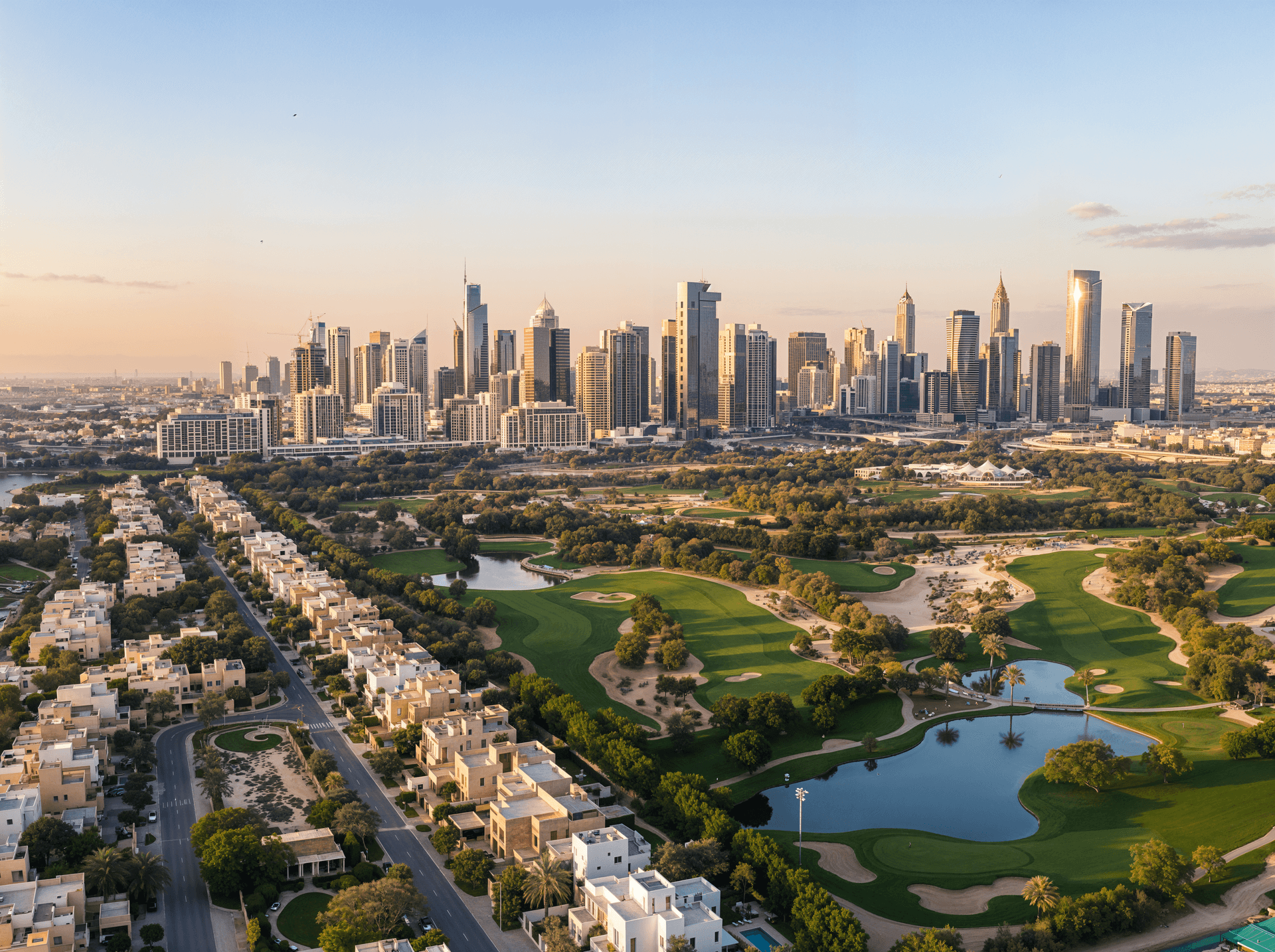
Excessive speculation is one of the clearest warning signs of a real estate bubble. When buyers purchase property primarily for short-term resale gains, often with high levels of leverage, markets become more vulnerable to sharp corrections if sentiment changes.
Dubai has experienced speculative market conditions in the past, most notably before the global financial crisis. Since then, the regulatory environment has become significantly more mature. Measures such as higher transaction fees, tighter mortgage loan-to-value ratios, escrow requirements for off-plan projects and stronger oversight of developers have helped improve transparency and reduce excessive leverage.
These measures do not remove market risk entirely. However, they make today’s market structurally different from the conditions that existed before previous downturns.
Dubai’s favourable tax environment remains a major attraction for international investors. The absence of personal income tax, capital gains tax and annual property tax, combined with relatively low holding costs, continues to support the emirate’s appeal compared with many other global property markets.
This does not mean investors should ignore service charges, financing costs or transaction fees. However, Dubai’s overall tax position remains one of the reasons the market continues to attract global capital.
Dubai has continued introducing policies designed to support long-term market growth and improve accessibility for buyers. Recent changes to property-linked residency rules have broadened eligibility for certain international buyers, making ownership more accessible across a wider range of property values and investment profiles.
These reforms support Dubai’s wider objective of attracting talent, capital and long-term residents. They also help broaden the buyer base, particularly in mid-market and more accessible communities where end-user and investor demand remain important.
In 2025, Dubai Land Department and Dubai Department of Economy and Tourism launched the First-Time Home Buyer Programme to make ownership more accessible and support long-term market health.
The initiative offers eligible UAE residents priority access to selected new launches, preferential pricing on properties up to AED 5 million and tailored mortgage options through partner banks. By encouraging more residents to move from renting to owning, the programme is designed to support a broader and more sustainable ownership base.
Dubai’s Urban Master Plan 2040 is designed to support the emirate’s continued population and economic growth while improving quality of life. The plan aims to accommodate a population of 5.8 million by 2040 through better land use, enhanced infrastructure, increased green space and improved connectivity.
Prioritising green spaces
Enhancing public transport and connectivity
Supporting innovation and smart technologies
Improving access to housing
Creating more sustainable and liveable urban communities
For the property market, Vision 2040 provides a long-term planning framework that supports continued development while helping Dubai evolve into a more mature and balanced global city.
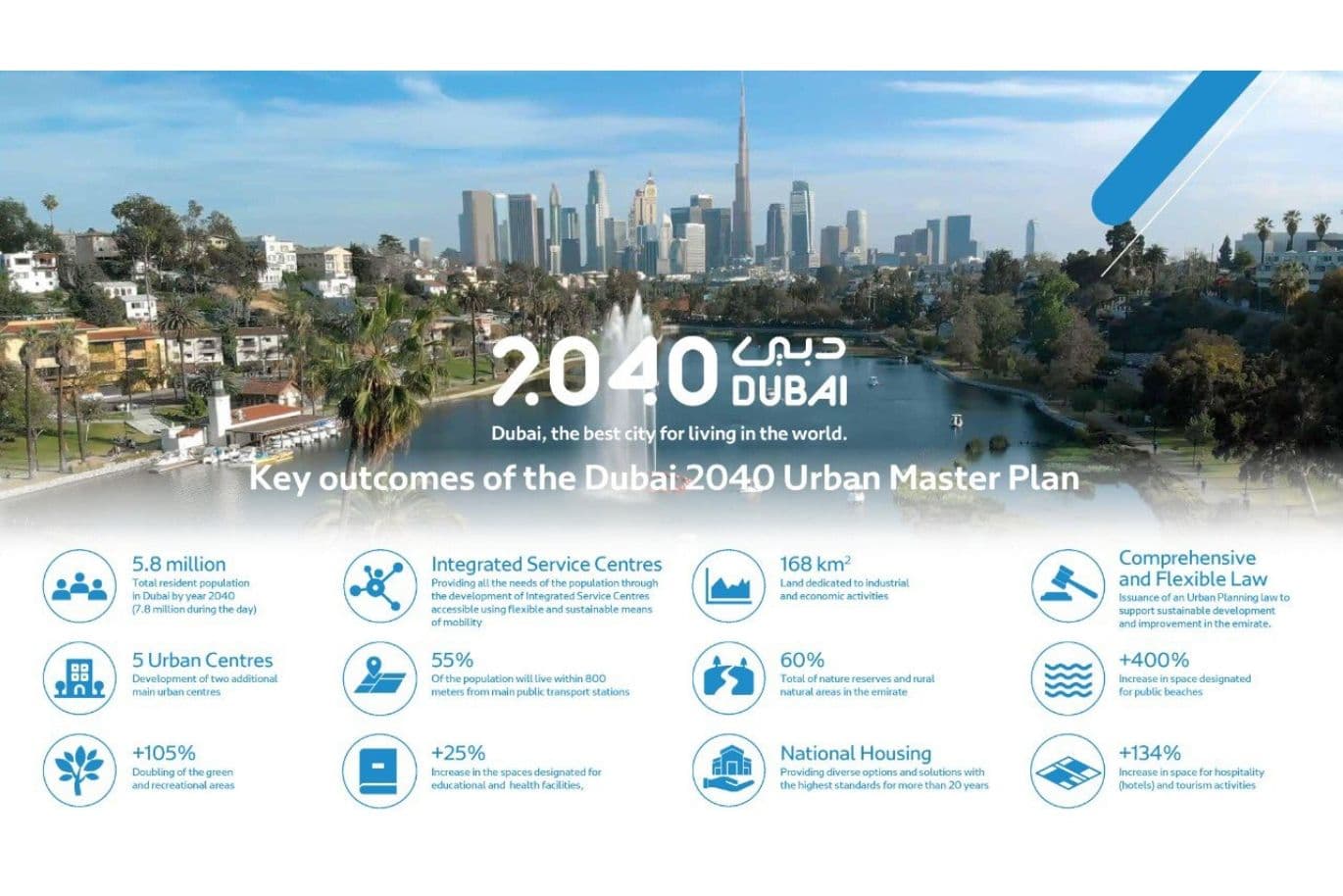
Source: Dubai Media Office on X
Investors and residents should assess Dubai’s property market through both short-term and long-term lenses. The first half of 2026 has shown that sentiment can change quickly, especially after a period of exceptional price growth. However, several structural factors continue to support Dubai’s long-term outlook.
Dubai’s economy is supported by a diverse mix of industries, including trade, tourism, aviation, logistics, finance, technology and professional services. This diversification has reduced the emirate’s reliance on oil and made the economy more resilient than many regional markets.
Continued government investment in infrastructure, business reforms and global connectivity also supports employment, business formation and population growth. These are all important drivers of residential property demand.
One of the defining features of Dubai’s next property cycle will be increased supply. A significant development pipeline is expected across a range of communities, from established prime locations to emerging suburban districts.
This additional supply may moderate price growth in some areas, particularly where new handovers compete directly with existing stock. However, increased supply also helps accommodate Dubai’s expanding population and reduces the risk of severe undersupply.
For investors, this means asset selection becomes increasingly important. The strongest long-term performance is likely to come from well-located properties with strong rental demand, quality construction, sensible service charges and access to transport, amenities and employment hubs.
Dubai’s luxury real estate segment has seen extraordinary growth in recent years, driven by demand from high-net-worth and ultra-high-net-worth individuals. Areas such as Palm Jumeirah, Emirates Hills, Jumeirah Bay Island, Dubai Hills Estate and Downtown Dubai continue to attract global buyers seeking lifestyle, security, connectivity and long-term wealth preservation.
Although luxury demand can fluctuate with global sentiment, Dubai’s position as a global wealth hub remains a major long-term advantage. The market’s appeal extends beyond investment returns, with many buyers choosing Dubai for residency, family relocation, tax efficiency and lifestyle.
Dubai continues to attract international capital from a diverse range of markets. Buyers from Europe, Asia, the Middle East, Africa and the Americas view the city as a stable, globally connected destination with a favourable business and tax environment.
This diverse buyer base helps reduce reliance on any single nationality or investor group. It also supports liquidity across different property segments, from prime villas to mid-market apartments.
Dubai has placed increasing emphasis on sustainability, smart infrastructure and future-focused urban planning. Developers are incorporating more energy-efficient design, smart home technologies, community amenities and wellness-focused features into new projects.
As buyer expectations evolve, sustainability and build quality are likely to become more important differentiators. This is another sign of market maturity, as investors increasingly focus on long-term usability, operating costs and quality rather than short-term capital appreciation alone.
Dubai’s property market has clearly entered a different phase during 2026. After several years of exceptional growth, transaction activity has slowed, buyers have become more selective and price growth has moderated. However, this should not be confused with the conditions typically associated with a speculative real estate bubble.
Unlike previous cycles, today’s market is supported by stronger regulation, sustained population growth, healthy rental demand, a diversified economy and a broader international buyer base. Prices may soften or remain relatively flat in some areas, particularly where new supply is increasing or asking prices have moved ahead of buyer expectations, while higher-quality and more supply-constrained segments may continue to perform more strongly.
The most likely outlook is a more selective market. Buyers are taking longer, value matters more and investors need to pay closer attention to location, build quality, service charges, rental demand and future supply.
For investors, the focus should be less on trying to predict the exact top or bottom of the market and more on identifying quality assets supported by sustainable long-term demand. Location, build quality, service charges, rental demand and future supply are likely to become increasingly important as the market becomes more selective.
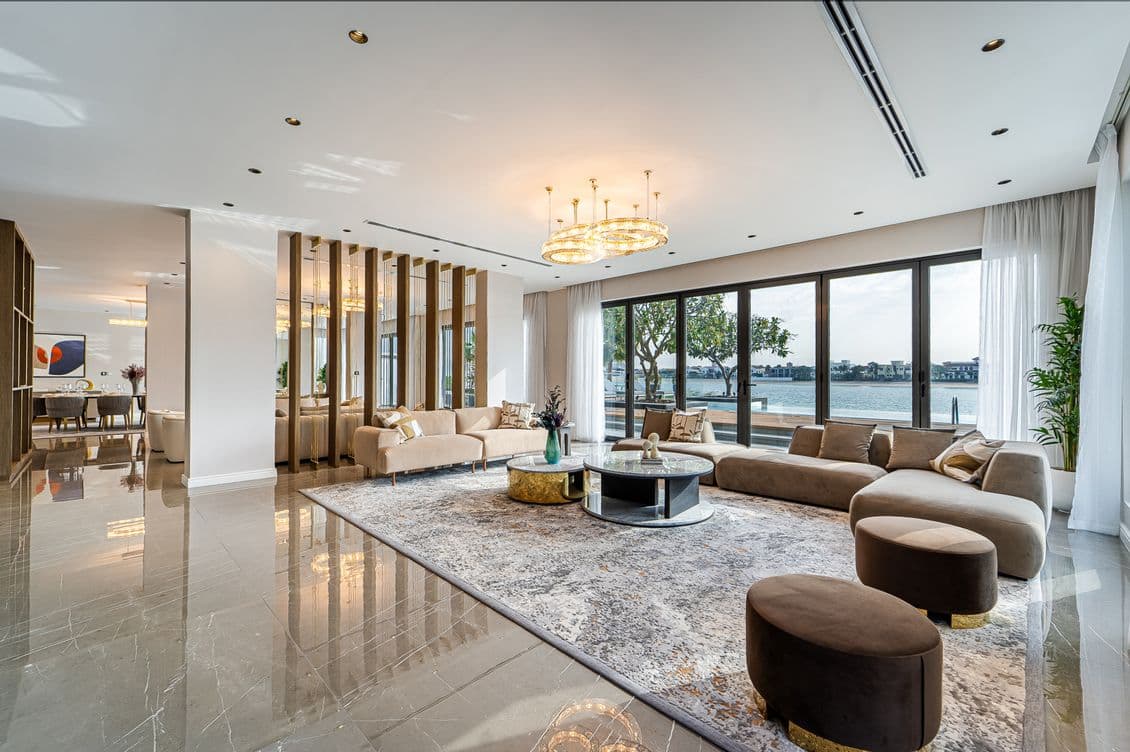
Make informed property decisions in Dubai
Understand the market, compare opportunities and invest with confidence with guidance from Engel & Völkers Dubai.
Dubai’s property market has cooled during 2026, but slower transaction volumes and moderating price growth do not indicate a speculative bubble. The market remains supported by population growth, economic diversification, rental demand and stronger regulation than in previous cycles.
A market-wide crash is not the base-case outlook. Some communities may experience price weakness, especially where supply is increasing or seller expectations remain too high. However, prices have so far shown more resilience than transaction volumes, suggesting a period of normalisation rather than a sharp collapse.
Transactions have slowed because buyers have become more cautious following several years of rapid price growth and a period of heightened geopolitical uncertainty. Increased supply and more selective investor behaviour have also contributed to a slower pace of decision-making.
Today’s market is more regulated, more transparent and less dependent on highly leveraged speculative buying than it was before the global financial crisis. Dubai also has a larger population, a more diversified economy, stronger infrastructure and a broader base of international buyers.
Dubai can still offer attractive opportunities for investors, particularly because of its rental yields, tax environment, population growth and international appeal. However, investors should be more selective in 2026 and focus on quality assets in locations with strong long-term demand.
Established communities with strong end-user demand, limited quality supply, good amenities and strong connectivity tend to be more resilient. Prime and mature areas may perform differently from emerging communities with larger pipelines of new supply, so investors should assess each location individually.
Investors should focus on location, rental demand, developer reputation, build quality, service charges, payment structure, future supply and resale liquidity. In a more balanced market, asset selection matters more than broad market momentum.
For buyers with a long-term view, a more balanced market can create better opportunities than a fast-rising market. There may be more room for negotiation and more choice, but buyers should avoid overpaying and should assess each property based on realistic rental yields and long-term fundamentals.
You may also be interested in




Natalie White
Natalie White is Head of Brokerage – Secondary Sales at Engel & Völkers Dubai, overseeing the company’s secondary residential sales business. Working in Dubai real estate since 2015, she has completed more than 300 transactions and developed extensive expertise across Dubailand and the wider residential market. Natalie combines hands-on market knowledge with a clear, service-focused approach, supporting clients through complex property decisions while also providing leadership and strategic direction to Engel & Völkers Dubai’s secondary sales team.
Contact



Engel & Völkers Dubai
7th Floor, Al Khail Plaza
Jumeirah Village Triangle, Dubai, UAE
Tel: +971 4 4223500