
Industrial & logistics properties in Berlin
The new GG website: Inspiring personalities, extraordinary places and exceptional properties. Discover now.
Inheriting real estate sounds simple: draw up a will, transfer the assets, done. In reality, however, the process is far more complex – especially when significant values are involved. At our event “Passing on Real Estate Smartly,” notaries Axel Sawal and Dominik Schüller explained why traditional solutions such as the “Berlin Will” are often insufficient, and what effective, forward-looking succession planning can look like.
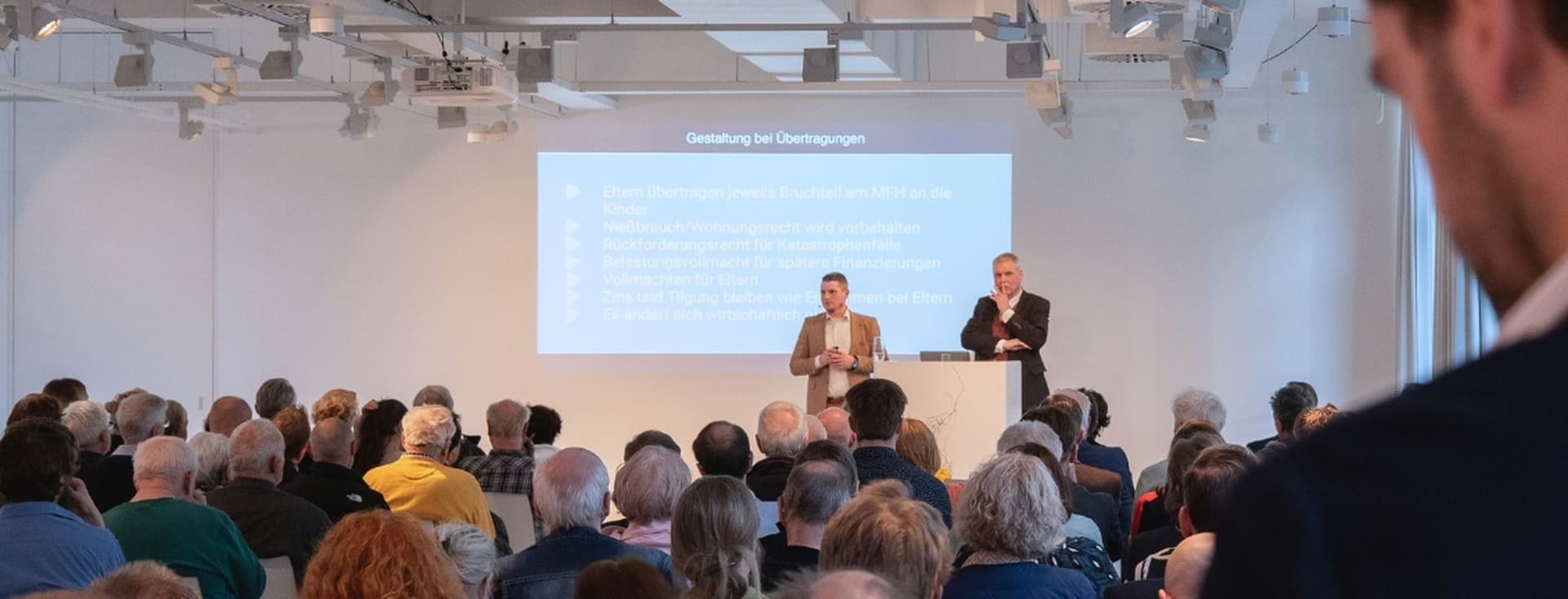
Real estate is often the most valuable component of private wealth. Those who fail to plan ahead miss opportunities to achieve significant tax savings or to protect heirs from unnecessary financial burdens. In particular, the widely used “Berlin Will” entails risks when it comes to preserving tax allowances or making effective use of available structuring options.
At the event, Axel Sawal and Dominik Schüller presented practical courses of action for transferring real estate more intelligently—while avoiding disputes and tax pitfalls.
In a “Berlin Will,” spouses—or registered civil partners—appoint each other as sole heirs; the children inherit only after the death of the surviving partner. What sounds simple and practical can entail significant tax disadvantages:
First, the children’s tax allowances (€400,000 per child every ten years) remain unused at the time of the first inheritance, which can lead to a higher tax burden upon the second inheritance. Second, compulsory portion claims by the children may place a financial strain on the surviving spouse. In addition, the entire estate is taxed again in full upon the second inheritance—often at high tax rates.
Sawal and Schüller illustrated this issue with a numerical example: with assets totaling €3 million, inheritance tax of more than €1 million can arise if no forward-looking structuring is put in place..
An attractive alternative to traditional inheritance is the lifetime transfer of real estate subject to a retained usufruct. In this structure, the donor retains important rights:
Tax allowances can be used optimally, as each gift reopens the allowances.
The donor retains the right to continue using the property or to receive income generated by it.
The value of the usufruct is taken into account as a tax-reducing factor, lowering the taxable base.
In addition, another tax-free gift can be made every ten years, which can help preserve substantial assets within the family over the long term.
Alongside lifetime transfers with retained usufruct, the speakers presented further structuring instruments that can help transfer real estate assets in an optimal manner:
Enhanced legacies (“Supervermächtnisse”) allow for targeted management of compulsory portion claims and help avoid inheritance disputes.
Partition orders in wills help establish clear rules for the allocation of real estate assets among multiple heirs.
Marriage contracts with a modified community of accrued gains can provide additional tax advantages through the targeted equalization of asset appreciation.
Early planning and a tailor-made approach are essential to fully leverage the available tax and family-law structuring options.
Passing on real estate in a smart way means thinking beyond the traditional will. Combining a will with gifts and a strategically structured usufruct can significantly reduce tax burdens and ensure a conflict-free transition to the next generation. Acting early—and seeking professional advice—is crucial.
Axel Sawal is an attorney-at-law and certified specialist in inheritance law, as well as a notary in Berlin. His practice focuses on succession planning and tax-optimized real estate transfers.
Dominik Schüller is an attorney-at-law, a certified specialist in tenancy and condominium law, and a notary in Berlin. He primarily advises on inheritance solutions in the real estate sector and also lectures on real estate law at the Berlin School of Economics and Law (HWR Berlin).
Note: This article does not constitute individual legal advice. Rather, it is intended to illustrate the potential for tax savings when real estate succession is structured early and with expert guidance.
You may also be interested in


&w=1920&q=75)



Contact provider

Page content provided by: Engel & Völkers Gewerbe Berlin GmbH & Co. KG
License partner of Engel & Völkers Franchise and Trademark GmbH