- 3 min read
- 25.03.2026
Neighborhood Report Prenzlauer Berg: Steady Demand at High Rent Levels
High demand coupled with limited new construction makes Prenzlauer Berg a stable neighborhood with potential for growth through renovation, modernization, and mixed-use development.
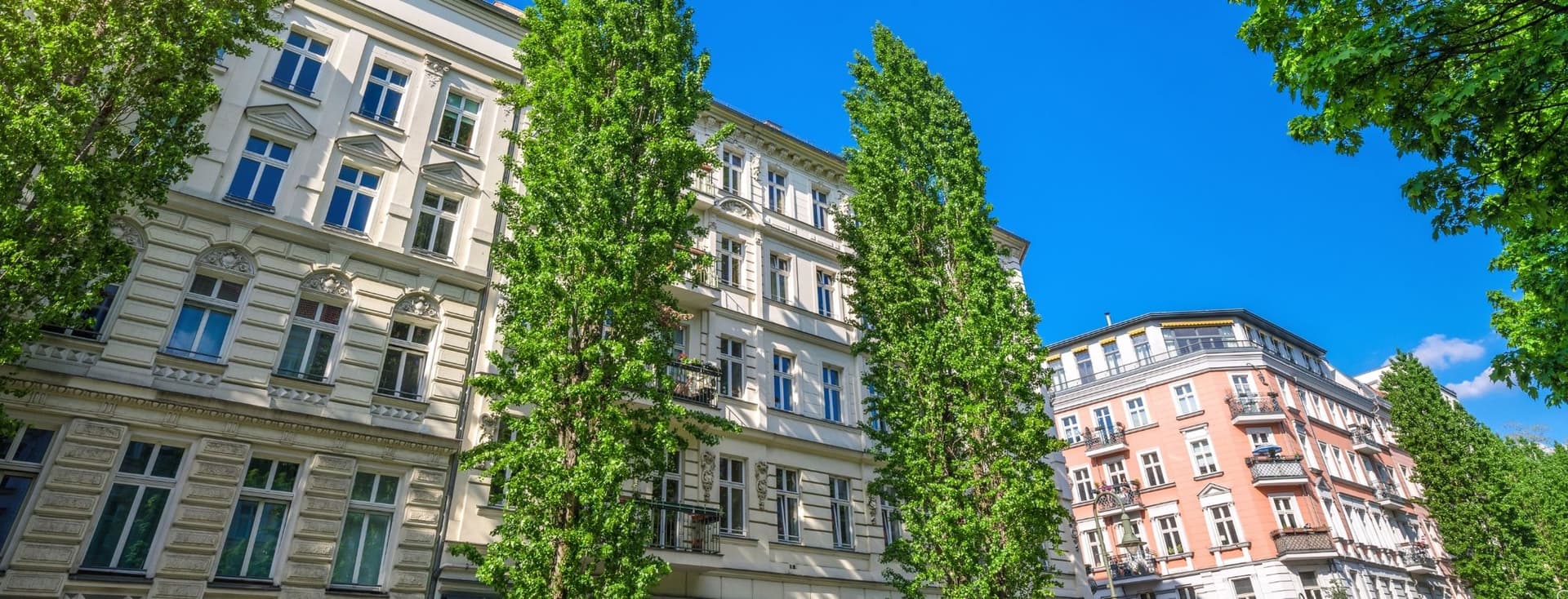
Prenzlauer Berg, more than almost any other neighborhood, epitomizes the transformation from a working-class district to a family-friendly neighborhood, as well as the near-complete renovation of its Wilhelminian-style neighborhoods. Between Schönhauser Allee, Danziger Straße, and Volkspark Friedrichshain, a series of closed block-edge structures with restored facades, converted attics, and landscaped courtyards line the streets. New construction occurs only sporadically, often to fill gaps or increase density.
The architectural cohesion forms the foundation for a closely knit neighborhood life. Around Kollwitzplatz, Helmholtzplatz, and the Kulturbrauerei, a unique mix of residential spaces, small-scale retail, restaurants, and social infrastructure comes to life. Many streets function almost self-sufficiently and are bustling with activity throughout the day. At the same time, Mauerpark in the west, as well as smaller neighborhood squares like Helmholtzplatz and Kollwitzplatz, open up the dense urban space and create tangible open areas.
Life in Prenzlauer Berg
Prenzlauer Berg is a stronghold for singles. Around 60 percent of households consist of a single person, which is above the Berlin average. Two-person households follow with a significantly lower share of 22 percent, while larger households make up the minority at just under 18 percent.
The age structure shows a strong concentration in the working-age population. The group of 30- to under-50-year-olds is particularly prominent at around 37 percent, which is significantly higher than the Berlin and national averages. Income distribution is also above average. Households with middle and higher incomes are disproportionately represented.
Rents and Market Trends
Asking rents in Prenzlauer Berg have been above the citywide average for years. Following a significant increase since 2020, figures have stabilized at a high level and remain well above the Berlin average.
The market for residential and commercial buildings in Prenzlauer Berg also remains intact. The significant upturn through 2020/2021 was followed by a phase of normalization at a lower level. Demand conditions vary noticeably within the district. Residential-dominated areas rely on a steady rental base, while mixed-use sections offer additional commercial income streams.
Neighborhood Framework Conditions
In total, there are currently ten neighborhood preservation zones in the Prenzlauer Berg area, including Kollwitzplatz, Helmholtzplatz, Teutoburger Platz, Winsstraße, and Bötzowstraße.
Renovations and conversions are thus subject to clear regulatory guidelines. This limits changes to the existing building stock, but at the same time stabilizes the social structure and creates transparency for owners.
At the same time, individual new construction projects are emerging, for example on Winsstraße or Greifswalder Straße. These projects create additional living space and strengthen local amenities, in a targeted manner and on a scale appropriate to the established neighborhood.
Outlook
Prenzlauer Berg remains one of Berlin’s most stable residential areas, supported by a high proportion of single-person households. The very high and constant demand for housing, combined with the limited supply of new construction, strengthens existing residential and commercial buildings. Value potential arises primarily from energy-efficient retrofits and modernization. Ground-floor spaces with local amenities or service-oriented uses can tap into additional sources of income.
At the same time, the challenges remain significant. Neighborhood preservation, tenancy laws, and permitting requirements set strict parameters. Construction and renovation costs are rising, particularly for energy-efficiency measures; moreover, stricter financing and ESG criteria are increasing the demands on planning and management.
Berlin is a city of many faces. Each district functions differently: with its own demographic and its own residential and commercial structure. We bring this diversity to light.