
GbR register for real estate transactions from January 2024
The new GG website: Inspiring personalities, extraordinary places and exceptional properties. Discover now.
&w=1920&q=75)
Hamburg’s Social Preservation Ordinance allows the city to restrict building measures that could lead to a reduction in affordable housing for displacement-sensitive population groups. This includes, in particular, the demolition of buildings or parts of buildings, structural alterations and modernisation measures, as well as the conversion of rental apartments into owner-occupied condominiums.
For owners of multi-family residential buildings, the Social Preservation Ordinance means that any measure likely to enhance the property’s value is subject to approval. When purchasing an apartment building located within a designated social preservation area, buyers are required to formally acknowledge and comply with the applicable legal regulations. These include, among other provisions, a restriction on rent increases above the average level defined by Hamburg’s current rent index. If this declaration of commitment is not provided, the City of Hamburg may exercise its statutory right of first refusal.
Hamburg’s population is projected to grow to around two million residents by 2035—developments that will inevitably impact the city’s housing market. Rising demand is already driving up rental and purchase prices. At the same time, the residential landscape is changing through the conversion of rental apartments into condominiums, demolition and new construction, and the consolidation of individual units.
This shift—often referred to as “luxury refurbishment”—carries the risk of displacing established residents as higher-income households move in. To counteract these gentrification effects, the City of Hamburg has introduced Social Preservation Ordinances for particularly sensitive neighbourhoods, based on the German Federal Building Code (§172 para. 1 BauGB). These regulations are designed to protect existing tenant structures and preserve the social fabric of affected areas.
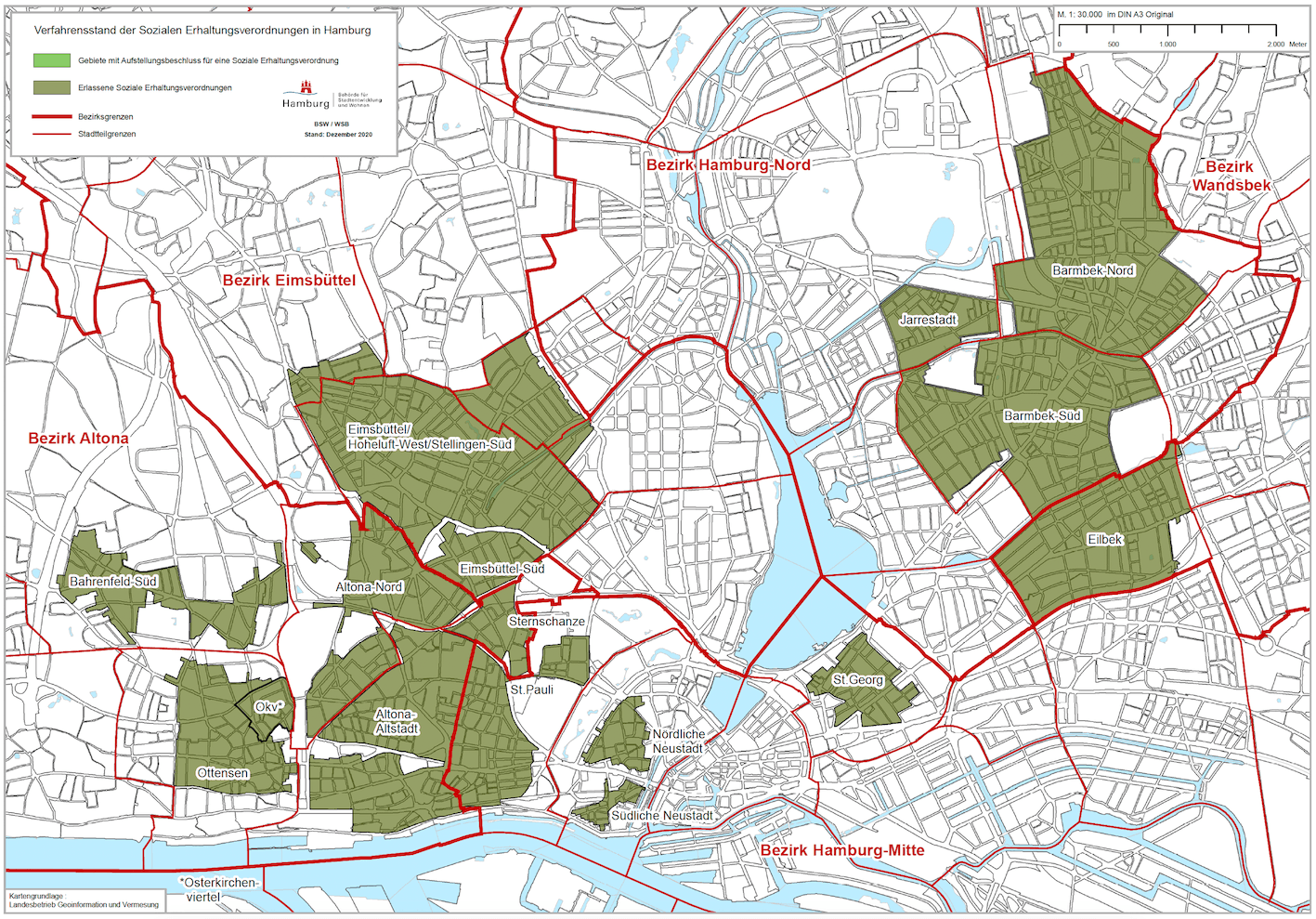
The city’s statutory right of first refusal places Hamburg in a strong strategic position when apartment buildings are sold within designated social preservation areas. Whenever a multi-family property in such an area is transferred, the city reviews whether the buyer intends to use the property in line with the applicable development plan or the objectives of the Social Preservation Ordinance. This review typically focuses on, among other aspects:
Planned (energy-efficient) refurbishment measures
Extensions or enlargement of balconies
Use of development potential, for example through attic conversions
Changes to the rental model, such as furnished letting
If, in the context of a property acquisition within a social preservation area, there is justified concern that the transaction could lead to an adverse change in the resident structure, the City of Hamburg may exercise its right of first refusal. To avoid this, buyers may enter into a so-called avoidance agreement (*Abwendungsvereinbarung*) with the city.
If no avoidance agreement is concluded, the city may step into the purchase contract—potentially on less favourable terms. In this case, the seller has one month to withdraw from the contract or proceed with the sale to the city at the reduced purchase price. Where no protected interests under the Social Preservation Ordinance are identified, the City of Hamburg generally waives its right of first refusal.
However, a ruling by the German Federal Administrative Court (BVerwG) in November 2021 has significantly restricted the application of this right compared to previous practice.
In its decision of 9 November 2021, the BVerwG held that the former approach to exercising the right of first refusal is lawful only under narrow and clearly defined conditions.
+++ BVerwG ruling on the inadmissibility of the municipal right of first refusal +++
Pursuant to Section 26 No. 4 of the German Federal Building Code (BauGB), the right of first refusal is excluded if the property is already developed and used in accordance with the provisions of the development plan or the objectives of the relevant urban planning measures. In addition, the right of first refusal does not apply if the apartment building sold shows no deficiencies or shortcomings within the meaning of Section 177 BauGB.
Crucially, the BauGB refers solely to the actual condition of the property at the time of acquisition. It does not take into account whether a buyer might potentially use the property in a manner contrary to urban planning objectives in the future. Expected future developments or assumptions about intended use are therefore not relevant when assessing the City of Hamburg’s right of first refusal.
Roland Hoinka, attorney and partner at the renowned Hamburg-based real estate and construction law firm Oberthür & Partner, therefore considers the City of Hamburg’s right of first refusal to be significantly limited. In his view, exercising this right in social preservation areas is no longer permissible when it is justified by:
Consideration of the buyer’s future intentions, even where there is an evident intention to subdivide the property
The buyer’s refusal to sign an avoidance agreement (Abwendungsvereinbarung)
An allegedly excessive purchase price, used to argue a lack of economic viability under the existing rental structure
“At the same time, the right of first refusal may still be exercised where the conditions set out in Section 26 No. 4 BauGB are met,” Roland Hoinka emphasises.
Clearly yes. Long-term investors who value the sustainable nature of real estate investments continue to benefit from strong tenant demand and secure rental prospects in sought-after locations.
A notarised purchase agreement only becomes legally effective once the City of Hamburg has formally waived its right of first refusal. As a result, the acquisition process may be extended by up to three months.
During the acquisition process, a unilateral avoidance declaration by the buyer pursuant to Section 27 BauGB is sufficient. This declaration confirms the buyer’s commitment to comply with all applicable legal requirements, including the Federal Building Code and Hamburg’s rent index.
Entering into a long-term avoidance agreement with the City of Hamburg—for example, for a period of 30 years—is not required.
Due to the restrictions imposed by the Social Preservation Ordinance and the previously applied right of first refusal, demand is generally lower compared to similar neighbourhoods outside designated preservation areas. As a result, achieved sale prices rarely reach absolute market peaks.
At the same time, social preservation areas are typically characterised by high tenant demand, which supports strong price stability.
Current case law has led to a slight increase in demand for apartment buildings in social preservation areas. Should the legal framework once again allow municipal pre-emptive purchases on a broader scale, a decline in demand and moderately lower prices can be expected.
In principle, a sale is possible without restriction. The only factor to consider is the City of Hamburg’s potential exercise of its right of first refusal within three months of signing the purchase agreement. However, if the city steps into the contract at the price agreed with the buyer, no disadvantage arises for the seller.
You may also be interested in

&w=1920&q=75)


&w=1920&q=75)

&w=1920&q=75)
Contact provider

Page content provided by: Engel & Völkers Gewerbe GmbH & Co. KG
License partner of Engel & Völkers Franchise and Trademark GmbH