- 4 min read
- 25.02.2026
- by Merle Wilkening
Facing Giants – The Swiss Winter Haven of the Jungfrau Region
&w=1920&q=75)
Issue
Online exclusive
Location
Grindelwald, Switzerland
Photography
Jungfraubahnen / Jungfrau Region Tourismus AG / Merle Wilkening
The bold pioneering spirit that first opened up the Alps can still be felt in every corner of the Jungfrau Region. Yet those traveling to Grindelwald today will not find a place concerned with seeing and being seen—instead, they discover a destination where authenticity and a deep connection to home come to life. A visit to the Eiger Village, where the mountains take center stage and humanity fits in with respectful ease.
For those setting out for the Jungfrau Region, the journey begins with a scenic overture. The roughly three-hour train ride from Zurich to Grindelwald is a travel experience in its own right. The route winds past lakes with names that inspire dreams: Lake Lucerne, Lake Sarnen, Lake Lungern, and Lake Brienz. Behind them, the mountain scenery unfolds like the most beautiful picture book, while the train steadily conquers the slopes, climbing higher and higher toward Grindelwald.
Grindelwald: Alpine Heritage at the Foot of the Eiger North Face
Upon arriving in the mountain village, it is immediately clear who the irrevocable protagonist is: the majestic rock faces of the Bernese Alps. The spectacular Eiger North Face towers over the village—a sight that commands instant respect. Grindelwald itself sits at 1,034 meters, with nearly half of the municipal area located within the UNESCO World Natural Heritage site Jungfrau-Aletsch. From here, one gazes upon the famous trio of peaks: the Eiger, Mönch, and Jungfrau. In their shadow, the tranquil life of the village plays out. Grindelwald is traditionally divided into seven districts, the so-called Bergschaften—a structure that to this day cements the strong sense of community among its roughly 4,000 residents.
The main street leads past hotels and specialized outdoor equipment shops. Here, the village does not seem to position itself as a glitzy luxury hub like St. Moritz or Kitzbühel—even if the density of four Michelin-starred restaurants is a clear indicator of high culinary standards.
Where Danish Hygge Meets Swiss Tradition
A sense of unity prevails among the locals: they wish to move with the times while preserving their traditional core. It is not just about building anew, but about utilizing and enhancing what already exists. This is the philosophy shared by Matthias Michel, who runs the Hotel Fiescherblick together with his brother Lars. Having grown up in Grindelwald, they represent the fourth generation of hotelier expertise.
The house in the "Hinter der Kirche" part of the village(which means behind the church) stood empty for twelve years before they reopened it in 2022 with a personal twist. The Fiescherblick feels modern and uncluttered, yet "woody" and cozy—more hygge than a classic alpine hut. The Scandinavian influence is a family trait: their father hails from Denmark, and both brothers hold Swiss and Danish passports. Recently, the brothers also took over a small bakery where freshly baked cardamom buns, following a Danish recipe, await.


Jungfraujoch: Pioneering at the "Top of Europe"
Meeting people like Ruedi is how one truly learns to understand the region. At 65, he is a true local fixture: silver ponytail, sun-tanned skin, and a mighty mustache. He has spent his life working in skiing and tourism and continues to serve as a tour guide for the Jungfrau Railways in his retirement. He knows everyone here—and everyone knows him. He has experienced countless adventures in the ice and snow, through sunshine and thunderstorms. He delights in sharing anecdotes, with his rolling Swiss "R," about his most impressive mountain experiences. Often, he leads his guests to the region's pinnacle: the Jungfraujoch.
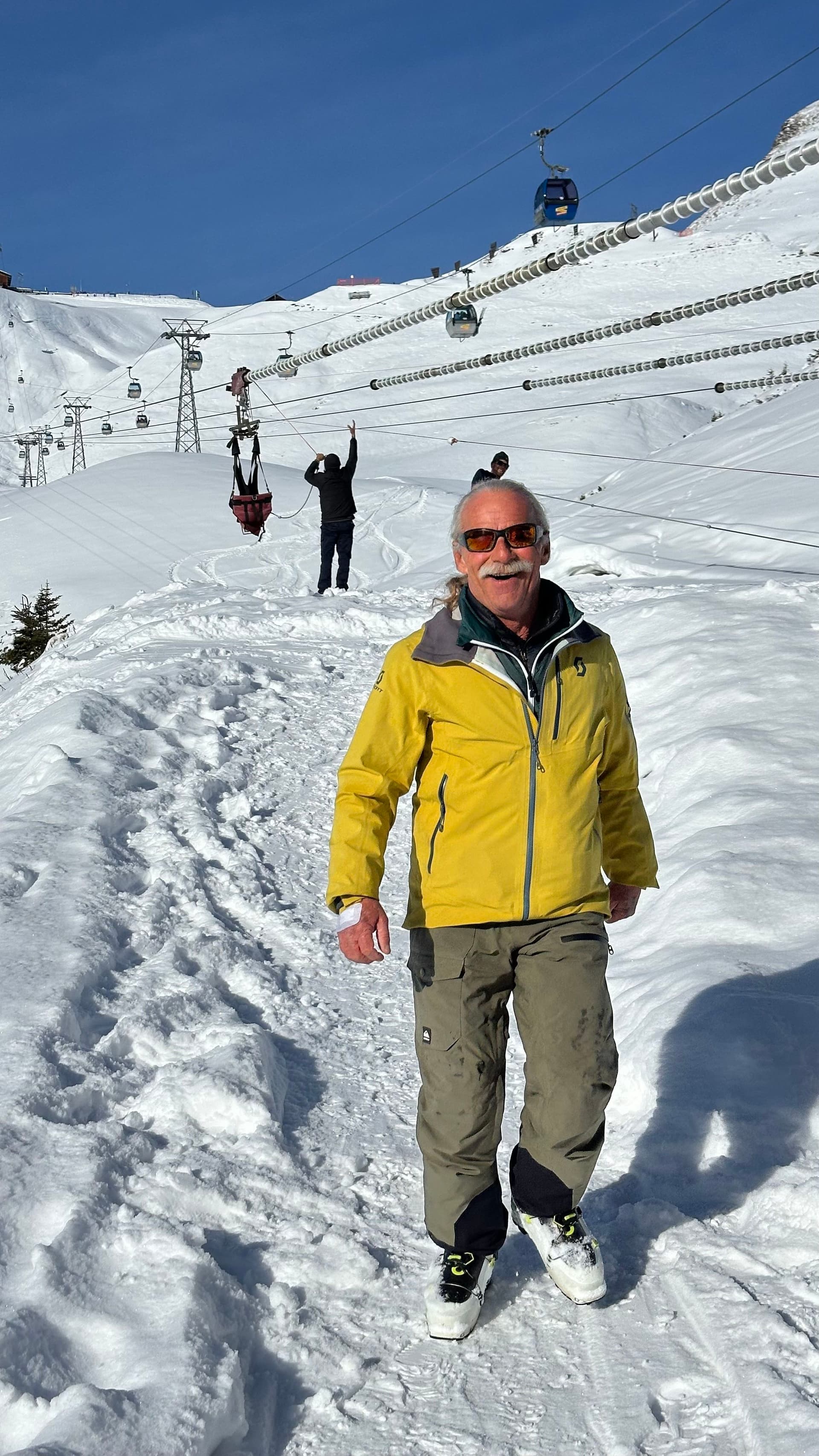
Up there, at 3,454 meters, the nickname "Top of Europe" becomes reality. It is the highest railway station in Europe, a place where the air grows thinner and the view wider. In just 45 minutes, one travels from the modern Grindelwald Terminal into a world of eternal ice. The Jungfrau Railway itself is a pioneering feat and a masterpiece of engineering. Construction began as early as 1896, following the plans of the Swiss visionary Adolf Guyer-Zeller. With unimaginable effort, workers drove the tunnel through the rock of the Eiger and Mönch. Guyer-Zeller himself passed away before ever seeing the finished work, which cost approximately 16 million francs.
Today, the observation platform offers views of the Aletsch Glacier, the largest continuous glacier in the Alps. Those who wish can dive deep into the glacier and walk through the corridors of the Ice Palace. In 2024 alone, over one million people visited the Jungfraujoch. It is a place of extremes that has even served as a spectacular venue for international soccer or tennis matches and has housed Europe’s highest research station reachable by public transport since 1931.


Continue reading below.
Find your property in Switzerland.
Offered properties
- Exclusive
- Reserved
Winter Sports in the Jungfrau Region: World Cup Fever and Night Sledding Adventures
Yet the region offers far more than just breathtaking vistas. The Jungfrau Ski Region spans the three major areas of Grindelwald-Wengen, Grindelwald-First, and Mürren-Schilthorn, encompassing 211 kilometers of pristine slopes, 50 kilometers of sledding runs, and 100 kilometers of winter hiking trails–all set against the iconic backdrop of the famous mountain trio. Here, the legendary Lauberhorn racecourse coexists with exhilarating offerings for those in search of a true adrenaline kick.
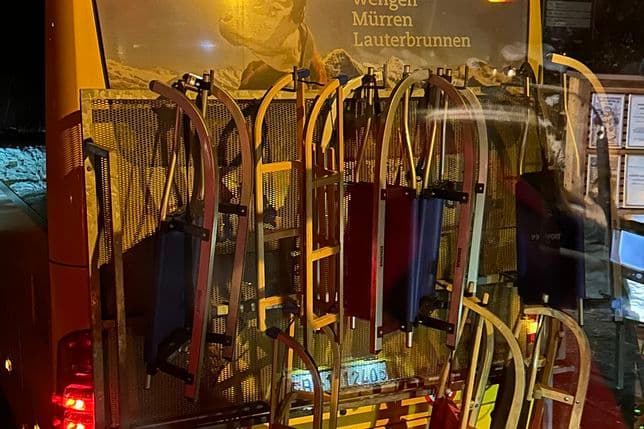
One of the most authentic experiences, however, begins in the evening, long after the sun has vanished behind the peaks. At the village bus station, yellow buses wait, equipped with heavy snow chains. The vehicle winds up narrow, snow-covered serpentines on a one-way road to Bussalp, situated at 1,800 meters. Once at the top, one is greeted by the comforting warmth of a cozy mountain parlor. Over a traditional cheese fondue, guests and locals huddle together. Yet the coziness has a time limit, made unmistakably clear by the driver on the way up: "If you're late, you walk."
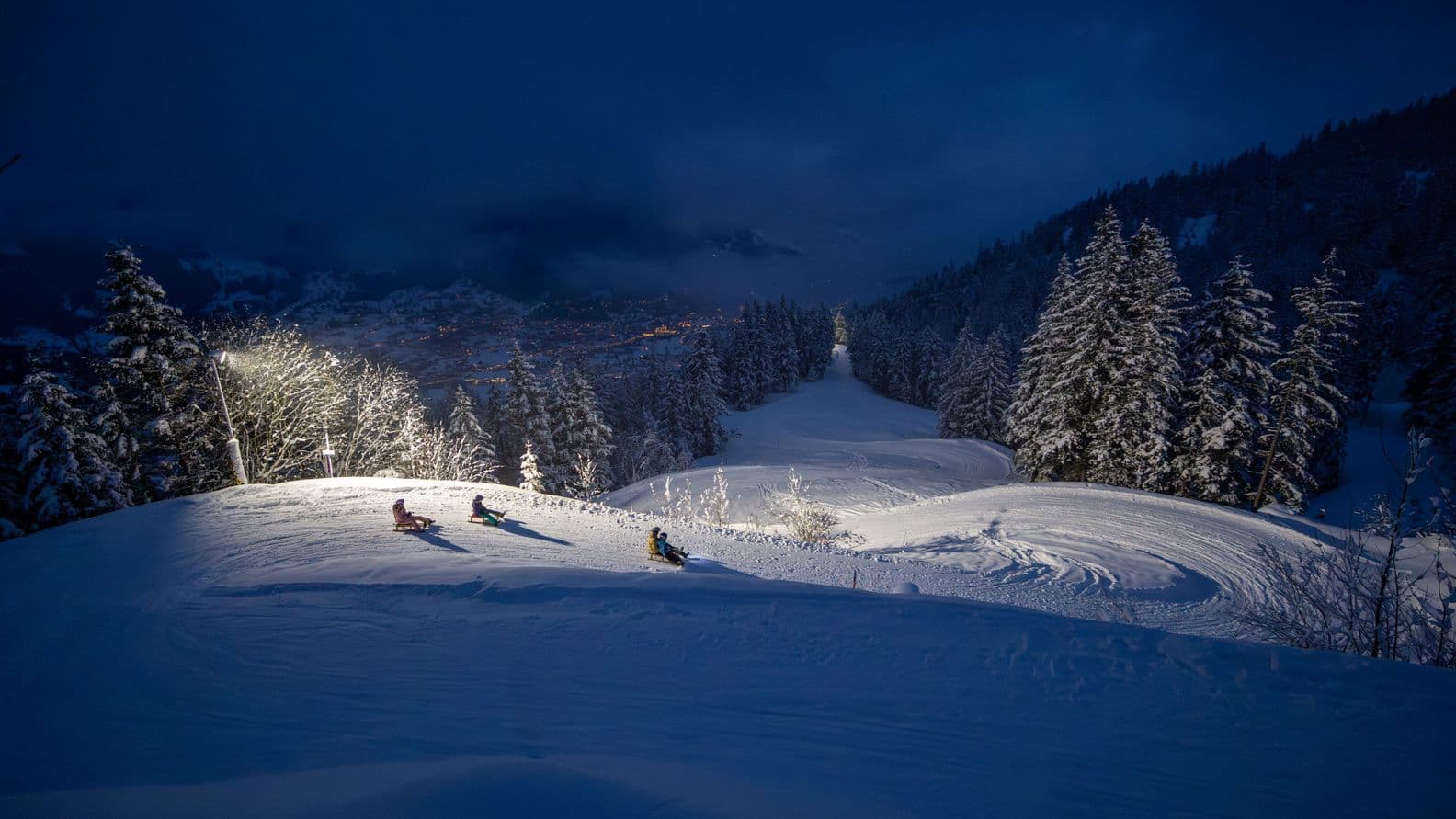
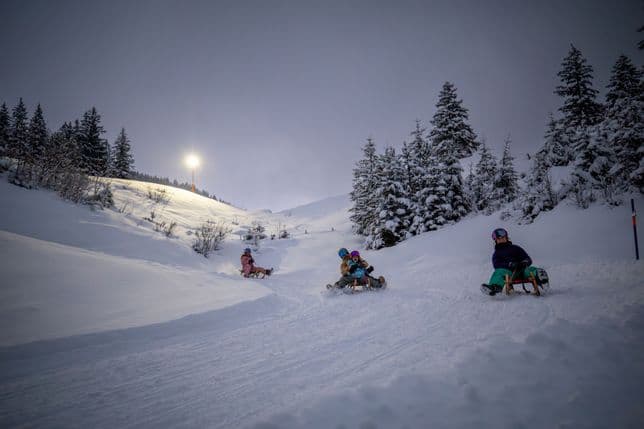
The return to the village is not by bus, but on runners. Armed with headlamps, one plunges toward the valley on a sled. When the full moon shines bright, the snow glitters; otherwise, one trusts the lamp's beam and their own sense of speed. At the meeting point below, an exuberant atmosphere prevails. The shared adrenaline connects everyone; there is cheering, laughter, and later, a word of thanks to the bus driver for the trip. It is this moment of community that shows: in Grindelwald, you are not just a guest—for a while, you become part of this special world facing the three- and four-thousand-meter giants.
You may also be interested in
 Castello di Reschio: The Art of Devotion
- 4 min.
- 04.09.2026
 Cool City Seattle – Emerald City
- 2 min.
- 4.8.2026
 Le Chambard – The Soul of Alsace
- 3 min.
- 4.9.2026
 Dolce far niente – a visit to the Adler Spa Resort Sicilia
- 2 min.
- 07.07.2026
 Four ultra-luxury yachts on the high seas
- 4 min.
- 09.06.2026
 Cool City – Parisian Savoir faire
- 2 min.
- 27.04.2026
 Glamour in the Alps – Cool City St. Moritz
- 2 min.
- 16.02.2026
 Antarctic Adventure – with the expedition ship Hanseatic Nature
- 8 min.
- 19.01.2026
GG Magazine exclusive content
GG is an independent magazine at the highest level. Exploring the world of architecture, lifestyle, design, fashion, yachting, luxury living and travel. We seek out the most exciting topics and personalities for you and invite you to get to know them from a fresh new angle. In GG, you will meet successful architects, interesting designers and exciting artists who are the talk of the town from London to New York and Berlin to Hong Kong.