Later is no strategy
In a volatile market, timely action determines stability and new opportunities.
Later is no strategy
In a volatile market, timely action determines stability and new opportunities.
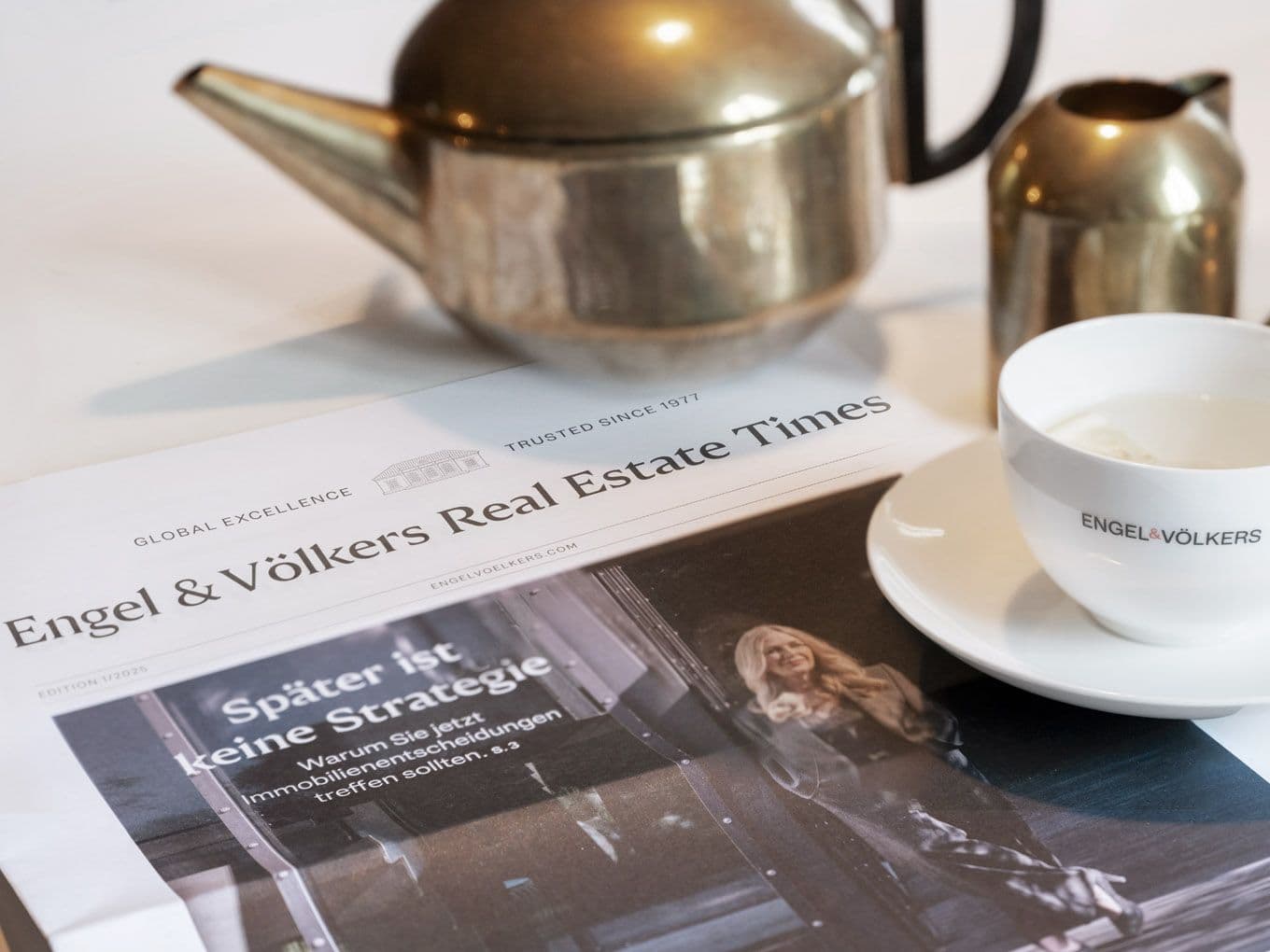
In the first issue of the Engel & Völkers Real Estate Times (01/2025), the developments of the real estate market in 2025 take center stage. In this newspaper you will learn how interest rates, property prices and market trends are currently changing – and what opportunities arise from this for buyers, owners and investors.
In September 2025, the European Central Bank (ECB) decided to pause its key interest rate – after eight consecutive cuts, most recently at the beginning of June by another 25 basis points. Many people expected that mortgage rates would continue to decline as well. However, unlike car loans, long-term mortgage rates respond only partially to monetary easing. Over the past three years, they have increasingly decoupled from the key interest rate. As a result, the interest rate for property financing has remained relatively stable at around 3.6 percent despite several cuts since mid-May 2025.
Market recovery and rising prices
The market has been recovering since the beginning of the year. Both private buyers and professional investors have largely abandoned the cautious approach they maintained over the past three years. This is reflected in the increased number of transactions. In line with the interaction of supply and demand, property prices are also beginning to rise again. The trend is still moderate, and potential buyers are benefiting from the stable prices the market had recently settled at. However, by the second quarter of 2025, the asking price for existing condominiums averaged 3,964 euros per square meter, 2.2 percent higher than in the first quarter. A similar trend can be observed for newly built apartments (+0.2% and +0.9%). Historically, actual purchase prices tend to follow asking prices shortly thereafter.
Favorable conditions for both parties
This creates opportunities for buyers considering a real estate investment and for owners contemplating a sale: the recovering market offers good conditions for both sides. Buyers benefit from a growing selection, attractive prices, and stable financing conditions. Sellers, in turn, encounter renewed demand that promises a swift marketing process. Recognizing the current opportunities enables forward-looking decisions – provided they are based on reliable information, foresight, and expert advice.
Receive exclusive Engel & Völkers Research Insights on property financing in turbulent times.
Vacationing in your own country is experiencing a sustained upswing. According to the census, the number of holiday and second homes in Germany has increased by 32.7 percent over the past decade. They not only offer individual retreats for owners but also prove to be a stable investment. The market in Germany’s holiday regions – from the coast to the Alps – is extremely diverse. Here we provide an overview.
How are prices developing?
In line with demand, asking prices for holiday apartments in Germany have risen slightly. In 2024, they averaged 5,808 euros per square meter, 2.8 percent higher than the previous year. There are, however, significant regional differences. Nordfriesland and Dithmarschen lead the ranking with average prices of 8,440 euros per square meter. At the lower end of the 11 holiday regions analyzed by Engel & Völkers Research is the Black Forest, with prices around 2,699 euros per square meter (see table).
Owner use or rental?
Holiday properties are purchased for different purposes. Often for personal use, but in many cases, buyers also consider that rental income can offset financing costs and generate an attractive return. In fact, a holiday property offers the perfect combination of both: a personal retreat and a promising investment. Properties in popular locations can provide considerable potential for value appreciation. Owners benefit from growing demand for individualized holiday accommodations and the increasing popularity of holiday apartments over hotels.
What makes a top property?
In addition to location, modern amenities are crucial to turning a property into a highly sought-after holiday rental. For example, the German Tourism Association’s (DTV) star-rating criteria require free Wi-Fi for classification. Furthermore, the presence of a dedicated workspace that enables a “workation” is positively rated by the DTV. Today, it is considered essential that the property includes a balcony and/or terrace.
Which trends are emerging?
When choosing a holiday property, buyers increasingly pay attention to regional architectural styles with a modern interpretation. Accessibility and high energy efficiency are also becoming more important criteria. A relatively new factor is flood protection: previously popular waterfront locations are now carefully assessed for safety against storm surges and extreme weather events due to climate change. As a result, interest is shifting in some areas to properties in the second or third row. In the mountains, buyers are increasingly focused on regions considered snow‑reliable.
Prices & trends in the new holiday property report
This ties up unnecessary capital and raises questions about efficient solutions. There are several options that companies can consider.
Subleasing: flexible interim solution
Subleasing part of the office is one way to reduce costs in the short term. With the landlord’s approval, some rooms can be rented out to other companies. This creates flexibility but also involves risks. Common areas such as restrooms or break rooms may need to be shared. Therefore, selecting reliable and compatible subtenants and clarifying legal aspects is crucial.
Space sharing: long-term adjustment
A similar, but more long-term oriented solution is negotiating a space-sharing arrangement with the landlord. In this case, the lease is adjusted and the rented area is reduced. This requires compromise from both parties and may involve renovation costs due to redesigning the space.
Moving to smaller premises: radical realignment
Moving to a smaller office at a different location is the most radical, but often the most efficient, solution. It allows a complete realignment and saves costs in the long term. In the short term, however, relocations involve both personnel and financial effort. It is also important to consider whether moving to another district or location aligns with the company’s strategic objectives.
Making the right decision
Each option has its advantages and disadvantages. To make an informed choice, it is helpful to discuss all possibilities with our experienced office leasing experts. Acting as a sparring partner, they support the analysis of the individual situation, the evaluation of alternatives, and the implementation of the chosen strategy.
The real estate market remained stable in 2025, offering attractive opportunities for investors. In particular, looking at the markets of smaller cities can be worthwhile.
The first half of 2025 brought encouraging signals: in many major German cities, transaction volumes exceeded the previous year’s levels. This boost is partly due to larger portfolio sales but generally indicates a market in motion. An active market creates opportunities – both for acquiring new properties and optimizing existing portfolios. The residential property segment continues to hold its position as the most popular investment class. This sustained preference among investors rightly reflects confidence in the long-term stability and development of the residential property market.
Rental prices support returns
Rental prices are trending upward, which benefits yields. Particularly noticeable is the development in A-cities, where rent increases remain above average. Market fundamentals suggest further rent growth throughout the year, especially in major cities and their surrounding areas, where demand for housing remains high.
Regional differences offer opportunities
Asking prices for residential and commercial properties remain largely stable in many regions. This continuity is remarkable, as it has proven resilient even amid increasing economic uncertainties. Volatility in capital markets generally strengthens demand for tangible assets such as real estate. However, there are interesting regional differences that are strategically important for investors. While prices in A- and B-cities remain largely stable, many C- and D-cities show moderate price increases within their generally lower levels. This highlights the potential of smaller cities as investment locations. C- and D-cities often offer attractive entry points while maintaining solid value growth. Investments in A- and B-cities remain promising, but stronger positive developments are increasingly seen in smaller city categories.
Structural advantages of smaller markets
The attractiveness of C- and D-cities is not only due to lower entry prices. These markets also benefit from structural changes that strengthen their long-term prospects. Remote work and hybrid models have loosened the location ties of many employees, leading to migration from urban centers to smaller, well-connected cities. This demographic shift sustainably stabilizes housing demand in C- and D-cities. Additionally, the often lower cost structure of property management in smaller cities – lower maintenance costs, reduced administrative effort, and moderate property taxes – significantly improves net returns.
Diversification as a success factor
Professional investors increasingly recognize the advantages of regional diversification in their real estate portfolios. While A-cities continue to form the backbone of institutional investment strategies, C- and D-cities complement these portfolios with an important risk-reducing component.
Read the investment guide now.
There has been significant change in the interest rate market in recent years. Currently, however, mortgage rates have stabilized at around 3.6 percent and appear relatively steady. How the interest rate market will develop in the coming years cannot be predicted reliably.
The positive news: while the interest rate level and financing conditions depend on the timing, they are also influenced by several additional factors. Personal creditworthiness, the location of the property, available equity, the financing objective and monthly income all play a key role in determining how favorable a loan will be. Depending on the provider, however, there can be considerable differences – which is why comparing several lenders is essential.
1 Equity: The basic rule is: the higher the equity, the lower the interest rate. The larger the amount invested, the smaller the gap between the loan amount and the property value, which reduces the risk for the lender.
2 Creditworthiness: Anyone seeking attractive mortgage financing should be able to demonstrate strong creditworthiness. Banks will request a SCHUFA credit report, which assigns a score of up to 100 percent. For most banks, a score above 90 percent is sufficient.
3 Income: The stronger the income situation, the more positively it influences the loan conditions. A stable and ideally high income is therefore advantageous. Permanent employment is generally preferred, although some banks also offer attractive financing solutions for self-employed professionals and borrowers who are older at the time of financing.
4 Property: Location, condition, size and energy efficiency are used by the bank to determine the property’s value. The better the loan-to-value ratio, the lower the interest rate.
5 Fixed interest period: A long fixed interest period provides planning certainty for a mortgage. Generally speaking, however, longer fixed terms tend to come with slightly higher interest rates.
6 Repayment rate: The higher the repayment rate, the lower the total interest costs. A higher initial repayment can also lead to a more favorable interest rate because the loan term and the lender’s risk are reduced.
Our conclusion
Finding the right loan with the best conditions can often be challenging. It is therefore essential to compare financing options thoroughly and tailor them to individual needs.
The Engel & Völkers Finance team provides comprehensive, individual and free advice. With a portfolio of more than 550 banks, we can identify the optimal financing solution for your real estate project.
Which property fits your budget?
The first step toward your new home: with our budget calculator, you can immediately see which properties match your financial possibilities. Quick, straightforward and with direct access to current listings in your preferred region.
The villa colony Prinz‑Ludwigs‑Höhe in Munich‑Solln is an extremely exclusive location, rich in beautiful and exceptional properties. Here, you will find an architectural gem like no other: a listed coach house from 1905, which, after extensive renovation, has become one of the most tasteful residential properties in southern Munich. The 226-square-meter main house impresses with its seamless combination of historic architecture and contemporary comfort. A hipped roof, timber-frame elements, and sash windows characterize the exterior, while a glass staircase inside provides clear, modern accents. The core renovation, carried out in 2015 under the direction of architectural designer Bernike Szabo, strictly adhered to the requirements of the heritage preservation authority.
Numerous amenities
Six rooms are spread across the property, including a master suite in the converted attic with dressing area and shower bath. The designer kitchen, featuring stainless steel countertops and a BORA extraction system, demonstrates how historic charm and modern amenities can harmoniously complement each other. Three bathrooms provide all the necessary comfort. Particularly appealing is the ensemble character of the property: two separate 46-square-meter apartments in the secondary building offer space for guests or a home office. The 300-square-meter garden, complete with a koi pond and three terraces, creates a private oasis in the city. The protected courtyard location ensures peace and privacy.
Garden city with city convenience
The location also impresses with excellent transport connections: via Solln S-Bahn station, the city center of Munich can be reached in just a few minutes. Residents also benefit from proximity to the Isar River and its recreational opportunities, as well as the overall green surroundings of this popular district. Combining the charm of a garden city with the convenience of city life – in Munich’s southernmost district, you get both. The coach house represents a unique residential property at one of the most sought-after addresses in the Bavarian capital.
Learn more about this exceptional property:
1. Video-Roomtour
2. Online-Exposé
3. Podcast-Episode
4. Video of the Podcast-Episode
Cornelia Augustin is a home stager. TV appearances and features about her work have made her known to a wider audience. In this interview, the expert explains what home staging actually is and how presenting a property can help with its marketing.
Ms. Augustin, what is home staging all about?
Cornelia Augustin: Home staging is a sales-enhancing measure. The idea is to put a house on the “stage” and present it. This allows us to achieve higher selling prices in a shorter time for many properties. In addition, nowadays many properties do not even find buyers without home staging, because potential buyers lack the imagination to visualize the space.
What do you do specifically?
I walk through a property and provide my recommendations. For existing properties, this might mean moving out furniture, painting walls, replacing carpets, or removing built-in fixtures. Often, the garden also needs attention, such as cleaning the paving stones. After the basic cleaning, we bring in our furniture, plenty of light, artwork, accessories, textiles, and everything else needed to transform the house. In older properties, outdated bathrooms are often a challenge.
What comes to mind, for example, with moss-green tiles?
Unchangeable features like such a bathroom are incorporated into the color concept. If a 1970s house has wooden ceilings and green bathrooms, it is clear that we also work with wood and green tones during staging. It doesn’t need to be much – a green vase in the entrance, a green cushion in the living room, and so on in each room. This sets the viewer’s emotional tone. Then, when the viewing leads to the moss-green bathroom, everything feels harmonious.
And what about actual defects?
Real defects are, of course, not hidden. As a member of the professional association DGHR (German Society for Home Staging and Redesign), I have signed a code of ethics. If a conservatory has moisture stains, these will also be visible.
Does the entire property always need to be staged?
Yes, it is not enough to stage only the entrance and living room. We need an emotional flow that covers the entire viewing. In every room, there is also a focal point. We guide the viewer’s attention to that point and place a particularly attractive detail there – the fireplace with armchair, the cozy sofa, or something similar. This ensures that the eye is rewarded upon entering the room.
What do Engel & Völkers and classic cars have in common?
By the end of this Open House podcast episode, you’ll know: quite a lot! Emil Pourkian from Emil’s Garage talks with us about shared clients, profitable investments, and how the profession of a classic car broker differs from that of a real estate advisor.
&w=1920&q=75)
Mitte, Berlin, Germany
Price
€4,850,000
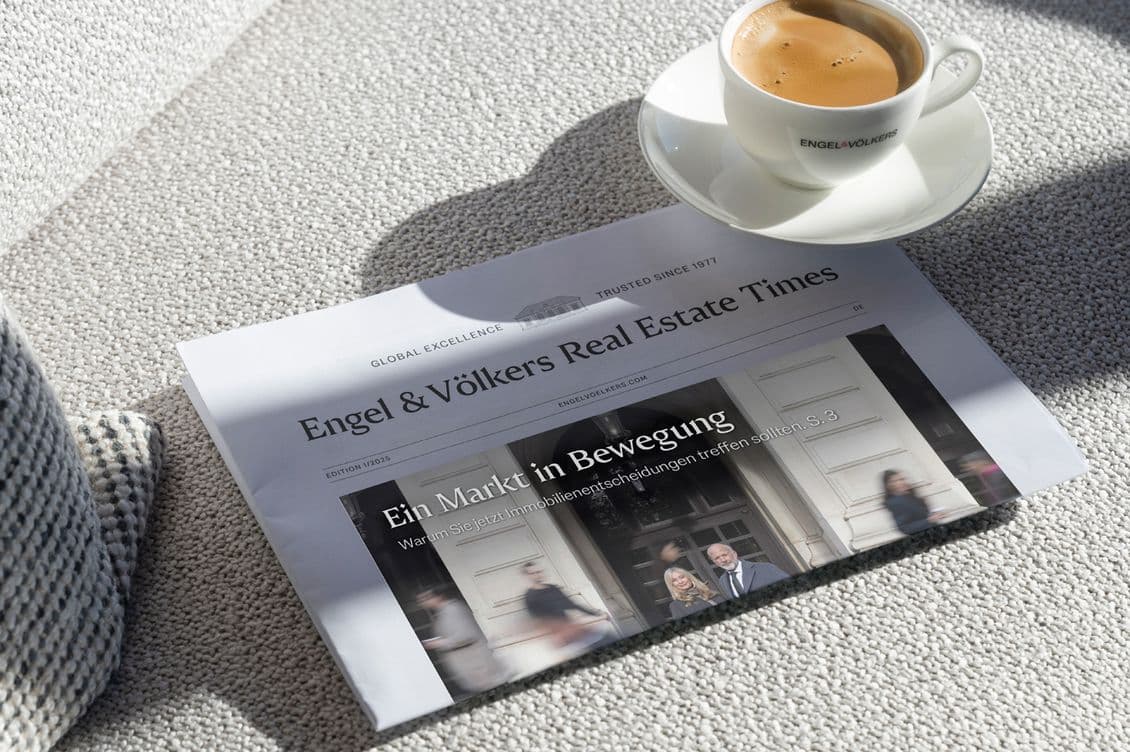
The second issue of the Engel & Völkers Real Estate Times (01/2026) highlights that real estate markets have regained stability and predictability in 2026. Moderate mortgage rates, a growing supply of properties, and increased confidence are shaping the market. The focus is on quality, energy efficiency, and analyses of investment properties.
Free, confidential and non-binding
Receive your digital valuation instantly
Based on data by Engel & Völkers