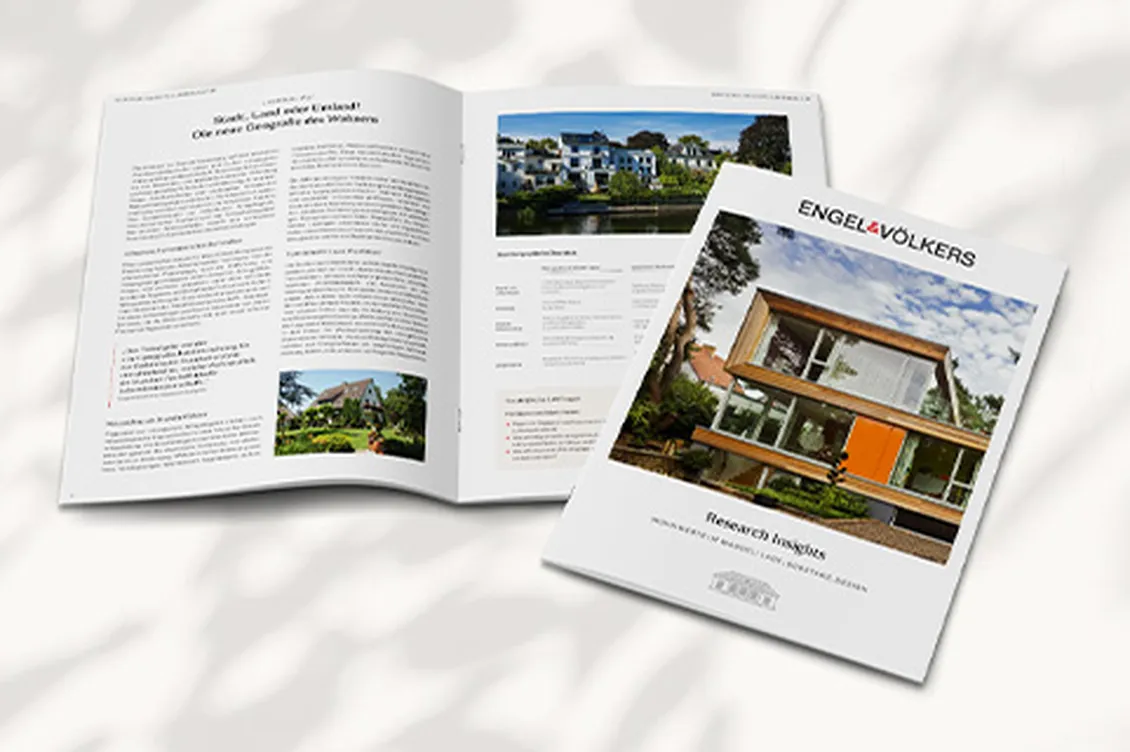
Research Insights
Learn more about changing living values: Location, building fabric, design
The new GG website: Inspiring personalities, extraordinary places and exceptional properties. Discover now.
How to make the right location decision when buying a property

When you buy a property, you are deciding not only about square metres and price, but also about your everyday life: How long is your commute? How hot does the apartment get in summer? And how much will the property cost to maintain in ten years’ time? There are three types of location to choose from, and each answers these questions differently.
City: Short distances, comprehensive infrastructure and a wide range of cultural and dining options – but the highest prices for comparatively small spaces. In summer, heat exposure tends to be greatest.
Suburbs: More living space and often a garden, with good transport links and a manageable commute into the city. Prices are usually below those in the city centre, without the isolation of rural areas.
Countryside: Plenty of space, proximity to nature and the lowest prices – but usually a dependence on the car and limited local infrastructure. Heat exposure tends to be lowest.
These are, of course, only general trends. Within each location type, individual areas can differ considerably, for example in terms of rail connections, building density or green spaces.
Learn more about changing living values: Location, building fabric, design
Hybrid working models are shifting priorities. Those who only need to be in the office two or three days a week are often willing to accept a longer commute in return for more space and a garden. Well-connected suburban locations benefit in particular, as they combine proximity to major cities with a greater supply of space, while their price per square metre is sometimes considerably below that of the city centre.
A sober calculation is worthwhile here. The price advantage of the suburbs shrinks with every commuting day, as travel costs and time come into play. However, since 1 January 2026, the commuter allowance has provided tax relief: it is a flat rate of 0.38 euros per kilometre of the one-way journey, starting from the first kilometre (whether this rule will remain unchanged in the long term is politically uncertain, as of November 2026). For 20 kilometres and 220 days at the workplace, this amounts to 1,672 euros in deductible business expenses per year. Those who work predominantly from home benefit correspondingly less.
The trend is moving away from a purely geographical assessment towards a functional location analysis. What matters is the quality of life a location creates for individual lifestyles.

Dense development and sealed surfaces store heat. City centres heat up strongly during the day and cool down much more slowly at night than the surrounding suburbs. In Berlin, for example, the maximum temperature difference between the city centre and its immediate surroundings averages three to four degrees in summer, according to the Federal Environment Agency. For residents, this also means more tropical nights – nights when temperatures do not fall below 20 degrees.
How pronounced this effect is depends on density, surface sealing, green space and building materials. Even in the city, there are cooler neighbourhoods, for example near parks, forests or bodies of water. When viewing a property, therefore, ask about its orientation, shading and the greenery of the surrounding area. A visit on a hot evening says more than any statistic.
longside location and climate, a building’s energy efficiency is becoming a key value factor. This applies particularly to existing properties. Especially in rural areas, the differences between individual properties can be considerable. Therefore, check the year of construction, heating system, insulation and windows, and ask to see the energy performance certificate. Factor any upcoming renovations into your budget from the outset.
City, suburbs and countryside are not inherently better or worse. The choice between them reflects highly individual lifestyles and circumstances. Those who honestly assess their weekly routine, budget and requirements for the building can make a decision that suits them personally and as a family. The Engel & Völkers experts in your region will be happy to advise you on locations, price levels and suitable properties.
Commute: How many days a week do you need to be on site, and how long does the journey realistically take, including by train or car during rush hour?
Total costs: What do journeys cost, including a second car if necessary, and how much of this can you claim for tax purposes?
Everyday life: Are schools, doctors and shops within easy reach, and how important are culture and dining options on your doorstep?
Space requirements: Do you need a home office, a garden or room for a growing family?
Building: What is the building’s energy efficiency, and what investments will be needed in the coming years?
Generally, yes, in terms of price per square metre. However, the advantage diminishes due to travel costs and time spent commuting if you commute frequently.
It depends on your office days, mobility and local infrastructure. Check transport links, amenities and the condition of the building before making a decision.
It primarily affects ongoing costs. Any need for renovation should be factored into your calculations and price negotiations.
You may also be interested in




Contact


Engel & Völkers Germany
Vancouverstraße 2a
20457 Hamburg, Germany
Tel: +49 40 361310