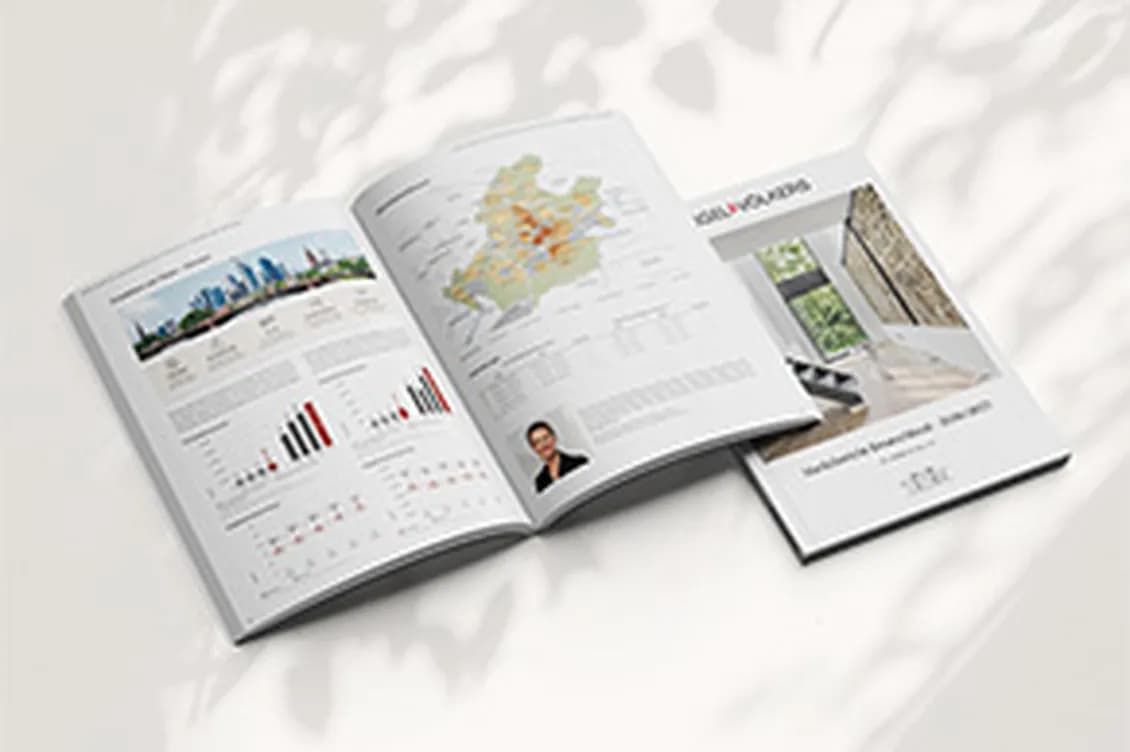
Market report for download
Prices and trends for residential real estate in Germany and 55 cities.
The supply in Germanys residential real estate market is growing, asking prices remain steady, and those looking for a property can take time comparing options
Table of Content
Prices in the private residential real estate market in Germany are holding steady. The average asking price for a condominium in Germany stood at 4,034 euros per square meter in the second quarter of 2026, up about 1.5 percent from the previous year.
For single-family and two-family homes, the median asking price was 395,000 euros, representing an increase of 2.6 percent. Adjusted for inflation, this results in a real asking price that remains virtually unchanged. These findings are taken from the Engel & Völkers 2026/27 German Residential Real Estate Market Report.
There are several reasons for this trend. The two most important ones are:
Mortgage rates have stabilized at around 4.0 percent. As a result, financing costs remain significantly higher than during the low-interest-rate period a few years ago. This is putting a slight brake on the resurgence in buyer demand seen in 2025.
On the other hand, the low number of new construction completions and the resulting structural excess demand are supporting prices. Supply remains tight, while demand is significantly higher in many areas. As a result, the balance between supply and demand for new apartments is more even than in previous years.
Prices and trends for residential real estate in Germany and 55 cities.
The supply of existing properties has grown significantly: In the second quarter of 2026, 10.8 percent more existing apartments were listed online than in the same quarter of the previous year. The reason for this is that many owners are now catching up on sales they had postponed in recent years.
For prospective buyers, this means they now have the pleasant situation of finding a wider selection of properties. As a result, the phase of rushed decisions is over for the time being.
At the same time, rents continue to rise: Over the past five years, asking rents for apartments have increased by a total of 24.3 percent. For many, this makes buying more financially attractive than renting.
Stable prices and a wider selection of private residential properties are calming a market that has been very dynamic in recent years. The moderate trend in purchase prices, coupled with growth in the rental market, underscores that buying a property is currently a particularly sensible option.

The highest asking prices for condominiums continue to be in Munich (9,061 EUR/m²), followed by Hamburg (6,569 EUR/m²) and Frankfurt am Main (6,358 EUR/m²). For single-family homes, Munich also leads (1,254,000 euros), ahead of Bad Homburg (1,090,000 euros) and Konstanz (985,000 euros). Thus, despite general price stability, the region continues to have a significant impact on price levels.
A property’s energy efficiency is having an increasingly significant impact on its price. Apartments equipped with modern heating systems, such as district heating or heat pumps, have seen their average asking prices rise by more than 5 percent over the past three years, while apartments with oil or gas heating have experienced a slight decline.
The energy efficiency class also makes a difference: Properties in the top classes – A+ through B – saw a moderate price increase, while the trend reverses starting with class E, with noticeable price discounts for properties in classes E, F, and G. So, those who renovate are not only investing in comfort and lowering their energy costs but also increasing the long-term value of their property.
The current combination of stable prices, a wide range of properties on the market, and significantly higher rents makes now a good time to buy real estate. Purchasing a property in need of renovation doesn’t have to be a compromise; in fact, from a cost-benefit perspective, it may even be the better choice despite the upcoming renovations.
Engel & Völkers anticipates that the market will remain stable in the coming months, with moderate price increases in line with inflation. Rents are expected to rise by about two percent annually. In short: Anyone planning to buy a home currently has a solid foundation for doing so.
You may also be interested in



&w=1920&q=75)


Contact


Engel & Völkers Germany
Vancouverstraße 2a
20457 Hamburg, Germany
Tel: +49 40 361310