Taormina, Sicily, Italy
Magnificent historic villa in the center of Taormina
Price on request
- 9 Rooms
- 5 Bathrooms
- ~910 m² Total surface
The new GG website: Inspiring personalities, extraordinary places and exceptional properties. Discover now.
The cellar-houses that changed the history of the volcano
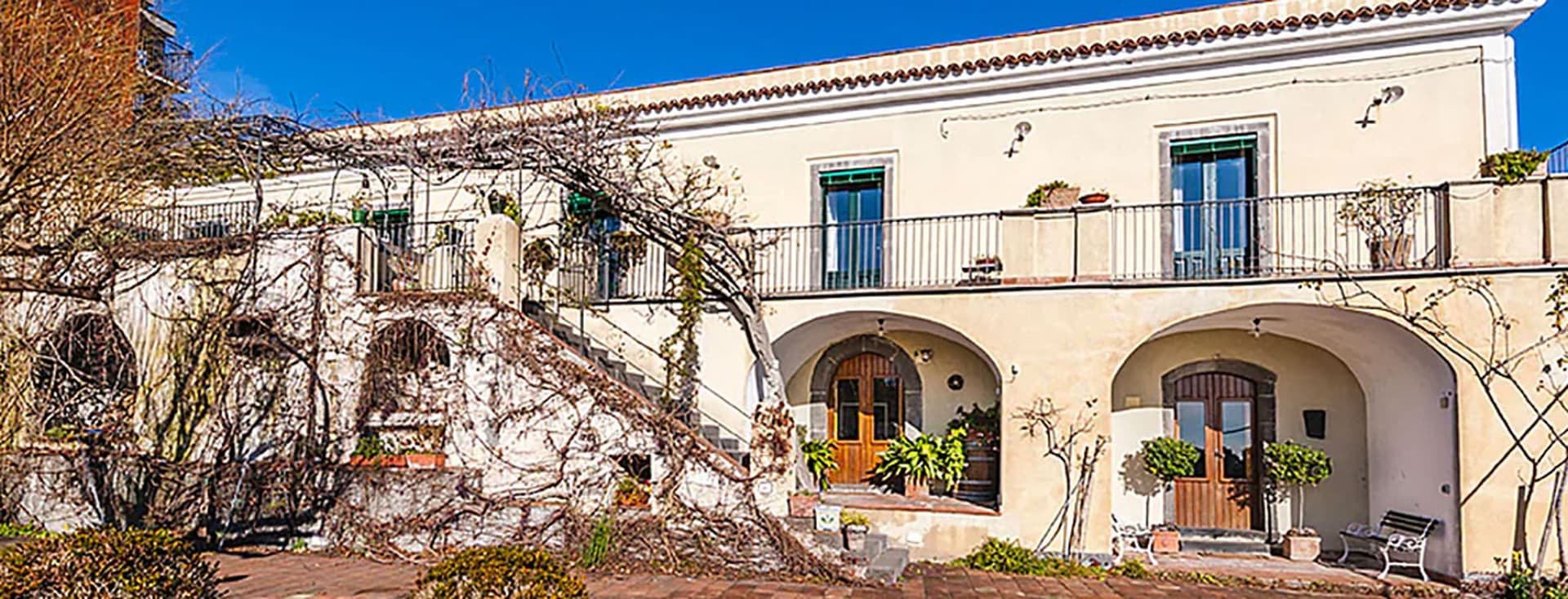
The charm of the ancient Etnean palmenti goes far beyond their aesthetic value. They serve as a precious testament to the millennia-old winemaking culture of Mount Etna, making it a true privilege to have such a feature within a property.
The palmento is an evolution of the Torcularium found in ancient Pompeian and Stabian villas from the Roman era. Its central element is the wine press, originally operated by a lever system, which was later replaced by a screw mechanism. This technical innovation on Mount Etna facilitated the widespread transformation of hilly terrain into stunning vineyards.
For this reason, the palmento became an economically, socially, and politically significant structure in the Etnean region. Given the extensive time and labor required for winemaking, many families eventually built homes on their land, always accompanied by a palmento to process their grapes.
Taormina, Sicily, Italy
Price on request
Taormina, Sicily, Italy
Price
€3,500,000
Castiglione di Sicilia, Sicily, Italy
Price
€2,900,000
Taormina, Sicily, Italy
Price
€1,800,000
Naxos, Sicily, Italy
Price
€1,680,000
Taormina, Sicily, Italy
Price
€1,300,000
Taormina, Sicily, Italy
Price
€1,200,000
Mascali, Sicily, Italy
Price
€1,100,000
Taormina, Sicily, Italy
Price
€1,020,000
This is how the Etnean countryside was soon colonized by hundreds of cellar-houses, characterized by an upper floor overlooking a terrace supported by sturdy arches, which sheltered the winery spaces on the ground floor.
What defines the typical Etnean palmento—besides the use of lava stone—is its gravity-based winemaking process. The entire structure was designed to rely solely on gravity for the movement of the liquid, eliminating the need for mechanical lifting equipment.
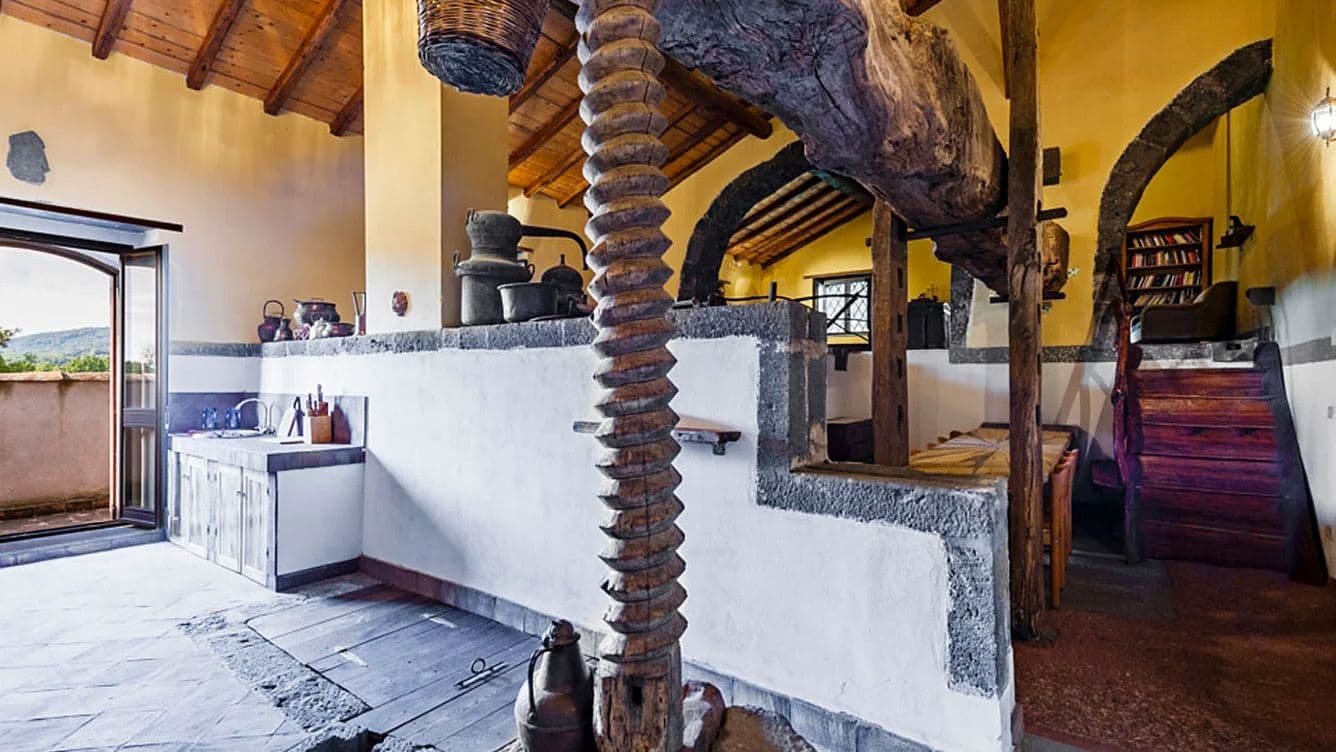
The harvested grapes, carried in woven cane baskets (coffe or cufini), were transported on the shoulders of labor crews known as "ciurme" to the palmento. Upon reaching the upper section via a staircase, the workers would unload the grapes through a window into the "pista", a lava stone vat where the pistaturi would stomp them barefoot or wearing heavy boots.
As they worked, these laborers performed a circular dance, singing traditional harvest songs while keeping a rhythmic step and holding their hands behind their backs. To further press the grapes, they used a large woven willow wheel about 1.5 meters in diameter, known as the "sceccu". Several workers would step onto it one foot at a time, and at a coordinated signal, they would all jump onto the "sceccu" at once, applying additional pressure to the crushed grape remains.
The freshly pressed must flowed through narrow lava stone channels into another lower vat called the tina, also built from lava stone slabs. During pressing, previously crushed grape skins and stems (bucce e raspi) were continuously returned to the tina for further extraction.
Fortunately, the charm of these structures—many of which still house their original chestnut wood presses, carved from massive tree trunks—has ensured that these rural testimonies remain preserved. Today, many historic Etnean farmhouses still feature these remarkable palmenti, allowing us to appreciate their legacy.
You may also be interested in



Contact provider

Page content provided by: Deux Real Estate S.p.A.
License partner of Engel & Völkers Italia S.r.l.