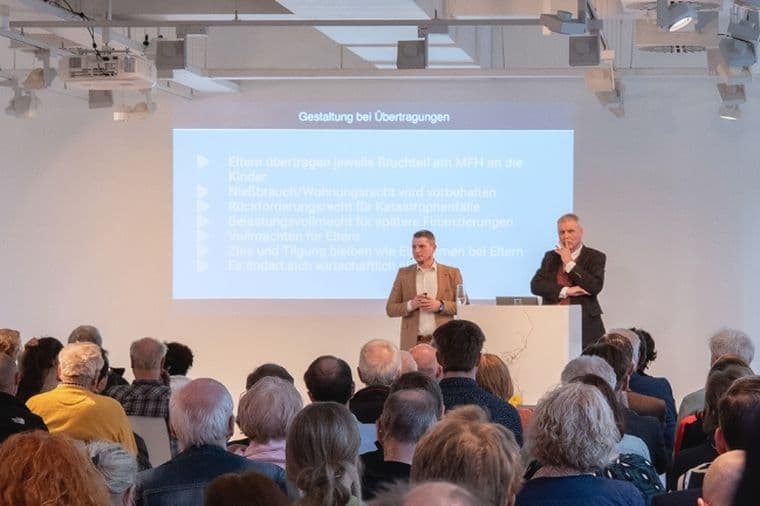
Passing down real estate is a key concern for many families of property owners. It is not just about assets, but also about responsibility, clear lines of authority, and the question of how real estate can be preserved within the family over the long term. The fact that this topic is currently on many owners’ minds was also evident at a well-attended event hosted by Engel & Völkers Commercial Berlin, where, among others, Berlin-based attorney and notary Philipp J. Scheerans explained the legal and tax fundamentals of real estate succession.
Real estate differs significantly from other assets when it comes to succession planning. It cannot be easily divided and is usually associated with ongoing obligations, such as leasing, maintenance, financing, and management. Without early planning, statutory succession applies. In the case of real estate in particular, this often leads to communities of heirs in which multiple people must make decisions jointly. This can limit the ability to act and foster conflicts within the family.
This is particularly relevant for residential and commercial buildings. If, in the event of inheritance, it remains unclear who makes decisions or how multiple heirs are to act jointly, this can have significant economic consequences. In the worst-case scenario, a forced sale looms, often to the detriment of all parties involved and, above all, to the advantage of the buyer, who can acquire the property at a bargain price in such a situation. Equally problematic is renovation work that has been postponed for years. If necessary maintenance is not addressed in a timely manner, a backlog of renovation work can result, which in turn leads to vacancies, loss of value, and additional economic pressure.
Plan Early Rather Than React Later
Anyone who does not simply want to let the statutory order of succession take its course should plan ahead. In particular, a will, an inheritance contract, or the transfer of real estate during one’s lifetime are options to consider. Early planning creates clarity, can prevent future disputes, and allows assets to be passed on in a targeted manner.
An important component is what is known as “anticipatory succession.” This involves transferring real estate during one’s lifetime. This can be beneficial because owners can personally determine who should receive which property. At the same time, tax exemptions can be utilized more effectively. This can have significant implications, particularly for larger assets.
However, a transfer during one’s lifetime should not take place without safeguards. Depending on the circumstances, usufruct, rights of reversion, and prohibitions on sale and encumbrance may be advisable. Claims to a compulsory share and supplementary compulsory shares should also be considered early on. After all, good succession planning is not limited to the mere transfer of property but must also take into account its legal and family implications.
Family Home, Planning, and Responsibility
The family home holds particular significance. There are specific tax considerations here that should be carefully examined on a case-by-case basis. For example, the transfer of the family home to a spouse or registered partner may be tax-advantaged or tax-exempt under certain conditions. This is another reason why it is worthwhile to assess early on whether a lifetime transfer or an arrangement for the event of inheritance is the better solution.
Succession planning also includes a power of attorney for healthcare, a general power of attorney, guardianship arrangements, and a living will. Especially when it comes to real estate assets, it is important that actions can still be taken even if the owner is temporarily or permanently unable to make decisions. A lack of planning can quickly lead to practical problems in such cases.
When passing on real estate, one is not only transferring ownership but often also ongoing responsibilities and long-term obligations. This makes it all the more important to plan early, take advantage of legal and tax options, and involve the next generation. This ensures that real estate assets are passed on in an orderly, forward-thinking manner that serves the family’s best interests.