- 8 min read
- 28.12.2026
- by Sven Michaelsen
Empathetic Trailblazer – the gallery owner Thaddaeus Ropac
Issue
01/26
Location
Salzburg, Austria
Photography
COURTESY OF GALERIE THADDAEUS ROPAC, LONDON • PARIS • SALZBURG • MILAN • SEOUL.
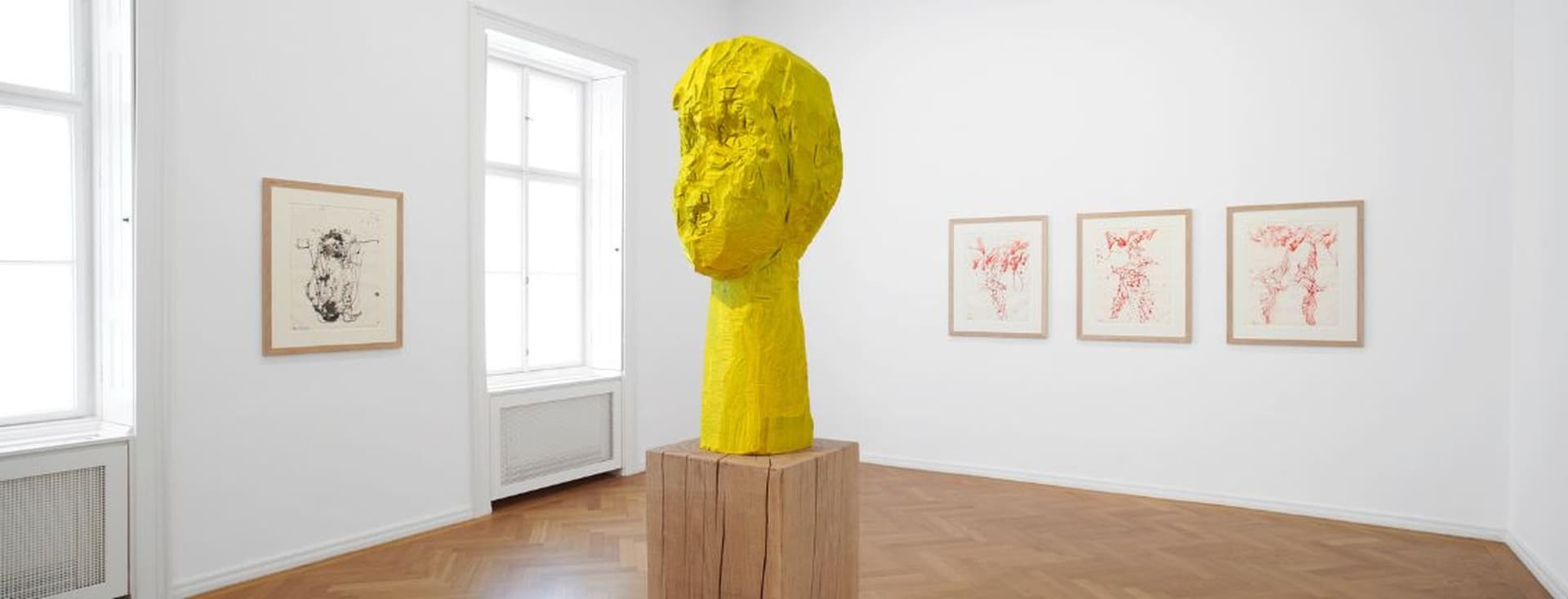
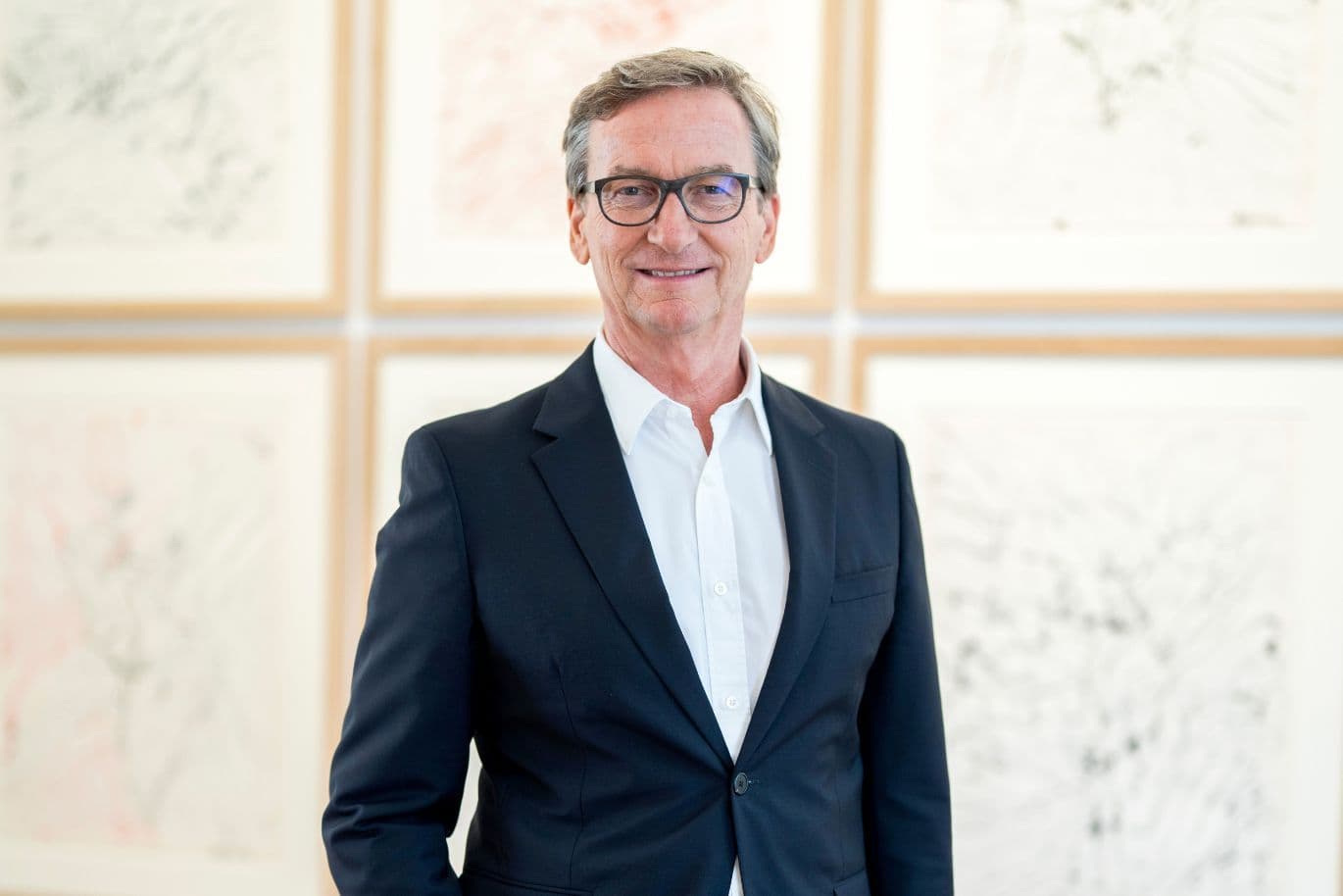
One of the world’s most influential gallerists, Austrian-born Thaddaeus Ropac and his teams represent 76 artists and their estates – including those of Joseph Beuys and Andy Warhol – across three continents. We talked with him about happy moments, missed opportunities and his own significance.
The remarkable career of Thaddaeus Ropac
When Thaddaeus Ropac recalls his journey from self-taught artist to one of the most important gallerists of our time, it’s tempting to think he has carefully crafted the story himself. Fine art was absent in his parents’ home life; his father was a leather expert who worked in factories in Carinthia. Describing himself as “ignorant of everything but willing to try anything,” Ropac applied for a position as an assistant to Joseph Beuys in 1982 and landed an unpaid job as “assistant to the junior assistant.” Beuys barely noticed him, Ropac says, but after a few months, he wrote Ropac a letter of recommendation for Andy Warhol “– purely out of kindness.” The text, written in felt-tip pen on a napkin, read: “Dear Andy, please meet this talented young man. Joseph.” When Ropac presented himself at The Factory in New York, he was introduced to Jean-Michel Basquiat the same day.
Ropac used Basquiat’s drawings to stage an exhibition in his newly opened gallery in Salzburg. “I later asked Basquiat why he had entrusted his drawings to a 22-year-old novice like me. He replied, ‘Because Andy brought you.’” Today, Ropac has 150 employees across the globe. The gallery’s roster of living artists includes such world stars as Anselm Kiefer, Georg Baselitz, Elizabeth Peyton, Tom Sachs, David Salle, Tony Cragg, Alex Katz and Robert Longo.
We found Ropac sitting in the executive office of his Salzburg gallery, a cup of green tea in front of him and a Baselitz behind him. Unlike the global market leader, Larry Gagosian, Ropac comes across as more of a reserved aesthete who would rather discuss the influence of Paul Celan’s poetry on Anselm Kiefer than talk about prices and profits.
The school of big names
Mr. Ropac, you are self-taught. At what point were you first able to distinguish a Monet from a Manet?
In my mid-twenties. I started with contemporary art and worked my way backwards.
Was there a particular moment that sparked your enthusiasm for art?
Yes, my eureka moment came in 1979 at Joseph Beuys’s installation “Basisraum Nasse Wäsche (Jungfrau)” in the Palais Liechtenstein in Vienna. At first, I was annoyed because I didn’t understand what three aluminum gutters, two tables and a bale of laundry had to do with art. On the other hand, I was curious about why people had chosen to exhibit this kind of thing in such a prestigious setting. This inner conflict is what led me to the art scene at the age of nineteen.
When did you first see Beuys in person?
At an event at the University of Applied Arts in Vienna in 1981. The room was so overcrowded, I had to stand on a table. Although he arrived with three or four other artists, by the end of the event it seemed like Beuys had been the only one there. He had a rare and remarkable presence and an ability to captivate an audience through his voice and body language alone.
What was your impression of Andy Warhol?
In many ways, he was the opposite of Beuys. He was shy and awkward and spoke so quietly, it was often difficult to understand him. But he was the living embodiment of his own myth, which was naturally very exciting. Whenever he appeared at an exhibition or party wearing his white-blond wig, a murmur would sweep through the room.
Artists want someone with a critical mind who can tell them when they’ve lost their way.
Thaddaeus Ropac
You presented the last exhibition of Jean-Michel Basquiat’s lifetime in Salzburg in July 1988. What did you think of him?
Basquiat’s drug addiction and erratic behavior were hard to overlook. Today, few people remember that his career had many ups and downs. When he died on August 12, 1988, his reputation was at an all-time low. His collaboration with the famous New York gallery owner Mary Boone had ended and the prices of his paintings were falling rapidly. The Basquiat boom didn’t begin until years later.
When you founded your gallery in 1981, Basquiat was one of the first artists you exhibited. How did his drawings go over with the public?
I couldn’t sell a single one. But then again, I didn’t really have much of a customer base. At the time, my gallery was located above a U.S. Army surplus store.
Have you ever discovered an artist, or is that something only smaller galleries can do?
We don’t constantly go to art schools looking for talent, but we make a point of finding young artists early – ideally before our colleagues spot them. Our youngest artist is Eva Helene Pade, who was born in Denmark in 1997 and lives in Paris. One of our employees discovered her at a group exhibition in Copenhagen. We all knew immediately that she was destined to have a great career.
Your legendary colleague, Rudolf Zwirner, said, “You can only appreciate the art of your own generation.” Now that you’re 65, do you understand the art produced by 30-year-olds?
I agree with Zwirner. When we exhibited Hito Steyerl in London, our team asked her to take part in a discussion with young artists. She agreed and chose the artists herself. I was in the audience at that event but didn’t always understand what they were talking about. I struggle to connect with art that applies AI in language and materials. I’m happy to leave these topics to our younger employees. As you get older, you can’t endlessly develop a new understanding of contemporary art.
On moderation, attitude and responsibility
Is there an artist that you regret not having recognized sooner?
Brice Marden is one example. He was a friend and neighbor of mine on the Greek island of Hydra. He was 22 years older than me and part of a different generation. If I’d recognized his importance from the start, I’d have made more of an effort to support him. It was a missed opportunity, and I do look back with regret.
Is there a piece of art that has haunted you because you wanted to buy it but couldn’t?
As I’m building my own collection alongside the gallery, this happens more often than I care to admit. No sooner do we acquire a piece to address one gap than a new gap opens. But there have also been lucky breaks I never thought possible. For years, I pursued a major work by Robert Rauschenberg: “Rigger,” from 1961, and finally acquired the painting in the spring.
Which piece in your collection holds the most sentimental value for you?
Perhaps the most important piece in my collection is Beuys’s installation “Lightning Strike with Glow on Deer.” I was there when it was created, though not as Beuys’s assistant, as is often mistakenly claimed. I just fetched beer or was sent out to buy glue. I wasn’t actually involved in the creative process at all. Thirty years later, Beuys’s widow offered to sell me the original sculpture, which consists of 39 parts. I never would have expected that, even in my wildest dreams. It brought me full circle, from being an assistant barely scraping by and living in a youth hostel to being a gallerist and Beuys collector.
What if you visited one of your artists in their studio and didn’t like what you saw. Would you tell the artist to their face or leave it up to one of your staff?
I’d do it myself. It’s much easier than you think. Over the years, you build a relationship of trust that allows you to be very honest with each other. When artists ask me what I think of their work, they’re looking for constructive feedback rather than empty praise. Unconditional approval would make them suspicious. They want someone with a critical mind who can tell them when they’ve lost their way or when a work still isn’t finished.
Ultimately, art is always about the artists. People like me are forgotten soon or later.
Thaddaeus Ropac
When long-time museum director and curator Kasper König was asked how long it takes him to recognize an exceptional work of art at exhibitions, he replied: “0.1 seconds. When I’m in the right mood, even my ass can recognize good art.” How about you?
König is right. When you’ve seen a lot of art, you quickly recognize something that’s special and extraordinary. But such moments are rare. Take the Venice Biennale, for example, where you can see hundreds of works of art. I discount most of them within just a few seconds.
Are you, Larry Gagosian, David Zwirner, and Iwan Wirth the first gallery owners in art history to be more famous than most of the artists you represent?
That’s a huge misconception, which I reject. I’ve studied the great gallery owners of the 20th century. The most powerful and influential of these was Leo Castelli. He discovered art movements and introduced them to the world. After his death in 1999, his artists grew in importance and prominence, while his own name gradually faded. Who still talks about Daniel-Henry Kahnweiler, Picasso’s gallery owner? Ultimately, art is always about the artists. People like me are bound to be forgotten sooner or later.
Every major collector dreams of having a museum named after them. Would you like to achieve immortality this way?
I don’t want to talk about a museum yet. You have to be careful it doesn’t become a vanity project. The art is what’s important, not the collector.
The question about favourite artists
Can you explain why three of the world’s most important gallerists – David Zwirner, Iwan Wirth and you – are all from German-speaking countries?
I’ve often wondered, but I can’t think of a logical explanation. Perhaps it’s due to the international presence of German art. Many people in the German-speaking world are unaware of the global fame that artists like Kiefer and Baselitz have achieved.
Alberto Giacometti was once asked what he would save from a burning house – a cat or a Rembrandt. He chose the cat. Which would you choose?
I’m not falling for that one. Any answer I gave would be banal and pointless.
What pitfalls would you warn an aspiring gallerist to try to avoid?
Responding to a journalist who asks, “Who is your favorite artist?” I fell into this trap many years ago. It wasn’t long before one of the great painters called me and said, “So you don’t love me!” I understood his frustration. It’s hurtful to discover that your gallerist doesn’t consider you his favorite artist.
Gerhard Richter’s fortune is estimated to be around €700 million. Are you surprised that someone can achieve so much with a paintbrush?
No, because artists like Rubens, Dürer, van Dyck and Bernini were also wealthy in terms of their purchasing power.
You have been the sole owner and director of your gallery for over 40 years. Who could possibly challenge you now?
Oh, anyone! In fact, I demand to be challenged. Sixteen directors from all over the world are part of our decision-making process. I recently suggested an artist who I thought would be a good fit for the gallery. I was sidelined, and accepted that. I know that I don’t always know everything. How could I possibly insist on being right about art from Southeast Asia or South America? I don’t have any experience in those areas.
Find your property in Salzburg.
Offered properties
- New
- New
- New
- New
- New
- New
International presence and personal touch
You have veto power. When do you make use of it?
If I can’t relate to a piece, I’ll tell the artist, “I’m sorry – it’s not going to work.” But situations like that are rare. We recently said goodbye to an employee in London who had managed a museum for forty years before joining us. Given her experience, her opinion was clearly as valid as mine.
Your gallery holds 35 to 40 exhibitions worldwide each year, including in faraway cities such as Seoul. Are you involved with every show?
I probably shouldn’t say this, but sometimes I don’t see the artworks until the exhibition opens. Then, I feel like a visitor.
You just opened a branch in Milan. Why aren’t you represented in New York yet?
I’d love to be there, but it would require a total commitment, like David Zwirner or Iwan Wirth, who moved to New York early on. I have an apartment in Manhattan but my life is in Paris and the cost of moving my life is too high for me. I’m probably too European.
Russian oligarch Roman Abramovich hides his art collection, which is worth an estimated $1 billion, from international sanctions in duty-free warehouses, the darkrooms of the global art market. Do you still accept money from Russian buyers or their proxies?
We’re extremely cautious about this and have reduced it to a minimum. Our compliance department can trace the flow of money back to its source. It’s a tedious and time-consuming process, but it ensures that we don’t deal with criminals hiding behind shell companies or fronts.
For many years, Picasso’s last painting hung above Larry Gagosian’s bed. What hangs above your bed at Schloss Emslieb in Salzburg?
An early painting from Baselitz’s “Heroes” series.
When you’ve seen a lot of art, you quickly recognize something that’s special and extraordinary. But such moments are rare.
Thaddaeus Ropac
How would you rate your lifestyle?
Not very highly. I’m a dyed-in-the-wool gallerist. My lifestyle denies me what many people consider a “quality of life.” What I’ve achieved is based on talent, luck and hard work that has taken a toll on my physical health. You pay a price.
How many days do you travel each year?
About 180.
How much time do you spend at your house on Hydra each year?
Three days in June.
What expression in your industry would you like to see banned?
“That’s so inspiring.”
What’s one thing people say about you that you’re tired of hearing?
That I’m a good host.
How would you end your autobiography?
Art goes on. Don’t believe anyone who predicts the end of painting. The next generation will create pictures we can’t even imagine today. In the art world, everyone is ultimately just a footnote.
Would you buy a portrait of the person you were before you became who you are today?
Absolutely! What would I see in that picture? A curious young man with very long hair who is naive and ignorant. I wouldn’t be afraid of anyone seeing that portrait.
You may also be interested in
 Hollywood’s Sorceress of Scent
- 5 min.
- 04.09.2026
 Champagne: Pure Gold from the Vine
- 6 min.
- 04.09.2026
&w=1920&q=75) Maj van der Linden – Art Space
Maj van der Linden – Art Space- 3 min.
- 4.9.2026
 Beaded Beauty – an interview with Marijke de Cock
- 2 min.
- 05.06.2026
 Going deep – an interview with freediver Guillaume Néry
- 2 min.
- 5.6.2026
 Francis Kéré – What really matters
- 9 min.
- 16.06.2026
 The fashion label Zeus+Dione: Threads of Force
- 5 min.
- 26.05.2026
 The Hand of the Visionary – Designer Kelly Wearstler
- 5 min.
- 14.04.2026
GG Magazine exclusive content
GG is an independent magazine at the highest level. Exploring the world of architecture, lifestyle, design, fashion, yachting, luxury living and travel. We seek out the most exciting topics and personalities for you and invite you to get to know them from a fresh new angle. In GG, you will meet successful architects, interesting designers and exciting artists who are the talk of the town from London to New York and Berlin to Hong Kong.