- 2 min read
- 05.06.2026
- by Merle Wilkening
Beaded Beauty – an interview with Marijke de Cock
Issue
03/26
Location
Antwerp, Belgium
Photography
Rodriguez Debal
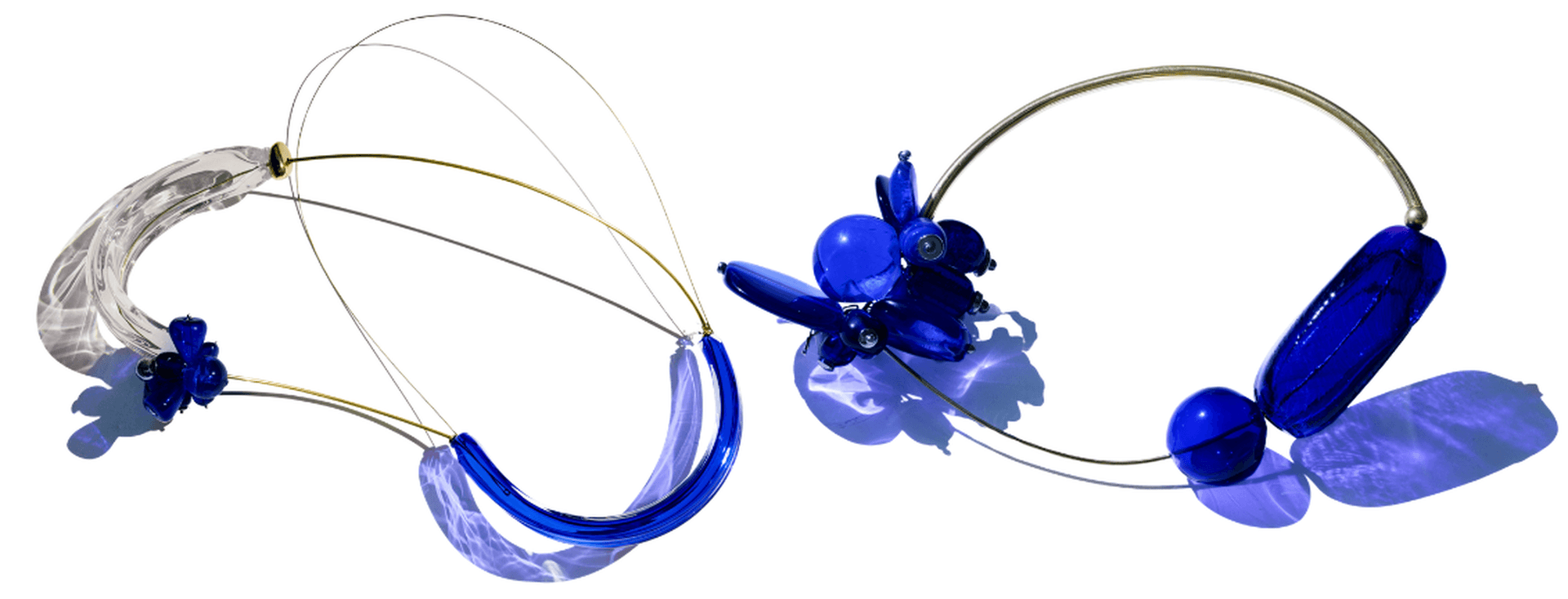
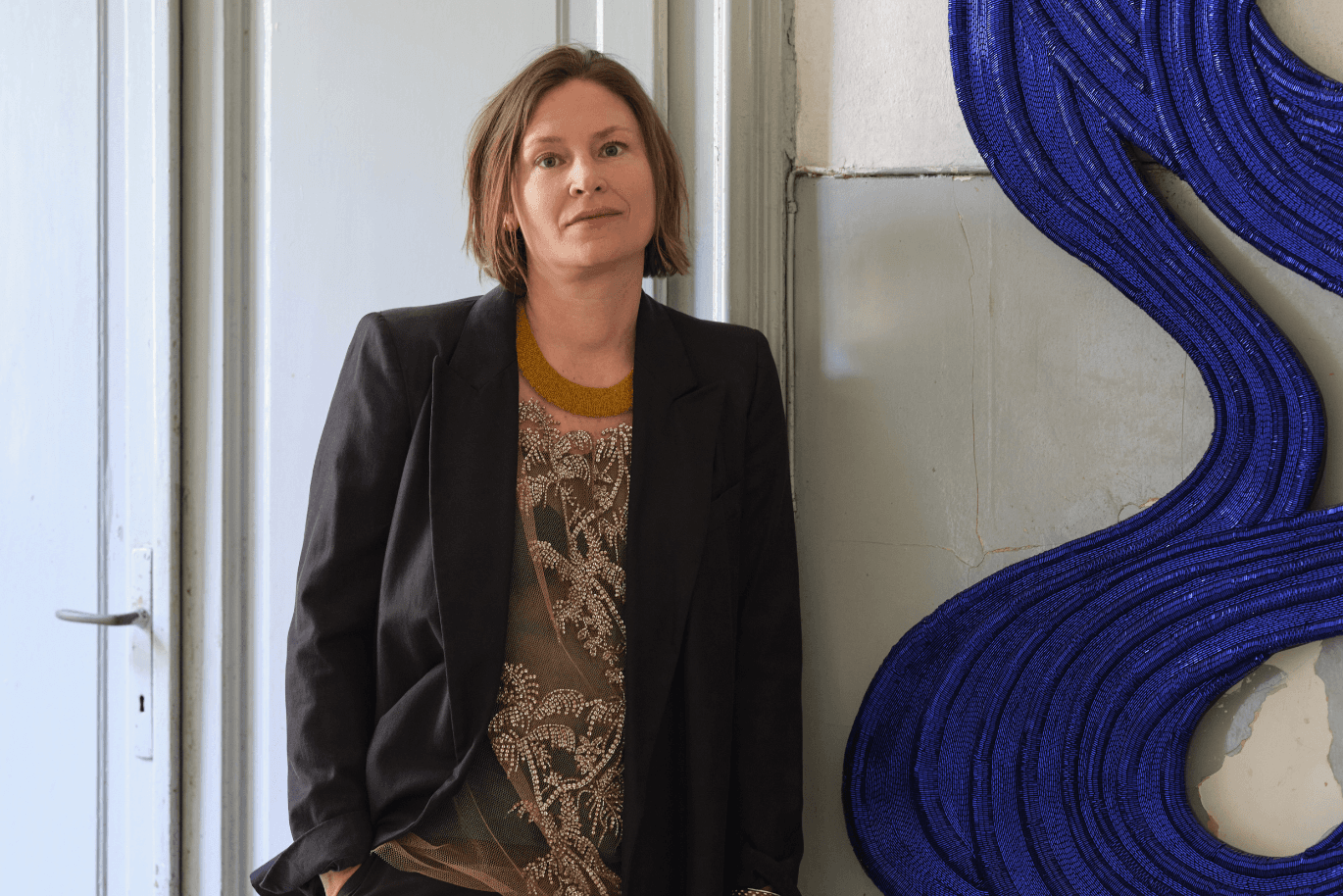
Delicate beads, glass, brass and oak are what Marijke De Cock uses to construct her remarkable pieces. But instead of fashioning precious jewelry to adorn a neckline or a wrist, the artist and designer from Antwerp creates dynamic sculptures. Influenced by the years she spent working for fashion designer Dries Van Noten and driven by a deep fascination for intuitive handcrafts, De Cock produces wall objects that celebrate modern abstract art as well as traditional techniques. She begins the creative process by surrendering herself to it entirely and allowing her hand to glide freely across a piece of paper. Her drawings are the foundation for works that live somewhere between art and design, pieces that appear to dance in space and move about a room. Like an article of high fashion, each piece is brought to life by the meticulous hand application of thousands of glass beads – an embroidery technique that creates a dynamic landscape where light and shadow merge. The result is an ornament for the soul of a home and an invitation to follow its shifting rhythms in space.
Table of Content
Flow takes time
The theme of our upcoming issue is "Flow" – a state where time often seems to stand still. Yet, your glass bead embroidery technique is extremely time-intensive. How many hours are invested in your most complex work to date?
It is a compelling duality. To create a work that exudes 'Flow' – where lines wander effortlessly across a space – requires a meditative discipline that stands in direct opposition to our culture of speed.
In our studio, time is not measured simply in hours, but in the layers of devotion required to bring a vision to life. The 'Flow' the viewer experiences is the result of a rigorous, multi-phased journey: from the initial intuitive sketch and the precision of the technical drawing to the rhythmic hand-embroidery and the essential period where the fabric must 'rest' to find its natural tension. The process continues with the engineering of the multi-part structural supports and the final, delicate mounting of the embroidery. We do not count the hours; we make the hours count. It is this accumulation of focused gestures – some invisible, all essential – that makes time tangible. We offer the luxury of a process that takes exactly as long as it needs to reach perfection.
In your practice, you describe the hand as "going beyond thought." Is this intuitive process, for you, the purest form of freedom?
Absolutely. For me, the 'hand moving by itself' is the only way to escape the ratio. In that initial phase, there is no plan – only the pure movement of the pen. It is the freedom to become without having to explain.
However, the paradox is that this absolute freedom can only be preserved through technical mastery. To translate a fleeting, intuitive 'doodle' into a monumental object, I must convert that line into a highly precise technical drawing. This is where my 25 years of experience within the creative team of Dries Van Noten becomes essential. Those decades taught me how to dissect an abstract idea technically without losing its soul. The freedom is in the spark; the expertise ensures that the spark survives the transition into a solid, physical reality.
The poetry of materials
Your new wall sculptures are described as lines that "wander" and "dance." How do you manage to translate the fleeting lightness of a hand-drawn sketch into the heavy materiality of oak, brass, and glass?
That is exactly where the greatest challenge and the magic lie. It is a process of constant dialogue. On one hand, there is the technical skill of 'reading' and deconstructing an intuitive line. On the other hand, there is the close collaboration with my partner, architect Rodriguez Debal.
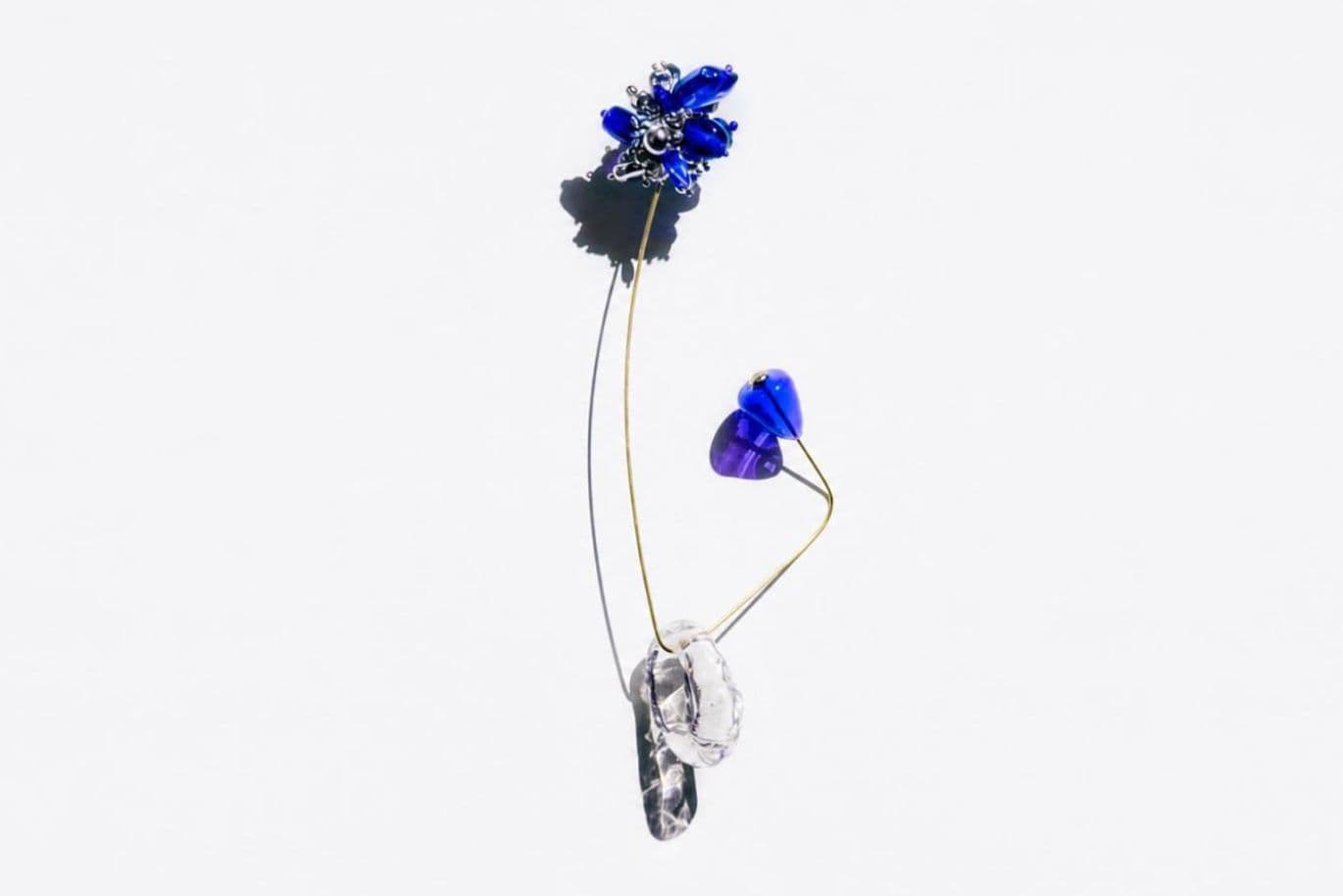
We combine his architectural insight with my focus on the finesse of the ornament. He translates my drawings into volumes – sawing, milling, and sculpting in oak – so the 'doodle' literally detaches from the wall. We obsessively guard the spontaneity; the beads sometimes 'overgrow' the wood or are hammered directly into it. By playing with the transparency of glass and the reflection of metals, we catch the light. It is the light that lifts the weight of the material, allowing a physically heavy object to breathe and dance just like the original line on paper.
In large quantities, glass beads often resemble water – reflecting light, shimmering, and creating an almost fluid aesthetic. What role does the element of light play in bringing vitality to your static artworks?
The comparison to water is very apt. I see the glass bead as a physical 'pixel of light.' A static object only becomes a living work of art through the interaction with its environment. Because each of the thousands of beads is set at a slightly different angle, the surface responds constantly to the movement in the room.
As the sun moves through a space, the sculpture begins to vibrate. In my newest works with hand-blown beads, the light doesn't just hit the surface; it is conducted through the core of the object. Light is the heartbeat of the work; it connects the piece to the present moment – a moment that, like the light itself, can never be fully captured.
When you look at your large-scale "spatial jewelry" – what specific place or moment of absolute freedom do you associate with this new series?
I associate it with the state of total innocence I find in the studio – a rare space where there is no 'must,' no function, and no judgment. Specifically, it is the moment a drawing is no longer a flat plane but becomes a volume that claims its space and embraces the viewer.
That, to me, is ultimate liberation. It is also a celebration of synergy: the freedom that arises when two people understand each other's language so deeply that technique becomes secondary to vision. My work is successful if the viewer feels that same stillness; a moment where they can get lost in the shimmer of a bead and simply be.
Find your property in Antwerp.
Living amongst canals and galleries
- AI
- Exclusive
- AI
The pearl, reimagined
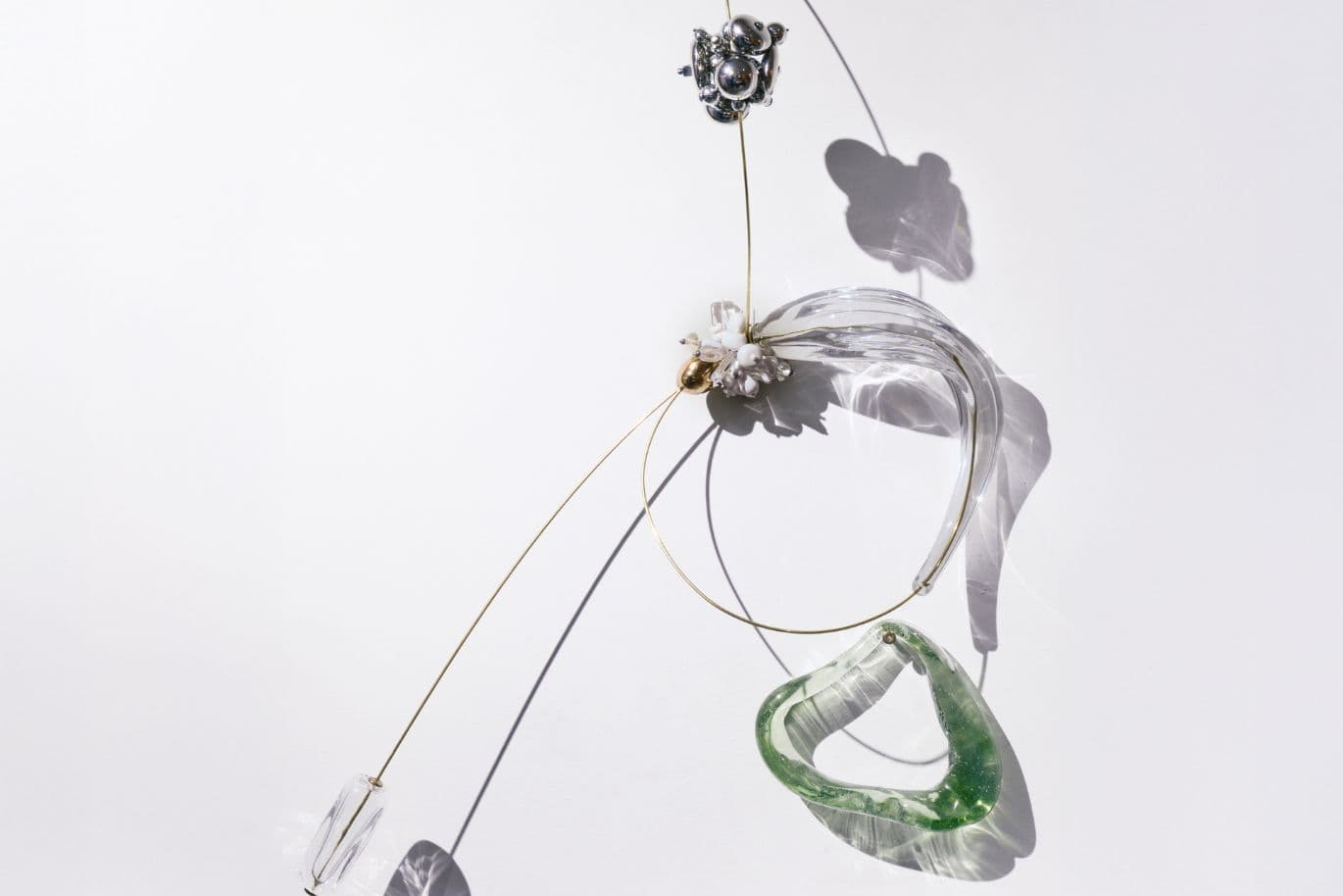
For your new works, you collaborated with a glassblower to massively increase the scale of the beads. How does this new dimension change the haptic experience and the overall aura of the object compared to traditional jewelry?
The scale change shifts the experience from the 'intimate' to the 'immersive.' Traditional jewelry is felt against the skin; these new dimensions create an architectural aura. The experience becomes much more physical: you feel the coolness of the large glass surfaces and the strength of the construction.
The transparency of these large beads also honestly reveals the 'nerve' of the work – the underlying line is now visible. It removes the bead from the realm of decoration and places it in the realm of sculpture. The ornament no longer needs a body to shine; the ornament has become the body.
Your works captivate through an organic visual language that evokes anything from coral reefs to dancing lines. Aside from the world of fashion, where do you find your strongest visual inspiration?
My strongest source is the abstraction of the subconscious. I am fascinated by the 'automatic' drawings of the surrealists and the boundary between control and letting go. In my studio, I surround myself with materials that seem to have a will of their own. I don't seek to copy nature, but to adopt its rhythm. I search for that 'unnameable' space between the recognizable and the otherworldly. That is what drives me most.
You may also be interested in
 Hollywood’s Sorceress of Scent
- 5 min.
- 04.09.2026
 Champagne: Pure Gold from the Vine
- 6 min.
- 04.09.2026
&w=1920&q=75) Maj van der Linden – Art Space
Maj van der Linden – Art Space- 3 min.
- 4.9.2026
 Going deep – an interview with freediver Guillaume Néry
- 2 min.
- 5.6.2026
 Francis Kéré – What really matters
- 9 min.
- 16.06.2026
 The fashion label Zeus+Dione: Threads of Force
- 5 min.
- 26.05.2026
 The Hand of the Visionary – Designer Kelly Wearstler
- 5 min.
- 14.04.2026
 Art in Karat – Up-and-coming goldsmith Luca Sonnentag on his passion
GG Magazine exclusive content
GG is an independent magazine at the highest level. Exploring the world of architecture, lifestyle, design, fashion, yachting, luxury living and travel. We seek out the most exciting topics and personalities for you and invite you to get to know them from a fresh new angle. In GG, you will meet successful architects, interesting designers and exciting artists who are the talk of the town from London to New York and Berlin to Hong Kong.