Engel & Völkers Real Estate Times – All Roads Lead Home
Your real estate partner, anywhere in the world.
Engel & Völkers Real Estate Times – All Roads Lead Home
Your real estate partner, anywhere in the world.

Issue 02/2026
Welcome to the online edition of the Engel & Völkers Real Estate Times. In this issue (02/2026), we take an in-depth look at the current dynamics of the real estate market across the DACH region. Discover why a stable interest rate environment and moderate price developments in 2026 present smart investors with a strategic window of opportunity for property acquisition, where to find the best entry opportunities for resilient holiday homes, and how innovative architecture seamlessly blends the historic with the modern. In addition, we highlight the exclusive advantages of discreet off-market property marketing and demonstrate why future-proof renovations for barrier-free living comfort are already economically viable today.
Despite ongoing geo-economic disruptions, the residential real estate market remains solid. Data from Engel & Völkers Research indicates that price growth is moderate and interest rates have stabilized at a predictable level. Purchasing a property now is a clear decision with long-term foresight. For existing condominiums, the average asking price stands at €4,017 per square meter. This represents a resilient value, reflecting a 3.4 percent year-on-year increase. New-build apartments also showed realistic market development, rising by 2.8 percent to an average of €6,327 per square meter. Both figures signal the same trend: the market is active, yet free from signs of overheating. Existing single- and two-family homes cater to a different buyer demographic but are currently particularly attractive for prospective buyers. While the average price per square meter for existing houses remains steady at €2,918, significant variations exist within this segment. Properties with lower energy efficiency ratings can see prices discounted by 15 to 20 percent depending on their efficiency class, whereas energy-efficient, well-maintained properties are increasingly sought after and command premium prices.
This energy-efficiency gap creates distinct investment opportunities: buyers who acquire a property requiring renovation at a comparatively favorable purchase price can modernize it to yield significant long-term returns. Post-purchase investments drive property value appreciation while allowing buyers to fully customize their existing home according to their own vision.
Additionally, rising rental yields and market rents present a compelling argument for property acquisition. Over the past five years, average asking rents in Germany have risen by 26 percent. A persistent shortfall in new construction paired with population growth continues to accelerate this trend. Buying real estate today provides a hedge against inflation and rising rental costs—while offering something no lease agreement can replicate: the long-term security of true ownership. Your own four walls provide a sense of stability and peace of mind that goes far beyond simply having a roof over your head.
Current interest rate trends also favor making a buying decision this year. The interest rate cuts already announced by the European Central Bank have long been priced in by the financial markets. Consequently, significant impacts on mortgage rates are not expected. However, a further drop below the 3.5 percent mark is unlikely given current inflationary risks. This makes the prevailing interest rate environment a reliable foundation for financial planning.
The real estate consultants at Engel & Völkers are ready to support your journey to homeownership with deep local market expertise and a global network—whether you are looking in a major city, a suburban community, or wherever you choose to call home. Take the next step and arrive: the most rewarding journey is the one that leads home.
With 497.5 million overnight stays, Germany recorded yet another historic high in tourism in 2025. In parallel with rising visitor demand, the desire to own a private retreat in premium holiday destinations continues to grow. The reasons are clear: holiday homes are considered highly resilient investments. As a rule, they deliver long-term property value appreciation combined with high emotional returns. This enduring appeal is directly reflected in pricing trends: across the 42 holiday locations analyzed by Engel & Völkers, the average asking price for holiday apartments rose by another 1.4 percent in 2025, reaching €5,914 per square meter.
Popularity comes at a premium
Along the North Sea coast, North Frisia and the East Frisian Islands remain among the most sought-after holiday regions. In North Frisia, average asking prices for holiday apartments climbed to €8,597 per square meter (+3.6%). For exceptional luxury estates on the island of Sylt, trophy properties even command premium prices of up to €29 million. The East Frisia and Wilhelmshaven region also saw asking prices for holiday apartments rise by 6.9 percent to €5,970 per square meter. Acquiring a holiday apartment on Norderney is particularly desirable, with peak prices there reaching up to €28,500 per square meter.
In southern Germany, the Bavarian Alps showed the strongest growth, with holiday apartment prices surging 9.7 percent to €5,831 per square meter. In prime locations such as Garmisch-Partenkirchen, premium houses achieve sales prices of up to €10 million. The Upper Bavarian Lakes command even higher valuations: exceptional luxury real estate listings reach up to €35 million at Lake Starnberg and up to €25 million at Lake Tegernsee. What these prime markets share is a chronic shortage of inventory, an economically resilient buyer base independent of bank financing, and an incomparable natural backdrop.
Where to find market entry opportunities
For those who cannot or prefer not to invest in a absolute top-tier location, three German regions offer highly attractive alternatives. The Southern Black Forest presents the most accessible price level among the 42 holiday destinations analyzed by Engel & Völkers Research, averaging €2,809 per square meter for holiday apartments. At the same time, rental yields of 3.5 to 8.0 percent are achievable here, supported by fewer regulatory restrictions than in other regions. In Mecklenburg-Western Pomerania, excellent entry opportunities are found primarily along the Western Pomeranian Baltic Coast and the Mecklenburg Lake District. Along the Baltic coast, average asking prices for holiday apartments stand at €5,228 per square meter, with Stralsund and Greifswald standing out as particularly attractive hubs. In the Mecklenburg Lake District, a holiday apartment costs an average of €4,270 per square meter, while detached holiday homes are sometimes available for under €500,000. For top-tier properties in this region, rental yields of up to 5.0 percent can be realized.
Future market outlook
According to Engel & Völkers Research, a two-tiered holiday real estate market is emerging. In the premium segment of prime locations, prices are expected to see further moderate increases due to chronically low inventory. In good and average locations, prices are largely consolidating at their current levels.
Energy efficiency remains a critical differentiator. Properties with a renovation backlog must accept price discounts, whereas real estate in efficiency classes A and B benefits from stable value forecasts and commands higher daily rental rates. Furthermore, regulatory restrictions—such as local zoning laws with exclusion clauses for holiday rentals—continue to limit new construction, ultimately strengthening the long-term value of existing properties.
Anyone looking to sell a property usually lists it online. Platforms like Immobilienscout24 or ImmoWelt record millions of page views every day. Many property owners assume that broad visibility automatically attracts the right buyers for a property. However, this logic does not apply to every property—or every buyer demographic.
The key to the market for exceptional real estate is discretion. Discreet marketing, often referred to as an "off-market sale" or "private sale," describes a process where a property is purposefully and confidentially presented to a select circle of potential buyers. The public never finds out that the property is available.
A shield against curiosity and rumors
The motivations for quiet marketing vary. Prominent figures from business, politics, and culture appreciate this approach to buying and selling real estate just as much as corporate owners or communities of heirs. People facing life transitions where a public listing could spark rumors among acquaintances or attract curious neighbors also prefer their property marketing to remain discreet.
The preparation for discreet marketing closely mirrors that of a public property listing. In both cases, the foundation is a premium exposé featuring high-quality photography. In an off-market sale, however, this exposé is not included in the publicly accessible Engel & Völkers online portfolio. Instead, our real estate consultants carefully and directly contact pre-registered, pre-qualified buyers. The advantage for qualified prospective buyers is clear: in quiet marketing, they receive privileged access to exceptional, often exclusive properties.
There is another underestimated benefit to an off-market sale: it prevents the property from becoming "stale" on the market. Real estate listings that remain publicly visible for extended periods are often viewed skeptically by buyers. Keeping a property completely out of the public eye from the very beginning protects it from this perception.
Success through targeted client engagement
The quality of your consultant’s network is critical to the success of an off-market sale. Thanks to its more than 1,100 locations worldwide, Engel & Völkers has access to an extensive and diverse pool of contacts who are actively searching for the right property. This ensures that we reach the exact buyers whose search profiles align with the home. Features, location, and other property requirements are matched just as precisely as the target price range.
For property owners, the most important benefit is retaining complete control over who learns about the intent to sell. There are no inquisitive questions from neighbors, no reputational risk, and no insights into personal or financial circumstances. The number of property viewings in an off-market sale is kept to a strict minimum. No one visits out of mere curiosity; every viewing is backed by genuine, serious interest.
Private Office: Discretion as a core competency
Engel & Völkers has not only integrated discreet marketing as a core service across all its locations. Through our Private Office division, the company offers a dedicated platform exclusively focused on the confidential buying and selling of extraordinary luxury real estate. The Private Office was established to meet the highest standards of a sophisticated clientele, providing discreet access to premium real estate portfolios in the world's most sought-after locations.
An increasing number of people in Germany are reaching an advanced age. As a result, tenant expectations for residential apartments are shifting, driving up demand for greater living comfort and barrier-free accessibility. For landlords, this represents a major strategic opportunity: those who invest in accessible renovations today secure a distinct competitive advantage in tomorrow's rental market.
Defining senior-friendly living
An age-appropriate apartment is designed to allow individuals to live independently and safely, even when facing limited mobility. At its core, it focuses on eliminating physical obstacles and simplifying daily life through thoughtful space planning.
Threshold-free entryways, slip-resistant flooring, ample clearance space, and highly accessible bathroom features—such as a flush, walk-in shower, grab rails, and wheelchair-accessible vanities—form the foundation of senior-friendly real estate. Wider doorways and ergonomically positioned light switches and controls further enhance functionality. Implementing these measures systematically creates a property that appeals not only to seniors but to a broad demographic of prospective tenants, including families with young children.
Why accessibility pays off
The financial logic is clear: high-demand, barrier-free apartments—provided they feature a prime location and good energy efficiency—can command noticeably higher rental yields than comparable standard listings. At the same time, vacancy rates generally drop because the property appeals to a significantly larger pool of potential tenants.
From a landlord's perspective, lower tenant turnover is particularly advantageous. Fewer move-outs mean reduced renovation costs between tenancies, lowering overall property management expenses. Ultimately, these upgrades elevate the asset's profile as a capital investment: senior-friendly features make a property future-proof and have a positive impact on its long-term resale value.
Financing support: KfW and regional subsidies
A portion of these renovation costs can be offset by government funding. Through Program 159, "Age-Appropriate Renovation" (Altersgerecht Umbauen), the KfW development bank provides low-interest loans of up to €50,000 per residential unit. Loan terms ranging from 4 to 30 years, alongside grace periods of up to five years before principal repayment begins, offer excellent financial flexibility. The interest rates for these promotional loans align with capital market trends and are adjusted regularly.
Eligible projects include creating barrier-free entrances, optimizing floor plans, installing elevators or stairlifts, and implementing burglary protection measures. It is mandatory to submit the loan application to your primary bank or savings bank before construction begins; DIY labor costs are typically not eligible for funding.
In addition to KfW programs, individual federal states and municipalities offer their own regional subsidies. Because criteria vary by location, contacting the local city or municipal administration is highly recommended. In many instances, multiple funding sources can be utilized simultaneously.
Act now to secure long-term value
Demographic shifts are already redefining modern housing requirements. Landlords who proactively undertake accessible renovations secure stable rental income, loyal long-term tenants, and an asset that delivers sustainable property value appreciation. Available financial subsidies significantly lower the entry barrier. Ultimately, it is a win-win scenario: your tenants enjoy an elevated quality of life, while you secure a future-proof property investment.
The mortgage market has experienced significant changes over the past few years. Currently, interest rates for construction and property financing have leveled off at around 3.6 percent and appear relatively stable. However, future developments in the interest rate market over the coming years cannot be predicted with absolute certainty.
The good news: while interest rates and financing terms are heavily influenced by market timing, they also depend on several other criteria. Your credit score, the property's location, available equity, your financial goals, and your monthly income play a decisive role in determining how favorable your loan terms will be. However, because different lenders offer widely varying rates, comparing multiple financial institutions is absolutely essential.
These factors influence your interest rate
Equity: The general rule of thumb is that higher equity leads to a lower interest rate. The larger the down payment, the smaller the gap between the loan amount and the property value, which significantly reduces the lender's risk.
Credit rating: Securing an attractive real estate financing package requires a strong credit profile. Lenders will pull a SCHUFA credit report, which calculates a score of up to 100 percent. For most banks, a score above 90 percent is considered sufficient.
Income: A stronger income situation directly improves the financing terms lenders are willing to offer. Consequently, a steady and ideally high income is a distinct advantage. Permanent employment is highly preferred, though certain banks also specialize in offering competitive mortgage loans to self-employed professionals and buyers of advanced age.
The property: Location, condition, size, and energy efficiency serve as the baseline for the lender's valuation of the property. The more favorable the loan-to-value (LTV) ratio, the lower your interest rate will be.
Fixed-interest period: Opting for a long fixed-interest rate period on a mortgage provides excellent long-term planning security. As a general rule, however, lenders typically charge a slightly higher borrowing rate for longer fixed terms.
Repayment rate: A higher principal repayment rate directly reduces your overall interest expenses. Opting for a higher initial repayment rate can also yield a more favorable borrowing rate, as it shortens the loan term and minimizes the bank's risk exposure.
Our conclusion
Finding the right mortgage at the best possible terms can often be a challenge. Therefore, it is critical to comprehensively compare financing options and tailor them precisely to your personal financial needs.
The team at Engel & Völkers Finance is here to provide you with complimentary, holistic, and bespoke advice. Leveraging a portfolio of over 550 banks, we will find the ideal financing solution for your next real estate project.
Which property fits your budget?
The first step toward your new home: use our online budget calculator to immediately see which properties align with your financial goals. It is quick, straightforward, and provides a direct view of current real estate listings in your preferred region.
Architect Florian Schlüter, partner at MEIXNER SCHLÜTER WENDT, explains how a simple country home was transformed into an award-winning designer house.
A house from the 1920s enveloped in a consistently modern architectural shell—it sounds like a contradiction, but it is anything but. The architectural firm MEIXNER SCHLÜTER WENDT brought the two concepts together in 2005: combining deep respect for the existing fabric with a contemporary reinterpretation of the structure. The result is a unique designer property with strong character and immense appreciation for history. It is ideally suited for families and offers exceptional energy efficiency, featuring a heat pump, photovoltaic solar panels, and an A+ energy efficiency rating. We asked the architect how he approached the project and what unique challenges arise with a "house-within-a-house" concept.
Mr. Schlüter, what was the initial spark behind the idea of integrating the existing house into a new envelope rather than demolishing it or carrying out a traditional renovation?
Florian Schlüter: The existing 1920s residential property found on the plot was originally intended to be replaced by a larger new construction, as it was too small for the owners' family of four. The clients even had initial drafts for a new build, but they weren't entirely satisfied with them. Then we met and toured the site together. From a precise analysis of the location and the quality of this very picturesque, archetypal "simple country home in the countryside," the idea emerged to use it as the starting point for all further architectural planning. The existing house possessed a solid, high-quality structure because a master carpenter had built it for himself. Thus, the idea quickly formed: why shouldn't we work with this location, the house, and its history? The clients were intrigued and open to our concept of incorporating it. Out of the necessity for expansion and structural energy optimization, the concept for a complex transformation of this archetypal house evolved.
What unique challenges arose during the process?
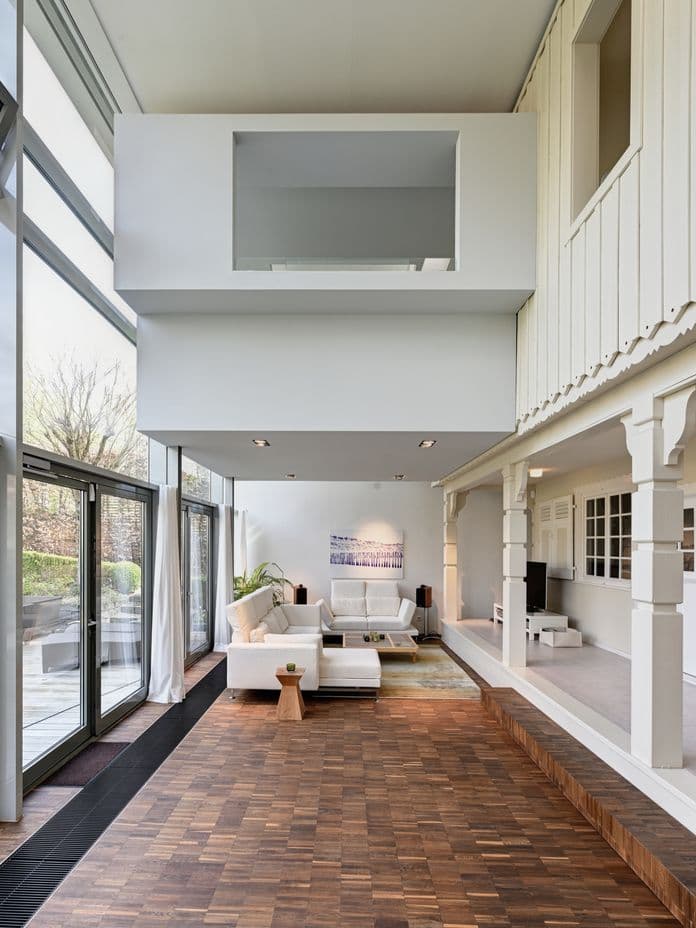
Florian Schlüter: The old house is conceived like a "readymade" artwork inside a new shell. Even now, it remains highly identifiable—at least upon second glance. So much of the original house is still visible; the presence of what remains is actually heightened because we isolated it and placed it within a new frame. The position of the outer shell, and its respective distance from the existing inner house, is determined entirely by the functional requirements of the floor plan. The "inner house" is opened or broken through wherever light or space is needed for the interior. These extensions are projected onto the outer facade in the form of "light" or "spatial" sleeves, translating into deliberate perforations on the exterior.
What advantages does this protective shell offer the residents?
Florian Schlüter: The structural envelope creates a new interior layout—an intermediate gap between the existing building and the new shell—which can be utilized as additional living space. This layout creates a new living room, spatial extensions in the bedrooms, and a stairwell in the basement. Furthermore, generous living areas were created in the attic, which previously had a relatively large, unusable knee-wall area. At the same time, the solid exterior shell represents an optimal thermal and structural upgrade for the thin-walled timber house, which has itself mutated into a "timber installation" or a piece of bespoke furniture.
How would you describe the interior living experience?
Florian Schlüter: Integrating the existing house into a cubic shell architecture creates highly diverse spatial configurations that play with the relationship between interior and exterior spaces, as well as the newly created intermediate zones. Simple and complex spaces alternate, paradoxically intertwining and shifting the architectural reality of the existing building.
The residential property has received multiple design awards. Has it influenced other renovations or extensions?
Florian Schlüter: Enveloping a building—meaning providing a property with a structurally and energetically optimized shell—has become an almost daily practice in times of increasingly stringent energy efficiency regulations. Unfortunately, creative freedom is very rarely on the agenda when dealing with old building stock in this manner. Yet, many properties harbor a unique potential that can be recognized and unlocked. To demonstrate this to future generations of architects, the Haus Wohlfahrt is regularly featured as a case study at various universities. Consequently, we frequently receive inquiries from students on the subject, most recently in the autumn of last year.
Which types of properties are suitable for such an architectural shell?
Florian Schlüter: The criteria vary greatly from case to case. Fundamentally, however, you can never look at a building in isolation from its immediate context. The unique characteristics of the location and the specific building assignment must always be thoroughly researched and analyzed. This can lead to completely different architectural approaches. There is no one-size-fits-all solution.
How do you look back on the house today?
Florian Schlüter: The Wohlfahrt-Laymann residence is a significant milestone of our design philosophy. It has been widely published, exhibited at the Venice Biennale, and met with immense positive acclaim. Even after 20 years and a multitude of subsequent projects, it holds a very distinct, emotional significance for us.
Discover a curated selection of premium properties in Germany’s most sought-after locations.
1. District, Vienna, Austria
Price
€7,998,000
Grünwald, Bavaria, Germany
Price
€9,800,000
Nienstedten, Hamburg, Germany
Price
€6,750,000
Der Immobilienmarkt auf dem Weg zurück zu Stabilität und Planbarkeit: Lesen Sie in unserer vorherigen Ausgabe, warum moderate Bauzinsen und ein steigendes Angebot für neue Zuversicht sorgen. Im Fokus: Qualitäts- und Energieeffizienz-Trends sowie tiefe Einblicke in Wohn-, Logistik- und Investmentimmobilien.
Free, confidential and non-binding
Receive your digital valuation instantly
Based on data by Engel & Völkers