Apartment building as a residential investment

A solid foundation is crucial when choosing a location. Feel free to contact our on-site experts and benefit from our market experience. You can also get a comprehensive overview of the market with our free Germany Market Report 2026 for residential and commercial properties.

Ein hell cremefarbenes, historisches Wohngebäude mit reich verzierten Fassadendetails, darunter dekorative Fensterrahmen, skulpturale Ornamente und gestufte Gesimse. Hohe, schmale Fenster spiegeln den Himmel und umliegende Bäume. Rechts ist ein kleiner Balkon mit schwarzem Schmiedeeisengeländer und Blumenkästen zu sehen. Grüne Blätter von nahe stehenden Bäumen rahmen den Blick auf die Fassade ein.

Where is it worth investing in a multi-family home?

When investing in an multi-family house or a mixed-use residential and commercial building, key factors include the development of the residential area, the structural and energy efficiency of the property, vacancy rates, and the risk-return ratio. Equally important, however, is the question of which city is the right fit for your investment strategy. How is the market developing in Germany’s largest metropolitan areas, the Tier 1 cities? What dynamics characterize the Tier 2 and Tier 3 cities? What are the arguments for investing in regional centers, the Tier 4 cities?

The Engel & Völkers research team analyzes trends across different city categories and highlights the pros and cons of investing in each. Feel free to use our interactive dashboard to compare potential locations for your investment.

City categories according to bulwiengesa

Definition of city categories

Compare factors und prices within a city category

Select a city category*
Select a location
Range of factors for multi-family homes
Range of prices in EUR/m² for multi-family homes

Sources: Engel & Völkers Commercial

* The analysis covered 17 of 22 Tier 3 cities and 31 of 84 Tier 4 cities.

Vacancy rates and rents by city category

Select a city category*
Vacancy rate in percentage
Average quoted rent in EUR/m² (existing apartment buildings)

Sources: empirica regio, CBRE-empirica-Leerstandsindex, VALUE Marktdatenbank, Engel & Völkers Commercial

* The analysis covered 17 of 22 Tier 3 cities and 31 of 84 Tier 4 cities.

What are the advantages of multi-family homes in a Tier 1 city?

  • Population (31.12.24)

    10,064,825

  • Transactions 2024

    2,656

  • Ø-Quoted rent 2.HY 2025

    16.73 EUR/m²

  • Ø-Vacancy rate 2024

    0.4 %

  • Transaction Volume 2024

    9.5 Mrd. EUR

  • Ø-Quoted price 2.HY 2025

    4,267 EUR/m²

Sources: Kommunale Statistikämter, VALUE Marktdatenbank, GEWOS-Immobilien IMA, empirica regio, Engel & Völkers Commercial

The real estate market in major cities is characterized by sustained strong demand for housing. In 2024, approximately 30% of the total market’s transaction volume was generated in the top 7 markets. This high demand is driven by a strong influx of new residents and, consequently, by steady population growth. About 12% of Germany’s total population lives in the top 7 locations.

At the same time, demand for rental apartments in Tier 1 cities continues to rise, as tight financing conditions are causing some potential buyers of condominiums to continue renting for the time being. Added to this are insufficient construction activity and immigration, meaning that significant pressure on the rental housing market in Tier 1 cities is also expected in the coming years. As early as 2024, the vacancy rate stood at an extremely low 0.4%. This also fuels the suburbanization trend, as more people are expanding their search to the surrounding areas. As a result, rent levels will continue to rise in both metropolitan areas and the surrounding regions. In the second half of 2025, the average asking rent in Tier 1 cities was 16.73 EUR/m², which was 4.2% higher than in the previous year.

Due to their high appeal, Tier 1 cities remain safe havens in the real estate market and are therefore primarily attractive to risk-averse investors. In addition, the growing surrounding regions also offer potential for investors.

Why invest in residential and commercial properties in Tier 2 cities?

  • Population (31.12.24)

    6,401,283

  • Transactions 2024

    3,575

  • Ø-Quoted rent 2.HY 2025

    11.28 EUR/m²

  • Ø-Vacancy rate 2024

    1.4 %

  • Transaction volume 2024

    4.1 Mrd. EUR

  • Ø-quoted price 2.HY 2025

    2,508 EUR/m²

Sources: Kommunale Statistikämter, VALUE Marktdatenbank, GEWOS-Immobilien IMA, empirica regio, Engel & Völkers Commercial

Given the high demand for apartment buildings and residential portfolios in Tier 1 cities, investors active nationwide are also turning their attention to Tier 2 cities. These cities offer them numerous opportunities and potential, as they too boast solid social and economic infrastructures. As a result, Tier 2 cities are no longer merely alternative locations. In 2024, the Tier 2 locations combined accounted for approximately 13% of the nationwide transaction volume.

In contrast to the Top 7, price levels in Tier 2 locations are significantly lower. On average, the asking price is even slightly lower than in Tier 3 cities. Combined with high demand, these are ideal conditions for core-plus and value-add investments. The investment risk remains quite manageable. Nevertheless, costs for future renovations should be factored into investment decisions and critically evaluated. In terms of building stock, significant disparities characterize Tier 2 cities in many places. It is not uncommon to find properties in dire need of renovation standing side by side with properties that have undergone extensive renovation and energy-efficiency upgrades.

Germany’s Tier 2 cities also have largely positive population growth forecasts until 2030. This is likely to further increase pressure on the rental market, and rent increases remain highly probable in the future. They also offer opportunities for every type of investor, from those focused on returns to risk-averse investors. Due to affordable entry prices and generally dynamic urban and neighborhood development, Tier 2 cities remain a focus for national and international investors.

Are Tier 3 cities becoming a trend in multi-family house investment?

  • Population (31.12.24)

    4,803,558

  • Transactions 2024

    2,656

  • Ø-Quoted rent 2.HY 2025

    11.80 EUR/m²

  • Ø-Vacancy rate 2024

    1.4 %

  • Transaction volume 2024

    2.6 Mrd. EUR

  • Ø-Quoted price 2.HY 2025

    2,747 EUR/m²

Sources: Kommunale Statistikämter, VALUE Marktdatenbank, GEWOS-Immobilien IMA, empirica regio, Engel & Völkers Commercial

Tier 3 cities are often located in metropolitan areas or in the immediate vicinity of Germany’s largest cities and benefit from the demand pressure in those housing markets. As a result, investors are increasingly drawn from tight markets to nearby cities. At the same time, the thriving Tier 3 cities surrounding major metropolitan areas are increasingly attracting the attention of people looking for housing and offer an attractive environment, particularly for students. Over the past five years, the population in Tier 3 locations has grown by an average of 2.0%, which is nearly on par with the level of the Top 7.

The combination of positive population growth and low vacancy rates suggests that a housing shortage will persist in the future. For investors, this offers secure long-term rental income, which on average is even slightly higher than in Tier 2 cities. Asking prices are also higher on average than in Tier 2 cities. Furthermore, in the second half of 2025, they recorded the highest year-over-year growth (+2.5%) among all city categories.

Why are Tier 2 cities increasingly attracting the attention of investors?

  • Population (31.12.24)

    8,880,770

  • Transactions 2024*

    5,229

  • Ø-Quoted rent 2.HJ 2025

    9.56 EUR/m²

  • Ø-Vacancy rate 2024

    3.1 %

  • Transaction volume 2024*

    3.6 Mrd. EUR

  • Ø-Quoted price 2.HY 2025

    2,051 EUR/m²

Sources: Kommunale Statistikämter, VALUE Marktdatenbank, GEWOS-Immobilien IMA, empirica regio, Engel & Völkers Commercial ; * Some of the data is based on estimates

The real estate markets in regional centers have so far been heavily influenced by local players. In addition, urban development and infrastructure projects have a significant impact on future regional market trends. However, due to the comparatively lower returns in Germany’s largest markets, interest among investors from outside the region in Tier 4 locations is also growing, particularly in the immediate vicinity of major metropolitan areas. For families, Tier 4 cities in the outskirts of Tier 2 cities represent attractive residential locations because there is often a larger supply of rental apartments of suitable size and at moderate rents.

Buyers of investment properties in Tier 4 cities can also expect solid growth in asking rents and prices in the medium term. When evaluating an individual property, however, the rentability should always be reviewed and the potential risk of rent default assessed. Across all Tier 4 cities, the vacancy rate in 2024 stood at 3.1%, which is higher than in the other city categories. For risk-tolerant investors, however, Tier 4 cities offer opportunities for investments with medium- to long-term profit maximization due to their generally attractive entry prices, higher returns, and significant development potential.

Tier 4 cities are particularly interesting for investors seeking opportunistic investments as well as strategic portfolio diversification.

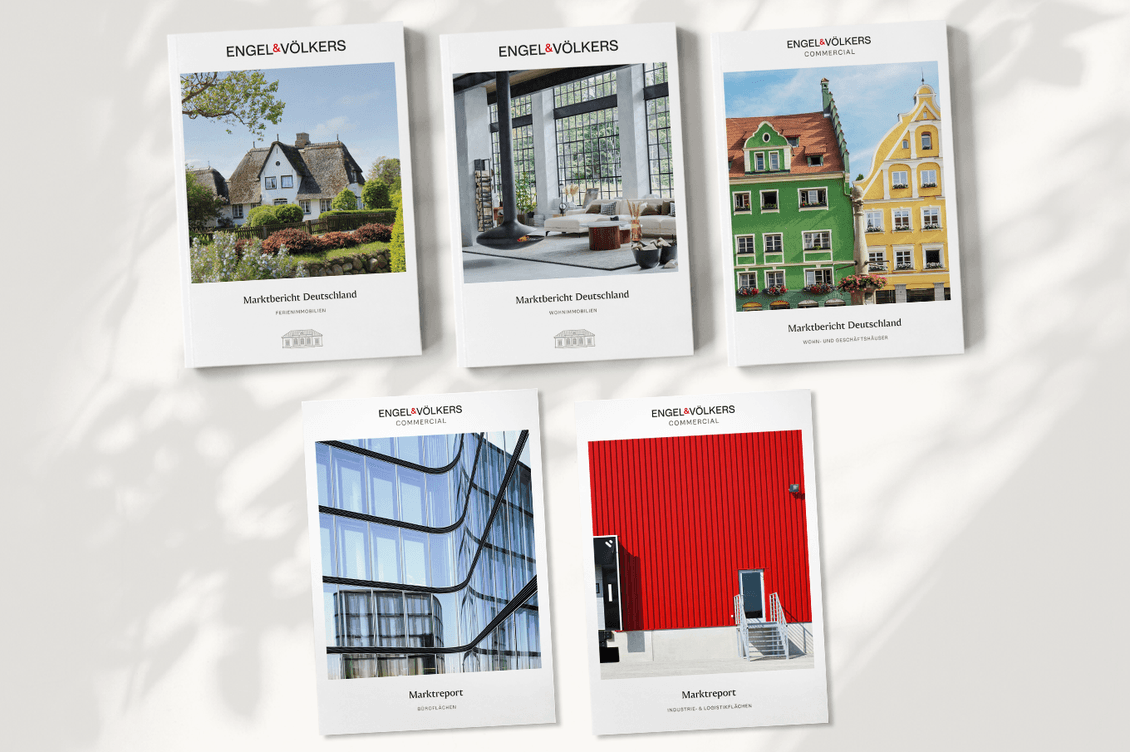
Fünf Immobilienmarktberichte von Engel & Völkers mit verschiedenen architektonischen Titelbildern, angeordnet auf einem hellen Hintergrund

Our knowledge for your investment strategy

Stay informed with Engel & Völkers Research’s market reports on residential and commercial properties. We analyze the markets for apartment buildings, office and logistics space, as well as residential and vacation properties in the D-A-CH region.

Your Shop

Engel & Völkers Deutschland

Page content provided by: Engel & Völkers GmbH

License partner of Engel & Völkers GmbH

+49 40 361310