Sörup, Schleswig-Holstein, Germany
Familienfreundliches Reetdachhaus mit großem Garten in naturnaher Feldrandlage
Price
€680,000
- 7 Rooms
- 2 Bathrooms
- ~170 m² Living area
- ~2,116 m² Plot surface
How historical architecture provides natural cooling without air conditioning while stylishly showcasing modern living comfort
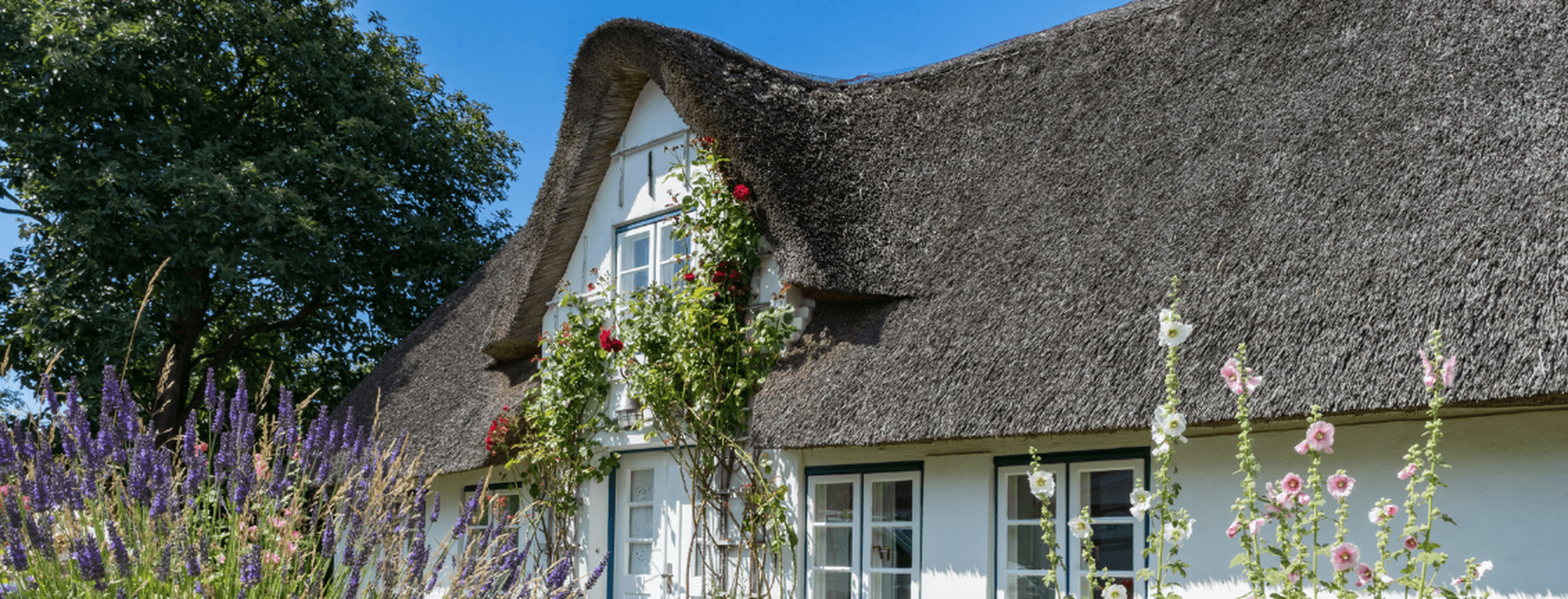
The summer months have unmistakably arrived, bringing a very special Nordic architectural style into focus: the historic thatched cottage (Reetdachkate). These buildings have shaped and been deeply intertwined with the Northern landscape for centuries. However, they are not just a picturesque cultural asset; they represent a traditional architecture that seamlessly blends aesthetics, functionality, and a remarkably modern understanding of sustainability.
While modern residential buildings often heat up significantly in midsummer or require mechanical cooling, historic thatched cottages offer a remarkable, entirely natural regulation of indoor temperatures. The reason for this lies in the nature and combination of traditional building materials.
The dried reed of a thatched roof is laid in thick layers and acts as a highly efficient, natural insulation material. It prevents summer heat from penetrating the living spaces from above. This effect is supported by the solid exterior walls, which in Schleswig-Holstein mostly consist of solid brickwork or traditional timber framing. These building materials possess a high thermal mass: they absorb the heat of the day very slowly and release it back into the environment only during the cooler night hours. Anyone stepping into such a cottage on a hot July day will immediately experience a noticeable, pleasant coolness without any artificial airflow.
Living in a listed heritage building has long ceased to mean sacrificing modern comfort. Instead, contemporary interior design utilizes the historic structure as a stage for character, creating an exciting dialogue between history and modernity. When designing for the summer, the main focus is on clarity and light:
Lighting and Color Concepts: Because historic cottages traditionally feature smaller window openings and lower ceilings, designers consistently rely on bright, Scandinavian-inspired color palettes. Shades of off-white, sandy tones, or subtle maritime accents like sage green visually open up the rooms and create an airy atmosphere.
Showcasing Materiality: Exposed historic ceiling beams, old floor tiles, or rough, whitewashed brick walls are preserved as original stylistic elements. Combined with minimalist, sleek furniture, this creates an understated elegance. A simple, light-colored sofa set against a historic wall emphasizes the room’s character without cluttering it.
Focus on the Essentials: To preserve the unique sense of space, heavy textiles or bulky wall units are avoided. Light linen or cotton curtains that filter daylight give the architecture the necessary room to breathe.
Sörup, Schleswig-Holstein, Germany
Price
€680,000
Sankt Peter-Ording, Schleswig-Holstein, Germany
Price
€790,000
Schotten, Nortorf, Schleswig-Holstein, Germany
Price
€995,000
Travenbrück, Schleswig-Holstein, Germany
Price
€1,440,000
Almdorf, Schleswig-Holstein, Germany
Price
€275,000
Acquiring and maintaining a listed thatched cottage undoubtedly requires commitment and expertise in handling old building materials. However, those who embark on this adventure are rewarded with a quality of living and lifestyle that can hardly be replicated in new constructions.
These homes impressively demonstrate that ecological building and the use of regional, sustainable materials are not modern inventions. A carefully modernized thatched cottage protects the architectural heritage of Schleswig-Holstein while offering a value-stable, character-rich retreat that showcases its full strengths, especially during the warm season.
In summary, historic thatched cottages are much more than just traditional eye-catchers in the Schleswig-Holstein landscape. Thanks to their ingenious, entirely natural construction, they offer an unbeatable indoor climate during the hot summer months without any modern air conditioning. When these history-steeped walls are combined with a clean, modern interior design, they transform into unique living spaces full of character and elegance. Preserving this architectural heritage is therefore not only an active contribution to regional cultural conservation, but also a future-proof investment in a sustainable, value-stable, and completely unmistakable home.
You may also be interested in

&w=1920&q=75)
&w=1920&q=75)
Contact provider
Page content provided by: EuV Wohnen GmbH
License partner of Engel & Völkers Franchise and Trademark GmbH